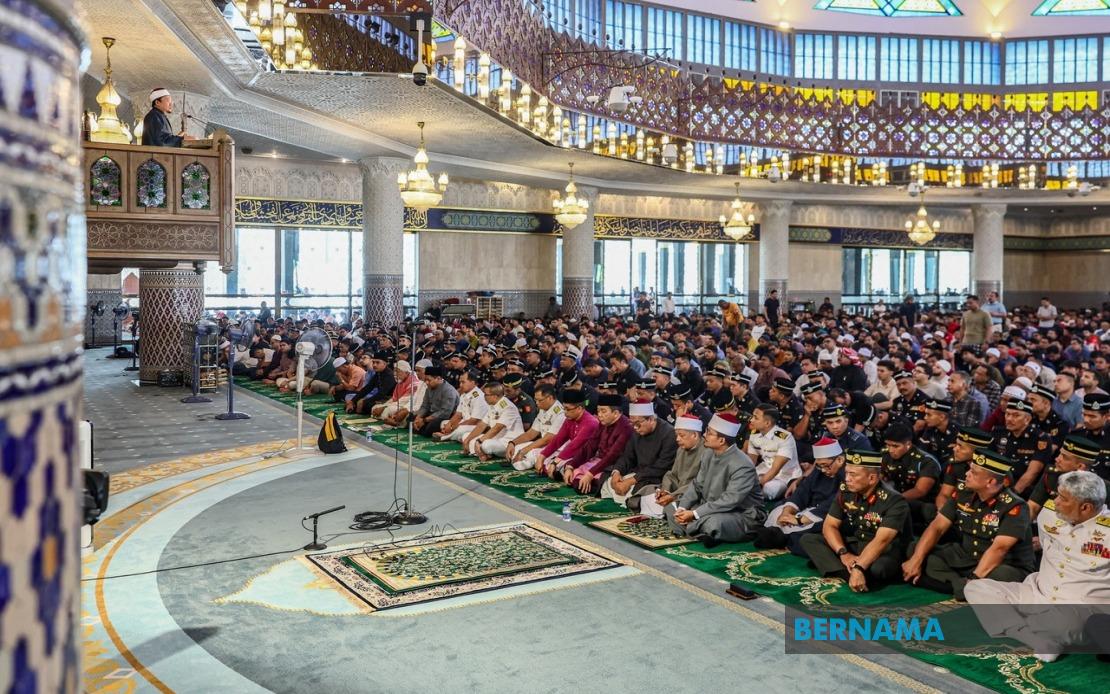
A nation's resilience cannot be measured solely through military hardware or advanced technology, but rather through the moral fibre of its populace and leadership, according to Datuk Dr Amru Alhaz Adnan, Grand Imam of Masjid Negara. Speaking during Friday prayers held in conjunction with Warriors' Day on July 31, the religious leader delivered a sermon that reframed the concept of national defence away from conventional security frameworks towards a broader understanding of collective responsibility and ethical conduct.
The sermon carried particular resonance given that Malaysia's top military brass attended the prayers at the national mosque. Present were Chief of Defence Forces Gen Tan Sri Malek Razak Sulaiman, Chief of Army Gen Tan Sri Azhan Md Othman, Chief of Navy Adm Tan Sri Dr Zulhelmy Ithnain and Chief of Air Force Gen Tan Sri Muhamad Norazlan Aris. Their attendance underscored the significance of integrating spiritual and ethical dimensions into Malaysia's defence philosophy.
Amru Alhaz articulated a vision of national defence that encompasses spheres far beyond military installations and border security. He emphasized that defending the country occurs not simply at geographical frontiers but continuously through the everyday execution of responsibilities by ordinary citizens. This perspective challenges the traditional militaristic understanding of national security by positioning every individual's conduct as a constitutive element of national strength. When people conduct themselves with honesty, when leaders demonstrate trustworthiness, when civil servants maintain integrity, when traders abstain from cheating, and when parents nurture children responsibly, the nation accumulates an invisible but formidable defensive capacity.
The Grand Imam's framing assumes particular importance within Malaysia's contemporary context. As the nation navigates complex governance challenges and public discourse increasingly scrutinizes institutional transparency, the emphasis on integrity across all societal strata offers a unifying principle that transcends sectarian or political divisions. The sermon implicitly acknowledges that citizens' faith in institutions and leaders directly impacts social cohesion, which itself constitutes a critical national asset in an era of rapid change and competing pressures.
Warriors' Day, commemorated annually on July 31, traditionally honours the sacrifice and service rendered by Malaysia's security personnel. However, the Grand Imam reoriented the occasion's significance by presenting it as an opportunity for broader societal reflection on collective responsibility for national preservation. Rather than confining the celebration to military institutions, this interpretation encourages every citizen to recognize themselves as participants in national defence through conscientious adherence to ethical principles and civic duties.
For Muslim citizens specifically, the sermon issued an explicit call to honour national heroes by embodying integrity and discipline in their personal and professional lives. The exhortation to reject corruption represents a particularly salient intervention, given ongoing public concerns about institutional accountability and transparent governance in Malaysia. By grounding anti-corruption efforts in religious and patriotic sentiment, the sermon attempts to mobilize spiritual conviction as a motivating force for ethical conduct beyond legal enforcement mechanisms alone.
The emphasis on preserving national unity emerged as another central theme in the sermon. In a multi-ethnic, multi-religious nation like Malaysia, maintaining social harmony constitutes an essential prerequisite for political stability and economic development. The Grand Imam's call to uphold integrity and discipline while fostering unity positions these virtues as interconnected elements of a coherent national project. Corruption and dishonesty corrode trust between communities and institutions, whereas consistent ethical conduct strengthens the bonds that hold diverse populations together.
The sermon's broader significance extends beyond the immediate religious or military contexts. It reflects growing recognition among Malaysia's leadership that sustainable national development requires more than infrastructure investment or technological advancement. The cultivation of civic virtue, institutional accountability, and ethical governance creates the institutional and social foundations upon which economic progress and political stability ultimately depend. For Southeast Asian nations grappling with development challenges, this perspective offers a valuable counterpoint to purely technocratic or materialist approaches to national advancement.
The timing of these remarks during a formal state occasion attended by senior military leadership suggests deliberate strategic messaging about the interconnection between military preparedness and societal moral health. By positioning integrity as central to national defence, Malaysian authorities communicate that security threats extend beyond conventional military concerns to encompass institutional dysfunction, corruption, and erosion of public trust. This integrated understanding of national security aligns with contemporary international security discourse, which increasingly recognizes that governance quality and social cohesion influence state resilience as much as armed capabilities.
For Malaysian citizens and residents, the sermon invites reflection on personal contributions to national strength through daily choices and professional conduct. The message resonates particularly within civil service, business, and professional communities where individual decisions about ethical behaviour accumulate into either institutional integrity or systemic dysfunction. In this formulation, each act of honesty or dishonesty carries implications beyond individual consequence, rippling through social and institutional structures that ultimately determine national capacity to address collective challenges.

