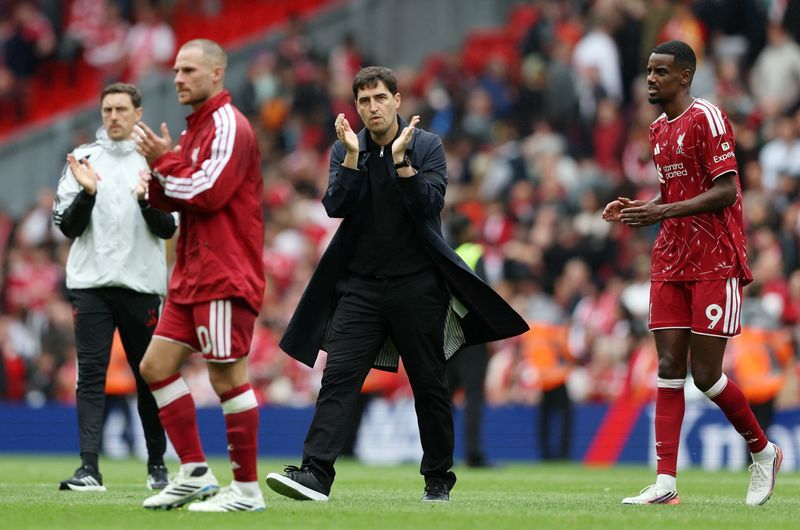
Andoni Iraola is still searching for his maiden Premier League triumph as Liverpool's new manager, yet the 2-2 stalemate against Nottingham Forest on Saturday offered sufficient encouragement that his revamped squad is developing the tactical foundations he envisages. The former Bournemouth strategist took the helm this summer tasked with reversing the fortunes of a club ravaged by last season's title collapse, when defending champions Liverpool plummeted to fifth position despite investing a record £446 million in fresh talent.
The scale of the challenge facing Iraola cannot be overstated. His appointment comes as Liverpool seeks to restore its dominance in English football while recapturing the distinctive intensity that once rendered Anfield an inhospitable destination for visiting teams. Where predecessors favoured measured approaches, Iraola is implementing a more aggressive philosophy rooted in rapid ball circulation, immediate pressing, and sustained attacking momentum—a methodology reminiscent of Juergen Klopp's era rather than the more conservative tactics employed during Arne Slot's two-year tenure.
Yet translating tactical vision into consistent performance proves considerably more complex than theoretical discussion suggests. The first-half display against Forest demonstrated this reality acutely, with Dan Ndoye's opening goal stemming from a direct counterattack that exposed Liverpool's defensive vulnerabilities. Prolonged periods of sluggish play left Iraola visibly frustrated, though he identified the specific weakness rather than accepting excuses. The Spaniard pinpointed passive ball-recovery efforts and excessive defensive spacing as the principal issues, problems arising from insufficient intensity in the team's work off possession.
The transformation materialised dramatically after the interval. Liverpool substantially elevated their pressing effectiveness, accelerated possession circulation, and generated sharper attacking opportunities. Alexander Isak restored parity shortly after the hour, before substitute Victor Munoz completed the comeback with a late equaliser. This represented the second consecutive match in which Liverpool recovered from adverse circumstances—a 2-2 draw with Newcastle had preceded the Forest encounter—suggesting character and resilience despite the absence of victories.
Iraola's assessment focused particularly on Munoz's contributions across both matches. The winger demonstrated consistent threat generation whilst providing defensive support, qualities the manager deemed valuable even acknowledging imperfections in overall performance. Munoz's willingness to persist in his pursuit of attacking opportunities throughout the encounter earned particular praise, highlighting the manager's emphasis on mentality and work ethic alongside technical proficiency.
The underlying pattern troubling Iraola involves Liverpool's persistent sluggish starts, a characteristic persisting from the previous campaign. Rather than viewing the opening-half struggles as isolated incidents, he recognised systemic issues within the team's collective defensive organisation and transition speed. The contrast between first-half passivity and second-half intensity provided practical evidence of how tactical discipline and intensity elevation could transform operational effectiveness. When Liverpool increased their physical commitment and defensive pressing, duels turned decidedly in their favour and attacking transitions became considerably more dangerous.
Despite the frustration evident in Iraola's post-match commentary, panic remains absent from Anfield's corridors. The manager has consistently communicated that implementing his tactical system would require extended transition periods, whilst accelerating tempo and intensity adjustments cannot materialise instantaneously. Senior club leadership and supporter bases recognise that constructing an effective high-octane attacking system demands patience and progressive refinement rather than immediate perfection.
Transfer activity provides additional optimism regarding the squad's evolutionary trajectory. British media reports indicate Liverpool finalised terms with Paris Saint-Germain for France international Bradley Barcola, the 23-year-old winger representing an archetypal fit for Iraola's possession-based, tempo-driven system. Barcola's pace and directness should complement existing attacking players whilst providing the manager additional tactical flexibility.
For Malaysian and Southeast Asian followers of English football, Iraola's appointment represents a fascinating case study in tactical innovation. His strategic approach diverges markedly from the pragmatic, possession-heavy methods increasingly prevalent across elite European football. The Spaniard's insistence on immediate pressing and rapid transitions recalls earlier iterations of contemporary football rather than trending defensive approaches, suggesting potential strategic diversity within top-flight competition.
Currently, Liverpool occupies an ambiguous position between tangible progress and observable results. The entertainment value undeniably increased following Iraola's appointment, with attacking football generating excitement absent during Slot's tenure. Nevertheless, the conversion of improved performance into accumulating points remains incomplete. Iraola himself acknowledged that positive second-half football and recovery capabilities, whilst encouraging, ultimately prove insufficient without consistent victories yielding three-point returns.
The manager's frustration regarding a solitary point extracted from winning positions reflects realistic perspective on competitive football's demands. Draws occasionally feel like defeats when teams generate sufficient dominance to warrant victory, particularly during second-half periods when Liverpool demonstrated substantially superior technical execution and tactical discipline. Iraola's challenge involves extending that second-half intensity throughout full matches, establishing consistency rather than episodic excellence.
Looking forward, Iraola faces a critical juncture in his Liverpool tenure. Supporters and media will expect progression beyond draws toward convincing victories demonstrating tactical mastery. The forthcoming weeks will prove decisive in establishing whether his philosophical approach generates sustained performance improvements or remains confined to occasional strong passages separated by defensive deficiencies. Barcola's arrival may provide the tactical catalyst required for breakthrough performances.

