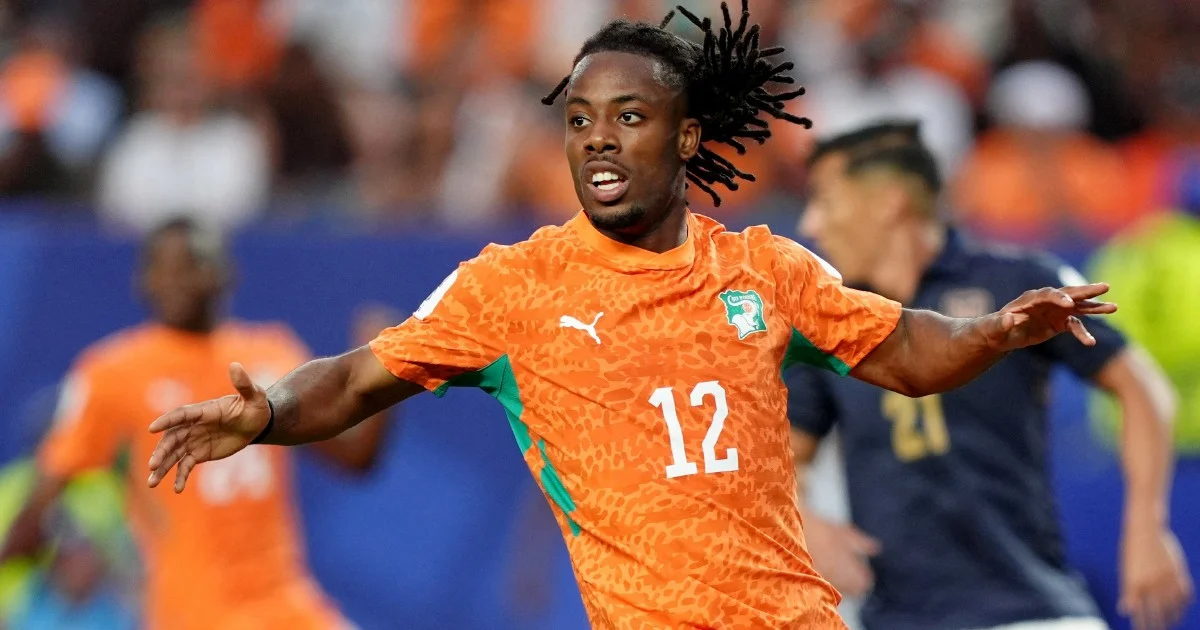
Elye Wahi, the Ivory Coast forward who took the field in his nation's World Cup triumph over Ecuador on Sunday, has become ensnared in a match-fixing scandal that unfolded quietly in France last month. The Athletic's reporting on Wednesday revealed that the striker was detained in May as authorities pursued a broader investigation into spot-fixing—a particularly corrosive form of corruption where specific moments within a match, rather than the outcome itself, are manipulated for gambling purposes.
The timing of Wahi's arrest adds a layer of intrigue to his recent international appearances. While specific details regarding the nature of the charges or the precise circumstances of his detention remain unclear, the player's involvement in a fixing probe represents a troubling development for both his club and country. Wahi's presence in Sunday's squad highlights the gap between investigation and public knowledge that often characterizes such cases in modern football, where allegations can simmer beneath the surface while players continue competing at the highest level.
Spot-fixing investigations have become an increasing concern across European football in recent years. Unlike match-fixing, which seeks to predetermine outcomes, spot-fixing targets discrete events—a particular yellow card, an own goal, or a missed penalty—allowing conspirators to profit from specific betting markets while the match itself proceeds with apparent normalcy. This approach makes detection considerably more difficult for authorities and undermines the integrity of competition in ways that can be invisible to casual observers.
France has positioned itself as increasingly vigilant regarding corruption in football. The country's anti-corruption and match-fixing infrastructure has become more sophisticated, with authorities working to investigate networks that operate across borders. The investigation into Wahi appears to be part of this broader crackdown, suggesting that French law enforcement has identified connections worth pursuing through formal detention and questioning.
The Ivory Coast national team's World Cup campaign against Ecuador provided context for Wahi's Sunday appearance, with the match holding significance within their competitive calendar. The striker's selection despite the ongoing investigation underscores either a lack of public knowledge about the case or a decision by coaching staff that the matter would not impede his participation. International football's governing bodies sometimes operate independently from national law enforcement, creating scenarios where players under investigation can continue competing unless formally sanctioned.
For Southeast Asian sports observers, Wahi's situation carries particular relevance given the region's persistent challenges with match-fixing. Malaysia, Thailand, Singapore, and other nations have confronted organized betting syndicates and corruption networks that exploit football's global reach. The European experience with spot-fixing provides a cautionary template for how sophisticated these schemes have become, and how difficult they are to detect and prosecute. Regional authorities can draw lessons from French investigative methods and international cooperation frameworks.
Wahi's arrest also illuminates the complicated intersection between individual player accountability and systemic corruption. Players approached by fixers often face immense pressure, including threats to personal safety and family members. Whether Wahi was a willing participant, a coerced victim, or an unwitting subject of conspiracy remains undetermined. The distinction matters significantly for his career trajectory and for how his case informs broader discussions about player protection and whistleblower mechanisms within professional football.
The delay in public disclosure—the arrest occurred in May but only emerged through media reporting in mid-week—suggests that the investigation remains active and compartmentalized. French authorities typically maintain discretion during ongoing probes, releasing information only when necessary or when media outlets uncover developments. This approach aims to preserve investigative integrity, though it also means that the full scope of the conspiracy and Wahi's precise role may not become public for months or years.
Looking forward, Wahi faces significant uncertainty regarding his career status. Even if cleared of wrongdoing, involvement in a match-fixing probe carries reputational consequences that can affect club relationships, sponsorship arrangements, and market value. For Ivory Coast's national program, the situation presents a diplomatic and sporting challenge, particularly if more players become implicated. International football's governing bodies, including FIFA, maintain strict anti-corruption protocols that can result in bans and sanctions independent of criminal proceedings.
The broader implications extend to the integrity frameworks that sports organizations have established across Africa and Europe. If Wahi's case reveals gaps in detection or accountability mechanisms, it may prompt FIFA and continental confederations to reassess their monitoring systems. The interconnected nature of modern football means corruption identified in France can influence policy decisions affecting clubs and national teams across the globe, including those in Southeast Asia.
Meanwhile, French investigators will continue pursuing leads within their probe, potentially uncovering broader networks beyond Wahi himself. These investigations typically expand as authorities identify co-conspirators and communication chains. Whether additional Ivorian players, European-based colleagues, or betting syndicates emerge from the investigation remains to be seen, but the case has already demonstrated that match-fixing corruption continues to operate even at the international tournament level, challenging the assumptions that elite competition remains insulated from such schemes.