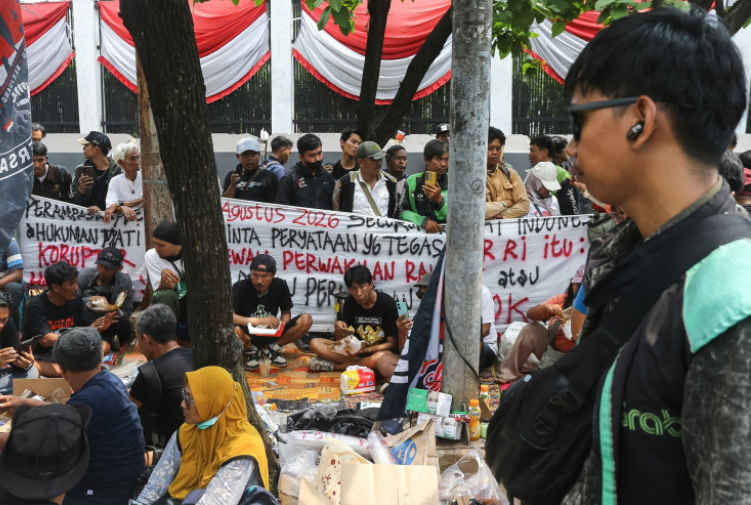
Hundreds of demonstrators converged on Jakarta's Senayan Legislative Complex on Thursday morning, pressing lawmakers to adopt sweeping anti-corruption measures that have long languished in legislative limbo. The coordinated action brought together diverse grievances—from demands for tougher penalties against officials accused of graft to calls for immediate price relief on essential goods—underscoring deepening public frustration with Indonesia's corruption battles and economic pressures.
The United Pati People's Alliance, an activist coalition mobilising supporters from Central Java, spearheaded the demonstration after weeks of preparation. The group's determination to press forward proved resilient despite encountering official obstacles. Police stopped several buses transporting protesters en route to the capital, while state-owned Bank Mandiri temporarily froze the account of AMPB coordinator Supriyono, a move that triggered immediate public backlash and sparked calls for boycotts against the financial institution. Such resistance appeared counterproductive, as Supriyono reported that fresh donations subsequently enabled five additional buses to reach Jakarta for the demonstration.
The show of force extended beyond activism. Authorities implemented comprehensive traffic management across central Jakarta, cordoning off both directions along Jalan Gatot Subroto between Senayan Park and the legislative complex entrance. Police deployed substantial security contingents throughout the surrounding area, bracing for what officials anticipated could exceed the initially forecast 500 participants. With regional groups preparing to join the Pati delegation, numbers threatened to swell considerably, prompting Jakarta Police spokesperson Sr. Comr. Budi Hermanto to emphasise preparedness while appealing for orderly conduct.
The focal point of Thursday's action centred on accelerating passage of Indonesia's long-delayed asset forfeiture legislation. First introduced to parliament in 2008, the bill has stalled repeatedly across multiple legislative sessions, frustrating anti-corruption advocates who view it as critical to tackling graft. The proposed law would grant authorities power to seize assets authorities suspect or identify as proceeds from criminal activity, bypassing the requirement for prior criminal conviction—a mechanism proponents argue would significantly strengthen asset recovery capacity against entrenched corrupt networks.
Yet this legislative tool remains controversial even among legal specialists. Experts caution that asset forfeiture provisions could potentially transform into weaponry for political targeting or extortion, particularly within Indonesia's fractious political environment. Such concerns reflect broader tensions between strengthening anti-corruption enforcement and preventing executive or prosecutorial overreach. Nevertheless, parliament has recently shifted into higher gear. The House of Representatives commenced formal bill deliberations in January, signalling renewed momentum that culminated in Monday's meeting with visiting Pati residents at the Senayan complex, where legislators promised final passage within eight months.
Gerindra Party lawmaker Habiburokhman, who chairs House Commission III responsible for legal affairs, projected that substantive deliberations required merely eight additional weeks. This timeline suggests parliament intends to deliver legislation by December, representing accelerated pace compared to the bill's tortuous fifteen-year journey through various legislative sessions. The compressed schedule reflects both genuine anti-corruption commitment and political calculation—with public pressure mounting and the Prabowo Subianto administration publicly supporting swift passage, parliamentary foot-dragging carries mounting political costs.
President Prabowo's government has positioned itself as champion of the asset forfeiture bill, with Government Communications Agency head Muhammad Qodari declaring that responsibility now rests with parliament to deliver. This rhetorical positioning allows the executive to appear proactive on corruption whilst placing implementation burden squarely on the legislature. For Malaysian observers, the Indonesian parliament's handling of this legislation offers instructive comparison with Southeast Asia's varied approaches to asset recovery and financial crime enforcement, particularly as Malaysia itself has grappled with major corruption cases requiring novel legal mechanisms.
The timing of Thursday's protest also reflects broader economic anxiety. Alongside corruption demands, protesters pressed for price interventions on essential commodities, signalling that public frustration spans both governance integrity and daily household costs. Indonesia's inflation and commodity prices remain sensitive political issues, especially in rural areas like Pati where residents have mobilised substantial activist infrastructure. This fusion of anti-corruption activism with economic grievance suggests that popular support for the asset forfeiture bill transcends abstract governance principles, embedding it within concrete economic concerns affecting ordinary households.
Police messaging throughout the episode balanced competing objectives—maintaining order while accommodating democratic expression, ensuring business continuity while acknowledging legitimate protest rights. Budi's statement appealed to demonstrators to avoid infrastructure damage and respect ongoing commercial and educational activities, framing police role as guardian of broader public interests rather than graft defender. This rhetorical framing attempted to depoliticise security operations whilst reinforcing state commitment to both anti-corruption action and stability.
The parliamentary response reflected calculated pragmatism. Rather than confronting protesters or dismissing demands, House leadership offered substantive engagement, receiving delegations and providing specific legislative timelines. This approach contrasts sharply with occasional parliamentary responses elsewhere in Southeast Asia and suggests awareness among Indonesian lawmakers that public pressure surrounding corruption issues carries genuine electoral consequences. The promised December deadline now faces test of parliamentary will—whether cross-party consensus actually materialises or whether the bill encounters familiar obstacles remains uncertain.
Looking ahead, the asset forfeiture legislation represents crucial test case for Indonesia's anti-corruption architecture. Successful passage would signal strengthened enforcement capacity, particularly against networks that typically move assets across jurisdictions to obscure illicit origins. However, implementation challenges would follow swiftly. Courts must interpret forfeiture provisions, prosecutorial agencies require training in novel asset-tracing techniques, and safeguards preventing abuse need genuine institutional commitment. For Malaysia and other regional economies confronting sophisticated financial crime, Indonesia's legislative journey and subsequent enforcement approach merits close attention as comparative model.

