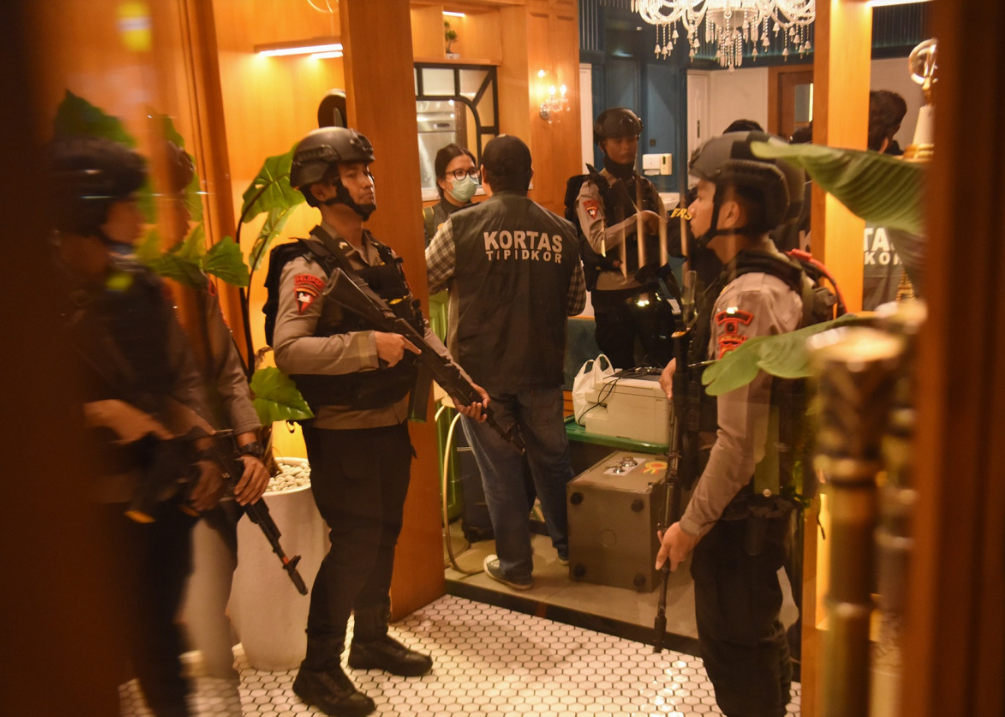
A dramatic early-morning crackdown across Jakarta this week exposed what may be Indonesia's most significant corruption scandal within its law enforcement apparatus in recent memory. When heavily armed officers from Jakarta's police force and the National Police's corruption crime corps descended on de'Clan Signature, an upscale eatery in the Cipete neighbourhood of South Jakarta, on Wednesday afternoon, diners immediately sensed something extraordinary was unfolding. The presence of Mobile Brigade units in full tactical gear, carrying long-barrel firearms and moving with evident urgency, transformed an ordinary day at the restaurant into a scene of high-stakes law enforcement action that would reverberate through Indonesia's corridors of power.
The initial discoveries set the tone for what would become an unprecedented operation. Behind a concealed safe at the restaurant, officers found documents and cash denominated in multiple foreign currencies valued at millions of dollars. The raid did not stop there. Next door at Koin Money Changer, police forced open another safe containing hundreds of thousands of dollars more in rupiah banknotes. These two locations represented merely the opening act in what would become a sprawling investigation reaching across the capital and into its surrounding suburbs, with officers seizing mobile phones, photographs, and extensive physical documentation throughout the following hours.
The most stunning discovery, however, awaited at a luxury residence in Sentul, a verdant suburban enclave situated roughly an hour's drive south of Jakarta. Within this high-end property, authorities uncovered seven suitcases filled with 74 kilograms of gold bars alongside additional cash reserves in multiple currencies. The combined haul was valued at approximately US$26.3 million, a figure that crystallised the scale of what investigators were confronting. Images of gleaming bullion and stacks of currency tied in bulky bundles, captured as police displayed their findings, became the defining visual narrative of the scandal and spread rapidly through Indonesian media outlets.
The residence belonged to Febrie Adriansyah, who until recently held the position of deputy attorney general specialising in special crimes—a role he had occupied for over four years. The timing of his resignation, occurring immediately after the raids became public, suggested his awareness of the imminent legal jeopardy. Though Febrie has been designated as a suspect in investigations into corruption and money laundering, he has not been taken into custody. His response to the discoveries was notably defensive: he acknowledged owning the Sentul property but flatly denied that the seized assets were his, suggesting instead that the origin of the funds would emerge through formal legal proceedings.
The breadth of the operation stretched far beyond the initial high-profile locations. Police conducted searches at more than a dozen additional sites throughout Jakarta and its immediate surroundings, including a residential unit at the exclusive Pacific Place apartment complex near the city's financial district and various corporate offices distributed across the metropolitan area. The investigation's tentacles also reached into the Gandaria district of South Jakarta, where authorities targeted a residence connected to Don Ritto, a lawyer implicated as a suspect in the case and subsequently detained according to local reporting. Corporate records referenced in media coverage revealed that Ritto maintained business interests in entities associated with both the raided restaurant and money changer, suggesting a network of financial and operational connections that investigators are now methodically unraveling.
The discovery has triggered profound reflection among Indonesia's political and legal establishment regarding the state of institutional integrity. By Monday afternoon, considerable speculation circulated through Jakarta's elite circles about the investigative pathway ahead and, more fundamentally, what these revelations signified about the overall health of Indonesia's anti-corruption mechanisms. The central interpretive question proved contentious: did the successful exposure of this wealth suggest that Indonesia's anti-corruption safeguards were functioning as designed, or did it merely represent another manifestation of deeper, more systemic corruption afflicting the nation's law enforcement hierarchy?
Procedural concerns have rapidly surfaced alongside the substantive corruption allegations. Mahfud MD, a towering intellectual figure in Indonesian constitutional law who formerly served as chief justice of the Constitutional Court and as coordinating minister for political, legal and security affairs, publicly raised serious objections regarding the decision to transfer investigation authority from the police to the Attorney General's Office. Speaking through his YouTube channel while wearing a batik blazer in white, blue and black, Mahfud argued that the transfer lacked any statutory foundation under Indonesia's criminal procedure code. Such a procedural misstep, he contended, could create vulnerabilities to pretrial challenges that might undermine the eventual prosecution. Rather than permitting the transfer, Mahfud advocated for the Corruption Eradication Commission—Indonesia's independent anti-corruption agency—to assume investigative control, thereby removing the case from the potentially compromised sphere of executive agencies.
This procedural dispute carries significant implications for how the investigation unfolds and whether public confidence in the outcome can be sustained. The Corruption Eradication Commission, operating as an independent state body with statutory protections against political interference, possesses both the institutional credibility and operational autonomy that the Attorney General's Office, as an executive agency, fundamentally lacks. The question of investigative jurisdiction therefore reflects deeper anxieties about whether institutions themselves can be trusted to investigate their own members when corruption reaches the highest levels. The transfer decision, if executed as authorities have indicated, risks confirming public suspicions that the investigation will be managed to serve political interests rather than uncovered truth and accountability.
For Malaysia and other Southeast Asian nations observing Indonesia's unfolding scandal, the events offer cautionary lessons about the vulnerability of anti-corruption institutions when independent oversight mechanisms are weakened or circumvented. Indonesia's experience demonstrates that even the arrest and public exposure of senior officials does not automatically translate into credible accountability if the investigative process itself becomes suspect. The parallel handling of Febrie and Ritto—one remaining free while questions swirl about procedural legality, the other detained—underscores the unpredictable and potentially selective nature of Indonesia's current enforcement approach. Whether Indonesia's leadership will ultimately strengthen independent agencies or tighten executive control over the investigation may determine not only the outcome of this particular case but also the trajectory of anti-corruption efforts throughout Southeast Asia.

