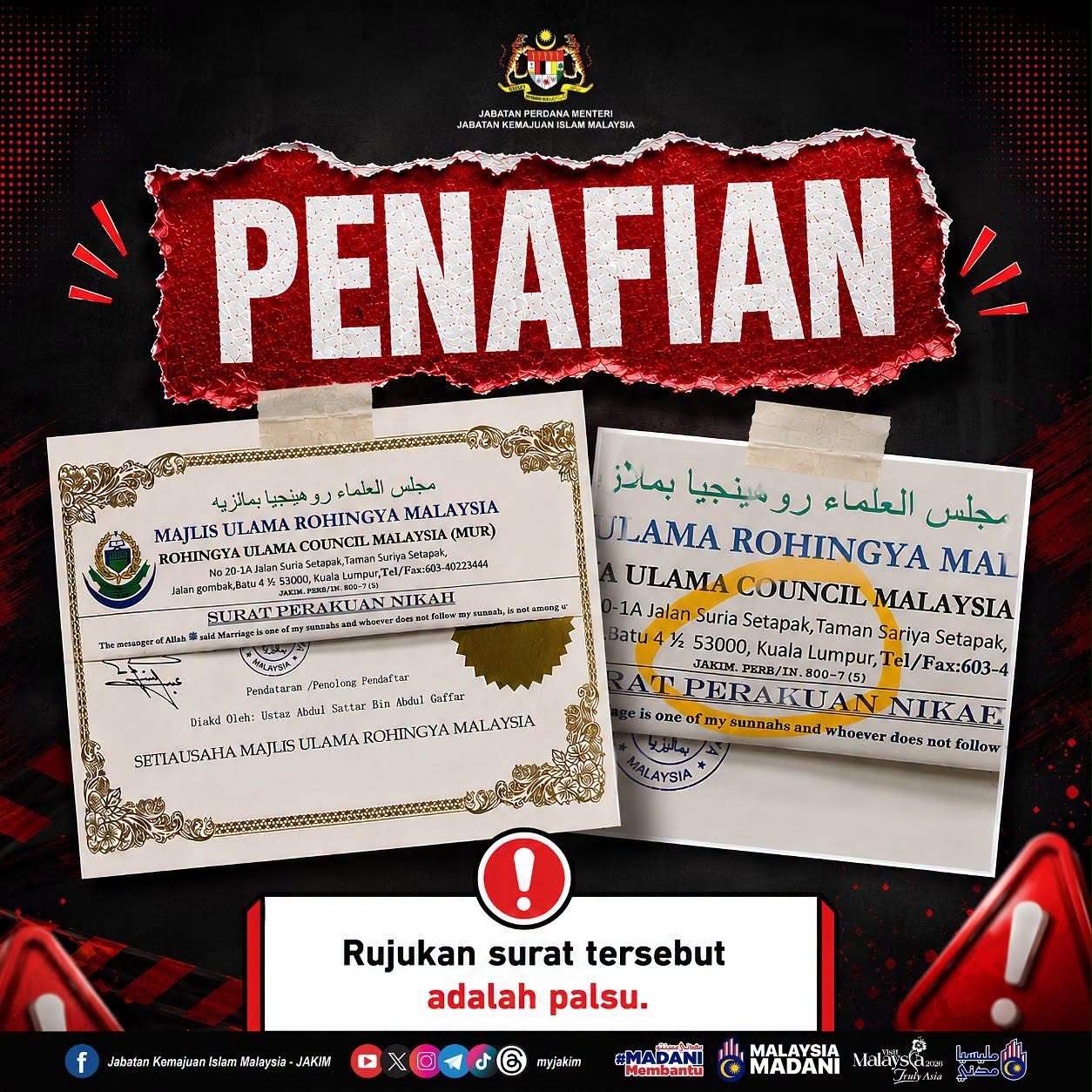
Malaysia's Department of Islamic Development (JAKIM) has issued a stark warning after discovering that a marriage recognition letter circulating on social media is entirely fraudulent, with fabricated credentials designed to deceive the public into believing it carries official Islamic authority. The announcement came through an official statement on JAKIM's Facebook page, addressing growing public concern about the document's authenticity after it gained significant traction online in recent weeks.
The problematic letter, purportedly issued by the Malaysia Rohingya Ulama Council, carried the reference number "JAKIM.PERH/LN.800-7(5)" and claimed to recognise an unspecified organisation's authority to handle marriage-related matters. This formatting appeared designed to mimic genuine JAKIM documentation, potentially lending credibility to what turned out to be an elaborate forgery. The circulation of such documents on social media platforms demonstrates the vulnerability of religious institutions and the public to coordinated misinformation campaigns, particularly when official nomenclature and bureaucratic formatting are weaponised to establish false legitimacy.
JAKIM's investigation definitively established that neither the reference number nor the issuing authority held any validity within Malaysia's Islamic regulatory framework. The department categorically stated that no state Islamic religious councils or departments had ever appointed the named organisation to certify or manage marriage-related matters, effectively dismantling the letter's purported authority entirely. This finding is significant because Malaysia's marriage registration and recognition processes operate through strictly regulated channels, with specific religious authorities designated at federal and state levels to handle such matters according to Islamic law and civil procedure.
The implications of this fraud extend beyond a single forged document. Fake marriage certificates and recognition letters could potentially affect individuals' legal status, inheritance rights, and family law matters governed by Islamic Syariah courts across Malaysia. Those who may have relied on such documentation could face serious complications when attempting to register marriages, secure spousal benefits, or establish legal family relationships. The perpetrators likely exploited gaps in public awareness regarding proper verification procedures and the legitimate channels through which such documents should be obtained.
Minister in the Prime Minister's Department (Religious Affairs) Dr Zulkifli Hasan indicated that investigations would be expanded once additional details were gathered, suggesting that authorities view this as potentially part of a broader scheme rather than an isolated incident. The involvement of a minister-level statement underscores the seriousness with which the government treats threats to the integrity of Islamic administration and public trust in religious institutions. Such high-level attention may also reflect concerns about whether other fraudulent documents employing similar tactics remain undetected in circulation.
JAKIM's public advisory represents a broader educational effort aimed at countering document fraud in the religious sphere. The department has urged Malaysian citizens to adopt verification practices before accepting any religious documentation, particularly those claiming official status or making significant assertions about marriage, inheritance, or religious status. This guidance is especially pertinent in an era when digital documents can be easily fabricated and shared across social networks, reaching thousands of people within hours before authorities can respond.
The emergence of such forgeries highlights vulnerabilities in how Islamic administrative documents are designed and disseminated. Unlike certain government documents that incorporate sophisticated security features, religious authority letters may rely more heavily on bureaucratic legitimacy and institutional reputation. Strengthening document security through enhanced features and establishing clearer public-facing verification systems could reduce the impact of such fraud. Additionally, religious authorities might benefit from more robust digital authentication systems that allow instant verification of document legitimacy.
For Malaysian citizens engaging with marriage matters, particularly those from refugee or immigrant communities, this incident underscores the importance of directly contacting recognised state Islamic religious councils rather than relying on third-party documentation. The proper channels for marriage recognition in Malaysia involve state-level Islamic authorities, and any legitimate process should be verifiable through official government contacts and procedures. Individuals who have already engaged with such documents should contact their relevant state Islamic religious department to clarify their actual legal status.
The Malaysia Rohingya Ulama Council's name being invoked in this fraud raises additional questions about whether the council's identity was deliberately misappropriated or whether it exists at all as a registered entity. This aspect of the investigation will likely determine whether authorities pursue charges related to identity theft or impersonation, beyond the document forgery itself. The broader context of refugee and migrant religious communities also means such fraud could disproportionately affect vulnerable populations less familiar with Malaysia's Islamic administrative structures and verification procedures.
Authorities have implicitly acknowledged that social media's role in amplifying such fraud requires a multi-layered response combining document verification technology, public education, and rapid institutional responses to suspected forgeries. JAKIM's swift public denial and detailed explanation represents best practice in combating misinformation, though it also demonstrates how reactive such defences necessarily are. Going forward, stronger coordination between Islamic authorities and digital platform providers may help contain the spread of fraudulent religious documents before they cause widespread harm to public confidence and individual citizens' legal standing.

