Visitors to George Town often find their bearings by mapping the Unesco-listed heritage district onto familiar landmarks and street names. The historic core—anchored by arterial roads such as Beach Street, Armenian Street, Lebuh Carnavon, Lebuh Chulia and Pengkalan Weld—draws the majority of day-trippers seeking restored colonial buildings, curio shops and the island's famous food culture. Yet beyond these well-trodden zones lies Jalan Burma, a thoroughfare that reveals the layered complexity of Penang's urban fabric and culinary identity.
At nearly 5 kilometres in length, Jalan Burma functions as one of George Town's principal connectors, stretching from the heritage zone's periphery all the way to the more affluent enclave of Pulau Tikus. The road itself presents a safe, walkable corridor through the city, though pedestrian infrastructure remains inconsistent in one or two sections. What makes Jalan Burma particularly compelling for visitors—whether Michelin-guide adherents or independent food explorers—is the concentration of acclaimed dining establishments interspersed with cultural and architectural landmarks that tell stories of Penang's transformation over the past two centuries.
The nomenclature of Jalan Burma carries its own historical weight. Originally designated "Burmah Road" on colonial-era signboards and maps, the thoroughfare has been known by multiple names across different linguistic communities. Historical records, accessible via an information board situated beneath the Komtar Octopus Pedestrian Bridge, document the road's evolution: in Malay, it was called Jalan Tarek Ayer or Water Cart Road; in Hokkien and Cantonese, references to water transport persisted with names such as Gui Chia Chui, literally meaning water on bullock carts. These multilingual designations reflect the practical reality of 19th-century Penang, when the route served as a crucial pathway for water distribution using beast-drawn vehicles.
The establishment of a Burmese settlement in the Pulau Tikus neighbourhood during the 1800s precipitated the road's eventual renaming, cementing its association with the Burmese diaspora that remains culturally significant today. Visitors traversing Jalan Burma can encounter enduring markers of this heritage: the Dhammikarama Burmese Temple, established two centuries ago on a lane branching from the main road, continues to function as a spiritual centre, while adjacent thoroughfares bear names such as Rangoon Road, Mandalay Road and Moulmein Close—toponyms that underscore the geographical and cultural ties binding the neighbourhood to Myanmar.
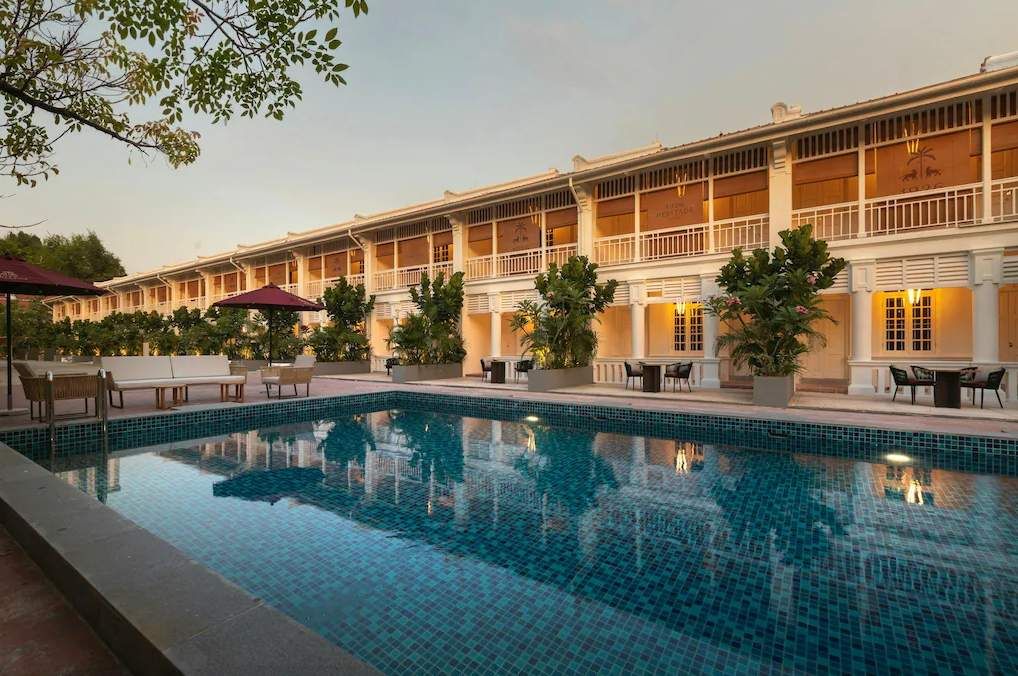
For contemporary travellers seeking accommodation within walking distance of Jalan Burma's culinary attractions, the recently renovated heritage hotel situated on the street offers compelling appeal. Constructed in 1926, the building occupies a significant milestone: its centennial anniversary coincides with the resurgence of heritage tourism in Penang. Architecturally, the structure exemplifies the Anglo-Malay design vocabulary prevalent in George Town during the British administrative period, when such properties served as residential quarters for colonial and local government officials. The original configuration of 24 interconnected link houses underwent conversion to hotel use in 1999 under the Penang Development Corporation's stewardship, a transformation that preserved the buildings' historical character whilst adapting them to modern hospitality functions.
The contemporary hotel configuration comprises 78 rooms and suites distributed across the original link-house footprint, with six distinct room categories catering to different guest profiles and budgets. The Heritage Room appeals particularly to solo travellers, while the Straits Suite represents the property's most spacious accommodation. Modern amenities, including in-room water filtration systems equipped with WiFi connectivity, illustrate how the hotel negotiates between heritage preservation and contemporary expectations. Access to the hotel's Root House by Gen restaurant—offering modern Cantonese cuisine—provides guests with fine dining without necessity of venturing into the surrounding streets, though such convenience pales against the gastronomic richness available immediately adjacent to the property.
The proximity of the heritage hotel to Michelin-recognised establishments exemplifies Penang's emergence as a gastronomic destination of international stature. The 2024 Michelin Guide to Penang identifies 74 recommended eateries, distributed across three tiers: two one-star establishments representing the pinnacle of technical execution and creativity; 33 Bib Gourmand venues celebrating exceptional value and consistent quality within casual settings; and 39 Michelin Selected restaurants offering noteworthy dining experiences. The concentration of these establishments throughout George Town—and particularly along arterial roads such as Jalan Burma—renders the guide a pragmatic navigational tool for discerning visitors uninterested in chance encounters or social-media-driven itineraries.
For many international visitors, the Bib Gourmand category holds particular appeal, particularly when establishments operate within food courts or communal coffeeshop environments. These settings generate a distinctive sensory ecology: the convergent aromas arising from multiple simultaneous cooking operations, the visual choreography of skilled preparation unfolding before diners' eyes, and the democratic mixing of customer types and price points create an experiential authenticity that fine-dining establishments, however technically accomplished, struggle to replicate. Duck Blood Curry Mee, located mere doors from the heritage hotel on Jalan Burma, exemplifies this category—a humble stall producing speciality curry noodles that warrant recommendation despite their unpretentious presentation.
Immediately adjacent to Duck Blood Curry Mee stands Restoran Old Green House, the original location of the Bib Gourmand-listed Green House Prawn Mee & Loh Mee operation. Local consensus designates this venue as the authoritative iteration, though a secondary branch operating as Green House Prawn Mee/Law Mee Corner functions further along Jalan Burma toward Jalan Penang (with Komtar serving as the principal landmark for orientation purposes). The existence of multiple outlets claiming authenticity reflects broader patterns within Penang's food culture, wherein competing establishments serving ostensibly identical dishes inspire fervent loyalty and spirited debate among regulars—a phenomenon that actually facilitates visitor navigation by converting culinary preference into a sorting mechanism.
Jalan Burma's role within George Town's tourism infrastructure extends beyond dining to encompass cultural and commercial exploration. A walking itinerary incorporating the heritage hotel, food stalls along Jalan Burma, and the heritage zone's shops concentrated on Lebuh Campbell, Lebuh Kimberley and Beach Street necessitates approximately 4 kilometres of pedestrian traversal, achievable within a half-day frame and rendering the accumulation of steps a byproduct rather than a burden. The thermal demands of Penang's climate—perpetually warm and frequently humid—reward preparation through borrowed umbrellas, absorbent towels and refillable water vessels, converting what might otherwise become an arduous perambulation into a manageable exploration of the streetscape.
Beyond the heritage zone's established circuits, Jalan Burma and its immediate surroundings reveal the topographical and commercial diversity characterising contemporary George Town. The transition from the heritage district's colonial architecture and museum-quality preservation to the vernacular shophouses and mixed-use buildings along Jalan Burma, subsequently yielding to the residential affluence of Pulau Tikus, traces the historical expansion and social stratification of the city. This geographical and socioeconomic variation, previously obscured by heritage-marketing narratives emphasising pristine conservation, constitutes the lived reality of George Town—a city perpetually negotiating between preservation and adaptation, tourism and inhabitation, culinary tradition and creative innovation.
For Malaysian and Southeast Asian visitors, Jalan Burma's significance derives partly from its accessibility without requiring specialised culinary or historical knowledge. The street functions simultaneously as a neighbourhood commercial corridor serving resident populations, a destination attracting food-focused tourists, and a vector for understanding how colonial toponymy, diaspora settlement patterns, and contemporary globalisation intersect within Penang's urban morphology. The Hin Bus Depot, a weekend marketplace located elsewhere in George Town where local artisans and food vendors congregate alongside live musical performances, extends this logic of convivial public-space activation—suggesting that George Town's vitality emerges not principally from heritage preservation initiatives but from the persistent engagement of vendors, artists, cooks and residents transforming inherited spaces into living cultural commons.