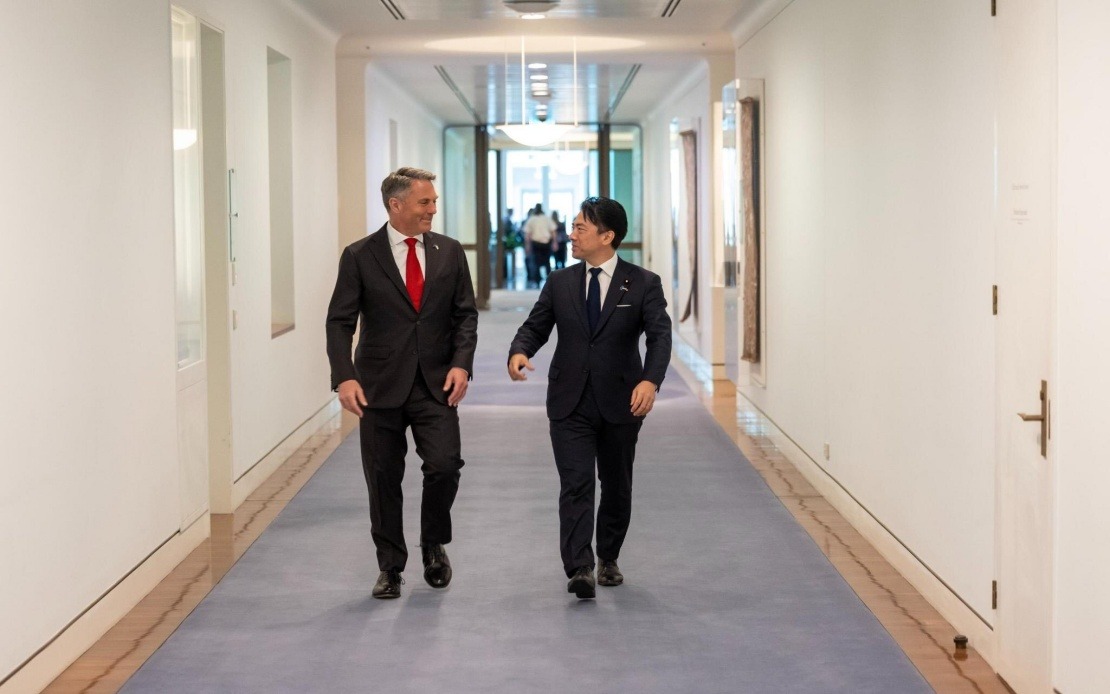
Japan and Australia have reached a landmark agreement to establish mechanisms enabling Tokyo to conduct test launches of advanced hypersonic and stand-off missiles within Australian territory, marking a substantial expansion of their military partnership at a time of growing strategic competition in the Indo-Pacific region. The bilateral arrangement, confirmed by defence ministers from both nations following talks in Australia this week, represents a practical step toward closer security integration between the two democracies and signals their joint commitment to developing cutting-edge defence capabilities.
Japanese Defence Minister Shinjiro Koizumi characterised the accord as genuinely transformative for Japan's military readiness and technological advancement. During a press conference following substantive discussions with Australian Defence Minister Richard Marles, Koizumi emphasised that gaining access to Australian missile ranges would constitute a watershed moment for Japan's ability to operationalise and validate hypersonic weapons systems—technology increasingly viewed as critical to regional deterrence architectures. The Japanese defence establishment has long sought practical testing grounds for such advanced weaponry, and the Australian facilities represent a geographically and politically suitable option for conducting trials of systems that Japan is actively developing.
Marles confirmed that both governments have committed to progressing what he described as an enhanced bilateral arrangement that would substantially broaden Japan's utilisation of Australia's existing missile testing infrastructure. His characterisation of the agreement as spanning "a range of missile capabilities" across the coming decade indicates that the arrangement extends beyond hypersonic systems to encompass other categories of stand-off weaponry. This broader framework suggests a more comprehensive defence relationship than the initial focus on hypersonic testing alone, potentially encompassing cruise missiles, air-launched systems, and other precision-strike platforms central to contemporary military doctrine.
The strategic context underpinning this agreement reflects regional security dynamics that directly affect Southeast Asia and the wider Indo-Pacific. Both Japan and Australia operate within an environment shaped by China's rapid military modernisation, assertive territorial claims, and expanding naval capabilities. Japan, confronted with direct security challenges in the East China Sea and facing China's military buildup, views advanced hypersonic missile capabilities as essential to maintaining credible deterrence. Australia, similarly concerned with maintaining strategic autonomy and regional stability, recognises that strengthening Japanese military capabilities enhances the overall security architecture upon which regional equilibrium depends.
Hypersonic missiles represent a frontier technology in modern warfare, travelling at speeds exceeding five times the speed of sound and posing unprecedented challenges to existing air defence systems. These weapons compress reaction times and complicate threat assessment, making them potentially transformative for military operations. Japan's pursuit of such systems reflects both technological ambition and strategic necessity—the nation seeks to develop indigenous capabilities rather than remaining dependent on external suppliers for critical weapons systems. Access to Australian testing ranges accelerates this developmental timeline considerably and allows Japan to validate systems in realistic operational conditions before full integration into Self-Defence Force arsenals.
The agreement also signals Australia's strategic calculation regarding great power competition in the region. By facilitating Japanese military modernisation, Canberra strengthens a key security partner whose interests fundamentally align with Australian regional objectives. This represents a deliberate policy choice to invest in coalition capability development and interoperability with a like-minded democracy. For Australia, hosting Japanese weapons testing enhances its position as a technological and strategic hub within the Indo-Pacific security architecture, reinforcing its relevance to multiple partners concerned with regional stability.
Koizumi's visit to Australia carried broader significance beyond the missile testing framework. The Japanese defence minister travelled specifically to expand the overall bilateral security and defence partnership, indicating that weapons testing represents merely one component of a more comprehensive strategic alignment. Both nations maintain deep concerns about maritime security, freedom of navigation, and respect for rules-based international order—concerns that increasingly manifest in concrete military cooperation. Previous bilateral arrangements have focused on information sharing, training exercises, and coordinated operational planning; the missile testing agreement represents a qualitatively new dimension of this relationship.
Both defence ministers reiterated their commitment to continuing substantive discussions regarding implementation of this initiative, suggesting that the agreement framework requires substantial technical and bureaucratic development before operational realisation. Questions surrounding testing schedules, environmental compliance, Indigenous consultation, domestic political processes, and detailed technical specifications all require resolution. The decade-long timeframe explicitly mentioned by Marles indicates that this represents a long-term institutional commitment rather than a temporary arrangement, with both governments prepared to invest sustained diplomatic and administrative effort into making the arrangement function effectively.
For Southeast Asian nations, this development carries important implications regarding the evolving security architecture of the region. Japan's enhanced military capabilities, developed in partnership with Australia, will factor into strategic calculations throughout the region. Nations like Malaysia, Singapore, and Vietnam monitor such developments carefully, recognising how alliance structures and weapons capabilities among major regional powers influence broader stability equations. The explicit focus on hypersonic systems indicates that Japan and Australia are positioning themselves to address emerging technological challenges that may reshape regional military balances over the coming decade.
The agreement also reflects a broader pattern of consolidating defence partnerships among Indo-Pacific democracies, complementing existing frameworks such as the Quad (Quadrilateral Security Dialogue) and bilateral alliances. As regional powers pursue military modernisation and grapple with strategic uncertainty, mechanisms for technology sharing and capability development become increasingly valuable. Japan's access to Australian testing facilities exemplifies this trend toward deepening practical cooperation on security matters, moving beyond diplomatic consultation toward concrete operational collaboration.
Looking forward, the success of this missile testing arrangement may catalyse additional defence cooperation initiatives between Japan and Australia. Both nations possess complementary strengths—Japan's technological expertise and Singapore's advanced manufacturing capabilities alongside Australia's vast testing grounds and geographic position. The hypersonic missile framework establishes precedent for government-to-government mechanisms facilitating advanced weapons development, potentially opening pathways for expanded cooperation in other technological domains critical to regional security.

