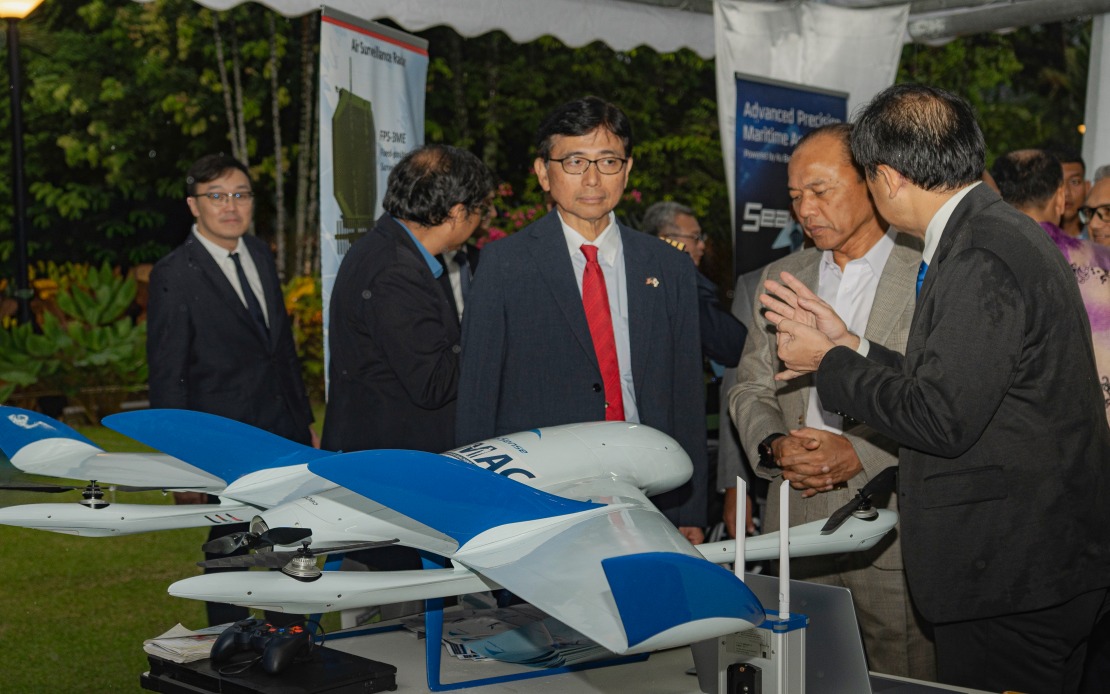
Japan's commitment to strengthening its security relationship with Malaysia took centre stage this week as Japanese Ambassador to Malaysia Noriyuki Shikata outlined plans for deepened defence cooperation between the two nations. Speaking at the 72nd Japan Self-Defence Forces Day Reception in Kuala Lumpur on Wednesday, Shikata emphasised that Japan remains ready to elevate partnership with Malaysia as both countries navigate a geopolitical landscape marked by competing strategic interests and maritime disputes.
The ambassador's remarks follow Japanese Prime Minister Sanae Takaichi's recent meeting with Malaysian Prime Minister Datuk Seri Anwar Ibrahim in Tokyo earlier this month. During that engagement, both leaders reaffirmed their mutual resolve to expand strategic cooperation, placing defence and security firmly at the centre of their bilateral agenda. This convergence reflects a broader recognition between Tokyo and Kuala Lumpur that closer security ties serve their respective national interests while contributing to regional equilibrium.
A cornerstone of Japan's emerging framework for regional engagement is its Free and Open Indo-Pacific vision, which emphasises transparent institutions, rule of law, and freedom of navigation. Shikata indicated that both nations have agreed to align this Japanese strategic concept with ASEAN's Outlook on the Indo-Pacific, a move designed to construct a unified regional approach to stability and prosperity. This alignment is particularly significant for Malaysia, which chairs ASEAN this year and must balance its relationships with major powers while upholding the bloc's centrality in regional affairs.
The bilateral relationship itself has evolved substantially in recent years. Japan elevated ties with Malaysia to the status of Comprehensive Strategic Partnership in 2023, a designation that opens pathways for intensified coordination across multiple sectors. As the two nations approach the 70th anniversary of formal diplomatic relations next year, Shikata indicated Japanese intention to deepen cooperation not merely in defence but across all domains, signalling a wholesale enhancement of the bilateral relationship.
Tangible evidence of security collaboration already exists through established military exercises. The Malaysia-Japan (MALPAN) maritime exercise, conducted regularly in the South China Sea and the Strait of Malacca, has become a symbol of operationalised partnership. In April of this year, the exercise expanded significantly to include the Royal Malaysian Air Force, demonstrating a deliberate effort to deepen coordination across naval and air domains. These exercises serve multiple purposes: they build mutual trust between military establishments, sharpen interoperability for potential joint operations, and reinforce both nations' commitment to maintaining secure shipping lanes critical to global commerce.
Japan has also leveraged its Official Security Assistance framework, established in 2023, to provide tangible military equipment and systems to Malaysia. Last year, Japan supplied unmanned aerial vehicles and rescue boats as initial contributions under this programme. Building on this foundation, the 2025 iteration of the assistance initiative includes provision of ceasefire monitoring equipment to the ASEAN Observer Team and, notably, a diving support vessel designated for the Royal Malaysian Navy. These contributions extend beyond symbolic gestures; they address specific operational requirements of Malaysia's maritime forces and acknowledge the country's pivotal role in maintaining regional stability.
Defence industry collaboration represents another avenue through which Tokyo and Kuala Lumpur are binding their security interests. Ten Japanese defence companies exhibited advanced technologies and equipment at Defence Services Asia 2026 in Kuala Lumpur, signalling Japanese commitment to supporting Malaysia's defence procurement modernisation. More significantly, both countries signed a Terms of Reference document to establish a bilateral defence industry dialogue, institutionalising mechanisms for ongoing commercial and technological exchange in the defence sector. This development could lead to co-production arrangements, technology transfer agreements, or joint development initiatives in coming years.
For Malaysia, this deepening security partnership addresses several strategic imperatives. The South China Sea remains contested territory, with overlapping territorial claims creating potential flashpoints. Japan, similarly affected by maritime disputes and island claims in its own region, shares Malaysia's interest in preserving freedom of navigation and preventing unilateral changes to regional geography. By intensifying security cooperation, both nations signal to the broader region—particularly to Beijing—that they are committed to maintaining a rules-based order in which disputes are resolved through peaceful mechanisms rather than coercion.
The timing of this security emphasis also reflects evolving regional dynamics. As major powers compete for influence across Southeast Asia, middle powers like Malaysia must carefully calibrate their partnerships to enhance security while maintaining strategic autonomy. Japan's approach differs from some other regional powers by explicitly emphasising ASEAN centrality and working through regional mechanisms rather than imposing bilateral frameworks that might divide the bloc. This positioning makes Japanese security overtures more palatable within ASEAN's consensus-driven decision-making environment.
General Tan Sri Malek Razak Sulaiman's presence at the reception, representing Malaysia's armed forces leadership, underscores the seriousness with which Kuala Lumpur regards these defence discussions. Military-to-military engagement at senior levels signals institutional commitment and facilitates the detailed coordination necessary for effective joint operations and technology integration.
The broader context suggests that Japan-Malaysia security cooperation will continue expanding in coming years. Beyond the immediate focus on maritime security and air defence, emerging areas of potential collaboration include cyber security, counter-terrorism operations, and humanitarian assistance-disaster relief capabilities. As both nations invest in defence modernisation, opportunities for shared procurement, joint training, and coordinated strategic planning will multiply.
For Southeast Asia more broadly, the Japan-Malaysia security partnership exemplifies how regional nations can balance engagement with multiple powers while maintaining commitment to ASEAN principles. Rather than choosing between competing visions of regional order, Malaysia is selectively adopting elements of different frameworks—Japanese FOIP concepts and ASEAN's Indo-Pacific Outlook—to construct a personalised security architecture. This pragmatic approach reflects the realpolitik that characterises contemporary Southeast Asian international relations, where middle powers leverage great power competition to secure resources and backing for their own strategic objectives.

