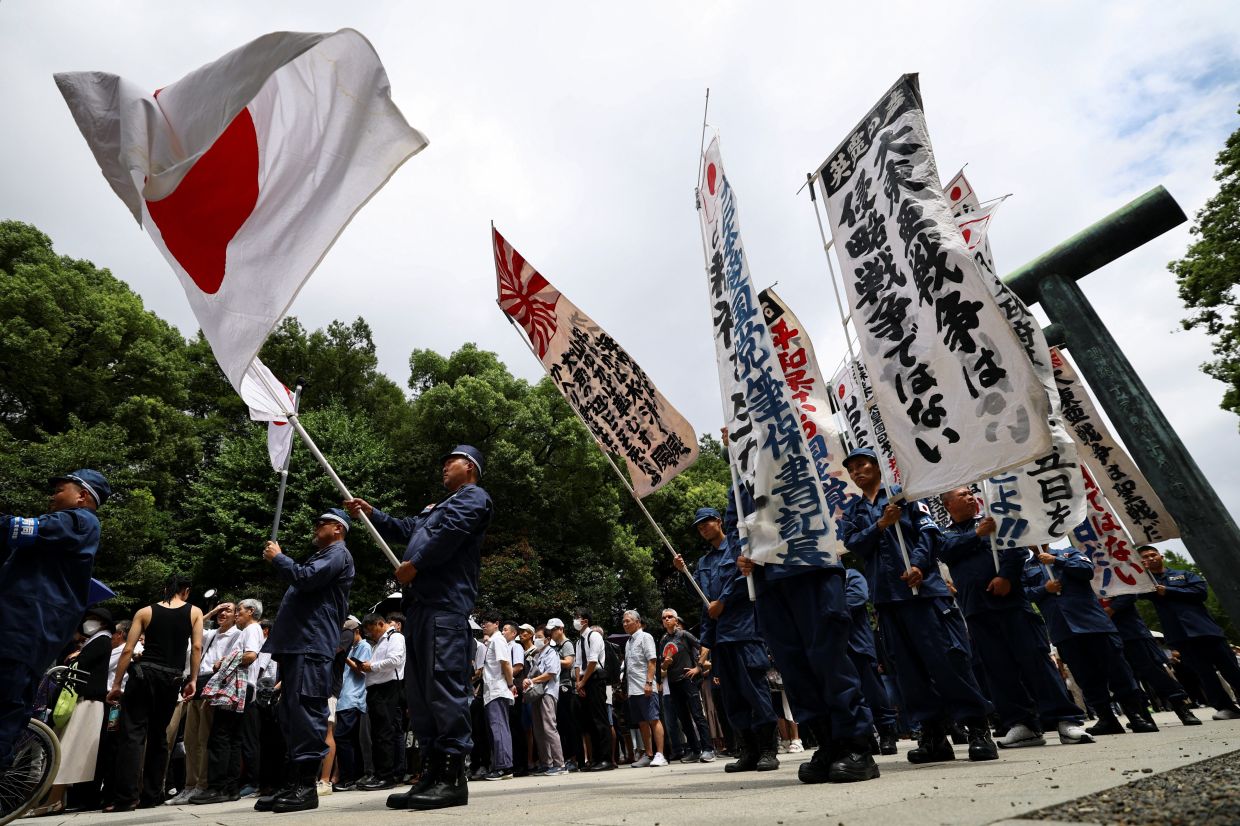
Japan's Defence Minister Shinjiro Koizumi visited the Yasukuni shrine on Saturday to mark the 81st anniversary of the country's surrender in World War II, a decision that threatens to complicate Tokyo's already strained relations with its Asian neighbours. Prime Minister Sanae Takaichi, despite being a longtime devotee of the shrine before entering her current office in October, chose not to attend, instead sending a monetary offering to the war memorial. The distinction between the two officials' approaches underscores a delicate political calculation within Japan's leadership regarding how openly to engage with a site that remains among the most sensitive flashpoints in regional diplomacy.
Yasukuni shrine has enshrined approximately 2.5 million war dead since the 19th century, but its controversial character stems from the inclusion of convicted war criminals who orchestrated Imperial Japan's brutal military campaigns across Asia during the 1930s and 1940s. For China, South Korea and other nations that suffered under Japanese occupation, the shrine represents not a place of solemn remembrance but rather a symbol of historical revisionism and inadequate contrition. When senior Japanese politicians visit the site, particularly around significant anniversaries like the August 15 surrender date, neighbouring governments interpret the gesture as an implicit endorsement of nationalist narratives that downplay or obscure Japan's wartime atrocities. This interpretive gulf has repeatedly ignited diplomatic crises throughout the past two decades.
Koizumi's visit as defence minister carries particular weight given the militaristic undertones the position carries in regional consciousness. While defence ministers have attended Yasukuni before—most recently Minoru Kihara in 2024—Koizumi's role in a government actively pursuing rearmament and strategic repositioning adds a layer of concern for Beijing and Seoul. His father, Junichiro Koizumi, remains the last sitting prime minister to visit Yasukuni on the August 15 anniversary, doing so in 2006 amid considerable regional backlash. Shinzo Abe, the former premier and Takaichi's political mentor, visited the shrine in December 2013, an act that provoked unprecedented fury in China and South Korea and even drew criticism from the United States, Japan's closest security ally.
Takaichi's decision to abstain from a personal visit appears strategically motivated, though her alternative gesture of sending an offering suggests she has not entirely distanced herself from the shrine's symbolic significance. Before becoming prime minister, Takaichi was known as a China hawk with strong nationalist convictions, raising expectations that she might emulate Abe's more confrontational approach. By staying away while still maintaining a spiritual connection through the offering, she attempts to navigate between domestic constituencies that value nationalist expression and international audiences increasingly concerned about Japan's military trajectory. Her restraint may reflect calculations about managing ongoing tensions with Beijing and Seoul while still satisfying influential conservative factions within Japan's ruling coalition.
China has adopted an increasingly assertive posture regarding Japan's political symbols and military moves. Senior Colonel Chen Xi, spokesperson for China's defence ministry, issued a pointed statement on August 14 urging Japan to "earnestly reflect on itself" and cease what he characterised as "dangerous acts of remilitarisation." Beijing has escalated its response beyond rhetorical warnings, recently restricting Chinese citizens' travel to Japan and imposing targeted trade limitations. The Chinese government has simultaneously increased military patrols around disputed territories in the East China Sea, part of a broader pattern of asserting pressure on Tokyo across multiple domains simultaneously. Russia's ambassador to Japan joined with China in issuing a joint statement emphasising their nations' wartime sacrifices, a coordination that underscores how Japan's historical reckoning—or perceived failures in that regard—intersects with broader geopolitical realignment.
Takaichi's broader defence posture has already generated considerable alarm in Beijing. In November, she suggested that Japan might intervene militarily in any conflict over Taiwan, a statement that struck at the heart of China's strategic calculations and its insistence that the self-governing island of over 23 million people belongs within its sovereignty. Taiwan's status remains one of the most volatile potential flashpoints in East Asian security, and Japanese statements hinting at military involvement represent a significant escalation in Tokyo's public rhetoric. China views such pronouncements not as abstract policy positioning but as potential indicators of a fundamental shift in Japan's willingness to depart from its post-war pacifist framework. This combination of historical symbol-making and contemporary strategic repositioning has created what Beijing perceives as a coordinated challenge to its regional interests.
Japan's accelerated military modernisation programme under Takaichi's leadership has prompted calls from multiple quarters for restraint and historical reflection. The government has progressively relaxed constitutional constraints on military spending and deployment, a process that began under previous administrations but has intensified under the current prime minister. This shedding of Japan's "peace constitution" posture, combined with visits to Yasukuni and rhetoric about Taiwan, creates a narrative arc that regional powers find genuinely destabilising. The contrast with South Korea, where relations have actually improved incrementally in recent years—including notable moments of personal chemistry between Takaichi and South Korean President Lee Jae Myung, who played drums together in January—suggests that diplomatic engagement remains possible despite historical tensions.
The shrine itself attempted to manage the political sensitivities surrounding Saturday's commemoration by appealing to visitors to refrain from wearing military-style uniforms, an effort to prevent what shrine authorities characterised as disruptions to the "peace and quiet" of the site. The request highlighted an awkward reality: Yasukuni has become a focal point not just for dignified remembrance but also for nationalist mobilisation, with military costume-wearing visitors understood across East Asia as signalling alignment with imperial nostalgia. An AFP reporter counted approximately 20 to 30 uniformed individuals at the site despite the shrine's guidance, suggesting that managing the political symbolism of Yasukuni remains deeply challenging even for Japanese authorities themselves.
The broader context includes Russia's strategic provocations, which complicated the regional atmosphere as the August 15 anniversary approached. Russian President Vladimir Putin visited the Kuril Islands in Russia's far east for the first time, sparking sharp protests from Japan, which also claims sovereignty over these territories. This Russian move, timed proximate to the anniversary period, illustrated how historical territorial disputes and contemporary geopolitical competition continue to reinforce each other, making it increasingly difficult for any single nation to compartmentalise historical memory from current security calculations. For Southeast Asian observers, these developments underscore how Japan's relationship with its own wartime history continues to structure the region's entire security architecture.
Takaichi's abstention from a personal Yasukuni visit should not be misinterpreted as signalling fundamental policy change regarding Japan's military posture or its historical narrative. Rather, her manoeuvre represents a tactical adjustment designed to preserve diplomatic flexibility while maintaining rhetorical and substantive support for military strengthening. The arrival of Koizumi at the shrine in his defence ministry capacity provides a symbolic continuation of political engagement with Yasukuni while allowing the prime minister plausible distance from the most controversial aspects of that engagement. For Malaysia and other ASEAN states observing these dynamics, Japan's evolving relationship with its historical reckoning and contemporary military role carries direct implications for regional security calculations and the broader question of how post-war international order functions in an era of great power competition.

