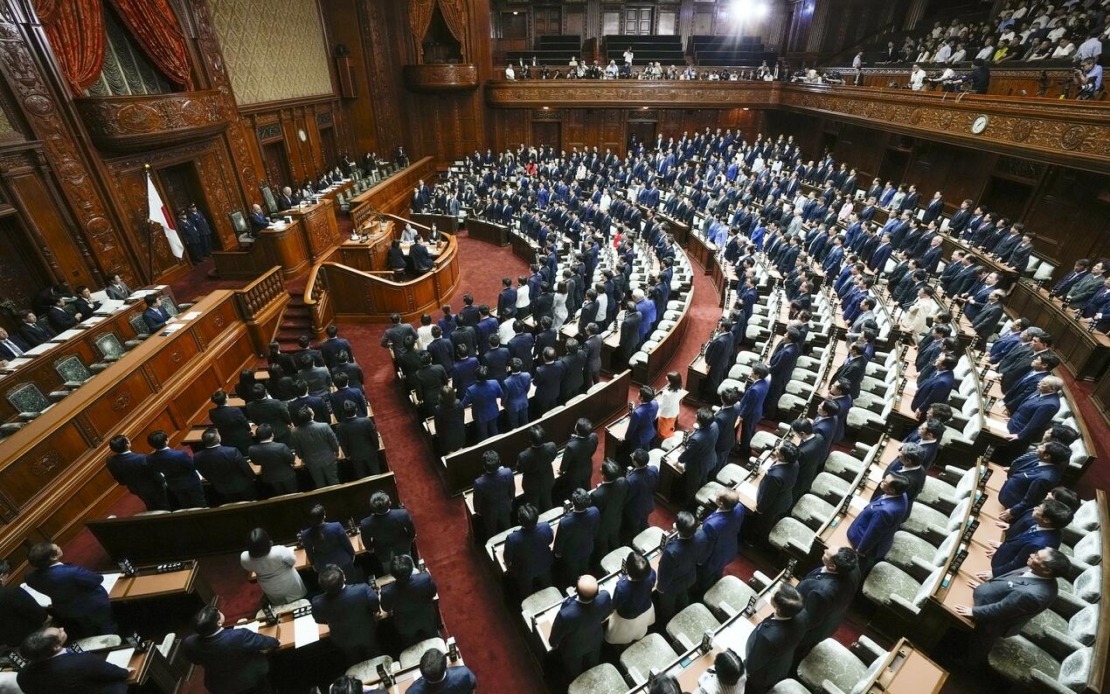
Japan has taken its most significant step in decades toward reforming its imperial succession rules after the House of Representatives approved a sweeping amendment to the 1947 Imperial House Law on July 10. The fast-tracked passage came within hours of debate beginning, reflecting the government's determination to address the shrinking pool of eligible imperial heirs—a demographic crisis that has shadowed Japan's centuries-old monarchy. The bill, backed by Prime Minister Sanae Takaichi's ruling Liberal Democratic Party and its coalition partner the Japan Innovation Party, commands more than two-thirds support in the lower chamber, providing the supermajority needed to override potential upper house resistance when the legislation is submitted to the House of Councillors.
The road to this parliamentary moment proved longer and more contentious than the one-day debate might suggest. Takaichi's administration introduced the legislation at the end of June, yet parliamentary dysfunction stemming from opposition resistance to the government's handling of other major bills stalled all deliberations. The impasse centred on competing measures to reduce lower house seats and establish a second capital to offset Tokyo's prominence—issues that triggered accusations of heavy-handed governance. Opposition parties weaponised these grievances to demand accountability from Takaichi herself, citing allegations that her political apparatus had orchestrated online smear campaigns against rivals. Only when the ruling coalition agreed on Tuesday to abandon its push for the seat-reduction bill during the current session did the legislative logjam begin to ease, permitting the imperial law debate to finally commence.
At its core, the bill addresses twin imperatives: ensuring sufficient imperial family members to sustain the institution and securing a viable succession pipeline. Current law restricts the throne exclusively to male descendants tracing lineage through the paternal line to an emperor, while women automatically lose imperial status upon marrying non-royals. This creates a cascading contraction in the eligible pool. The new framework introduces two principal mechanisms to reverse this decline. First, it authorises the imperial family to adopt males aged 15 and above who descend from emperors through historical male lines from 11 defunct branch families that were severed in 1947. Second, it permits female imperial family members to maintain their royal status even after wedding commoners, preserving both their personal rank and enabling their male offspring to remain within the succession framework.
Yet the bill contains nuances that have proven controversial. While adopted males themselves are barred from becoming emperor, their sons and male descendants would gain eligibility to ascend the Chrysanthemum Throne. This carve-out attempts to distinguish adopted members as outsiders while incorporating their bloodlines into the succession continuum. Such distinctions reflect deep conservative sensibilities within Japan's imperial institution, which has long emphasised patrilineal continuity as central to legitimacy. However, critics note that the legislation deliberately avoided embracing alternative pathways championed by growing segments of the Japanese public and parliamentary opinion. Most notably, the bill does not entertain the possibility of female monarchs or succession through maternal lines, both concepts that have gained considerable traction in opinion polling and among younger parliamentarians.
The imperial succession dilemma stems from stark demographics. Japan's reigning Emperor Naruhito has only one child—daughter Aiko—while his younger brother Fumihito has two sons, placing succession firmly within Fumihito's line. However, Fumihito's heirs face an increasingly attenuated pipeline of successors. The adoption mechanism responds to this bottleneck by reconnecting branch families severed in 1947 when Emperor Hirohito's relatives lost imperial status under post-war American-influenced constitutional reforms. Scholars and imperial specialists have argued that reopening this pathway offers a pragmatic solution that preserves patrilineal orthodoxy while expanding the viable candidate pool without fundamentally redefining the imperial institution.
The legislative framework emerged from an all-party consultative process. Both chambers' presiding officers, acting as institutional mediators, convened discussions with representatives from all 13 parliamentary parties and groups, eventually producing a compromise proposal designed to achieve broad consensus on succession mechanics while studiously avoiding more philosophically divisive questions about female emperors or maternal succession. That cautious middle path anchored the original negotiation text. Nevertheless, the government's final bill incorporated provisions absent from the speaker-drafted proposal—specifically, the expansion allowing adoptees' male descendants to become emperor. Opposition parties assailed this addition as evidence that the ruling bloc had unilaterally widened the legislation beyond what the multi-party consensus had produced, reinforcing perceptions of governing high-handedness that had already poisoned Diet dynamics.
The imperial law revision stands as a cornerstone commitment within the coalition agreement forged on October 20 between Takaichi's Liberal Democratic Party and the Japan Innovation Party. That compact proved transformational: it elevated Takaichi to the premiership on October 21, making her Japan's first female prime minister. Updating the Imperial House Law represented not merely routine governance but a signature policy objective tying together two partners with divergent philosophical outlooks into a functional government. For Takaichi, whom critics have accused of authoritarian governing instincts, the imperial reform provides substantive policy achievement alongside personnel and institutional gains.
With lower house approval secured, attention now turns to the House of Councillors, where the ruling coalition aims for enactment before parliament adjourns on July 17. That compressed timeline reflects government determination to complete this chapter of imperial reform during the current session. The upper chamber, which typically functions as a deliberative counterweight to the lower house, possesses theoretical power to obstruct legislation lacking supermajority support. However, the LDP's institutional dominance across both chambers makes upper house rejection highly improbable, barring unexpected defections. The government's supermajority in the lower house essentially guarantees eventual passage regardless of upper chamber resistance, though the coalition prefers consensual legislative passage over antagonistic override procedures.
For regional observers, including Malaysian policymakers tracking East Asian institutional development, Japan's imperial succession reform illustrates the intersection of tradition and demographic necessity. Monarchy-adjacent governance structures—constitutional arrangements where hereditary institutions coexist with democratic machinery—must periodically adapt rules to accommodate changing social realities. Japan's approach attempts incremental reform that preserves core institutional identity while acknowledging practical pressures. The deliberate exclusion of female succession from this reform, despite documented public support, demonstrates how conservative institutional cultures can resist transformative change even when demographic logic might support it. This tension between adaptation and preservation characterises how established hierarchical systems navigate modernisation across Asia.
The broader context reveals governance tensions extending beyond imperial succession. The parliamentary gridlock preceding this vote, rooted in disputes over lower house seat allocation and capital relocation, reflects deeper disagreements about democratic accountability, government transparency, and opposition effectiveness in Japanese politics. Takaichi's decision to compromise on the seat-reduction bill in exchange for resuming normal Diet operations suggests recognition that forcing contentious legislation against opposition resistance yields reputational costs exceeding immediate legislative gains. The restoration of face-to-face accountability debates between the prime minister and opposition leaders, scheduled for July 12, signals a partial normalisation of democratic deliberation. These developments carry implications beyond Japan, illustrating how coalition governments navigate the interplay between executive efficiency, legislative oversight, and institutional legitimacy in mature democracies.

