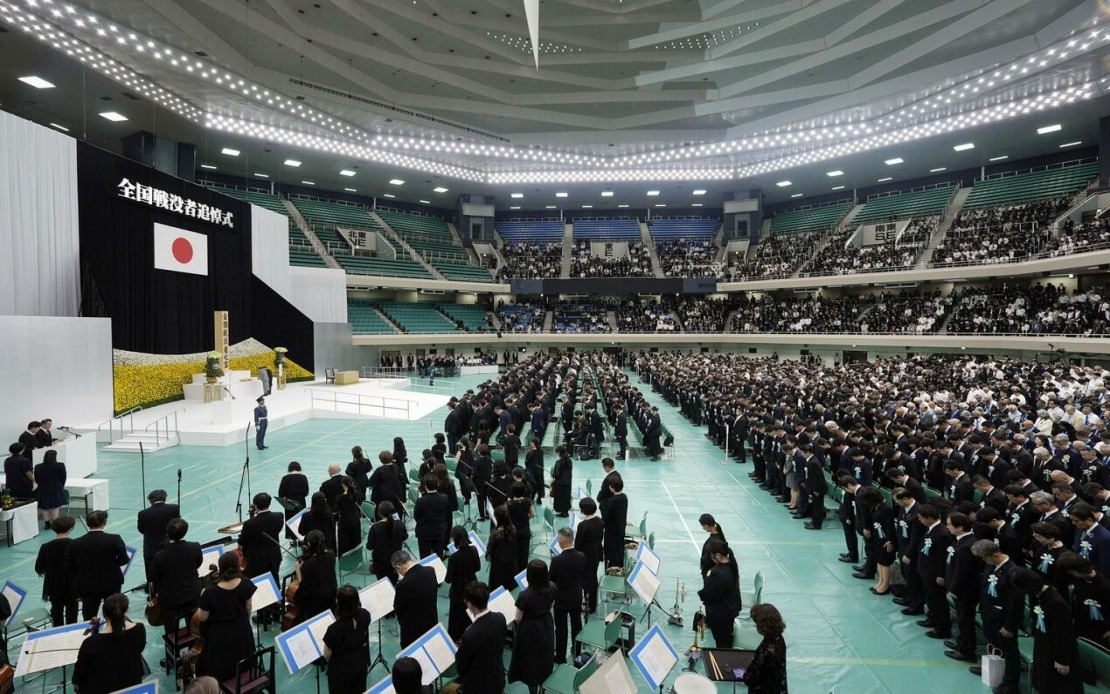
Japan observed the 81st anniversary of its World War II surrender on Saturday with a state ceremony in Tokyo, but the occasion revealed a notable shift in how the nation's leadership frames its wartime past. Prime Minister Sanae Takaichi, who assumed office last October, delivered remarks that emphasized Japan's commitment to peace without employing the language of remorse that has increasingly characterized these annual commemorations in recent years. The ceremony drew Emperor Naruhito and Empress Masako, who joined government officials in honouring approximately 2.3 million military personnel and roughly 800,000 civilians killed during the war that concluded in 1945.
Takaichi's absence of explicit expressions of remorse represents a notable departure from her immediate predecessor, Shigeru Ishiba, whose August 15 speech last year included direct references to Japan's regret over its wartime actions. Ishiba's decision to invoke the concept of remorse marked a significant moment, as no Japanese prime minister had employed such language at the annual ceremony for thirteen years prior. His remarks thus signified a temporary reversal of a diplomatic trend that had seen Japanese leaders grow increasingly circumspect about acknowledging wartime aggression. Takaichi's choice to sidestep this language suggests either a deliberate recalibration of messaging or a reflection of her hawkish stance on national security matters.
The Prime Minister's speech instead focused on Japan's peaceful trajectory since 1945, declaring that the nation has "consistently walked the path of a nation that values peace and made all possible efforts for world peace and prosperity." While such sentiments are standard fare at these ceremonies, the calculated omission of acknowledgment regarding Japan's military expansion across Asia—particularly towards China and the Korean Peninsula—carries symbolic weight in the context of regional sensitivities. Like other recent premiers before Ishiba's tenure, Takaichi avoided direct mention of wartime aggression, a rhetorical choice that reverses the pattern established by Japanese leaders prior to the late Shinzo Abe's return to power in December 2012.
Abe's political protégée has long been known for her assertive positions on Japan's defence and national security posture. Her attendance at the ceremony marked her first participation since taking office, and her remarks reflected commitments to perpetuating "resolute pledges" across generations without the emotional or moral dimension that the term remorse carries. The distinction between pledging peace abstractly and acknowledging historical wrongs represents more than semantic difference; it reflects competing visions within Japan's conservative establishment regarding how the nation should narrate its past to both domestic audiences and regional neighbours.
Emperor Naruhito maintained continuity with his established practice by expressing "deep remorse" during his own remarks at the ceremony. The Emperor's willingness to articulate regret annually stands in deliberate contrast to the Prime Minister's more measured language, underscoring an interesting tension within Japan's official commemoration of the war's conclusion. Naruhito also reiterated his hope that citizens would continue transmitting memories of wartime suffering to future generations, language identical to his statement the previous year. This consistency in the imperial address suggests a deliberate institutional position that transcends individual prime ministerial preferences.
The timing of this year's anniversary carries particular geopolitical significance given the current international environment. Japan faces heightened tensions across West Asia while simultaneously undertaking a substantial reorientation of its defence strategy. The government has dramatically increased national security expenditures and relaxed previously strict regulations governing the export of defence equipment—measures that represent the most significant shift in Japanese military policy since the post-war period. These developments occur against a backdrop of regional military buildups and strategic competition, particularly involving China and Russia. In this context, Takaichi's rhetorical choices at the war memorial may be understood as part of a broader repositioning of Japan's strategic identity.
For Malaysian and Southeast Asian observers, Japan's evolving approach to acknowledging its wartime history carries implications for regional stability and trust. The region experienced direct impact from Japanese military expansion during World War II, and perceptions of how Japan reckons with this history influence contemporary diplomatic relationships. Malaysia, like other Southeast Asian nations, maintains complex relationships with Japan that blend economic interdependence, security cooperation, and historical consciousness. The gradual shift toward less explicit acknowledgment of wartime aggression in official ceremonies may be viewed with concern by regional partners who value candid recognition of historical grievances as foundational to genuine reconciliation.
A noon moment of silence marked the precise moment when Emperor Hirohito announced Japan's surrender via radio broadcast in 1945, a tradition maintained since these annual commemorations began. This ritualistic pause continues to anchor the ceremony in historical specificity, even as the verbal framing of that history evolves. The ceremony thus embodies a tension between commemorative continuity and shifting political narratives, with different institutional actors within Japan's government expressing varying degrees of engagement with the nation's wartime past.
Looking forward, the trajectory established by Takaichi's remarks may influence how subsequent prime ministers approach these annual ceremonies. Should future leaders follow her precedent of minimizing explicit remorse, the cumulative effect could signal a deliberate departure from the post-Abe pattern toward greater acknowledgment of historical responsibility. Conversely, if Takaichi's approach proves to be an anomaly reflecting her personal views rather than a sustainable shift in official policy, the temporary reversion to more guarded language may prove merely episodic. Either scenario carries implications not only for Japan's internal historical consciousness but also for how the nation negotiates its regional relationships in an era of renewed great-power competition and fluid strategic alignments.

