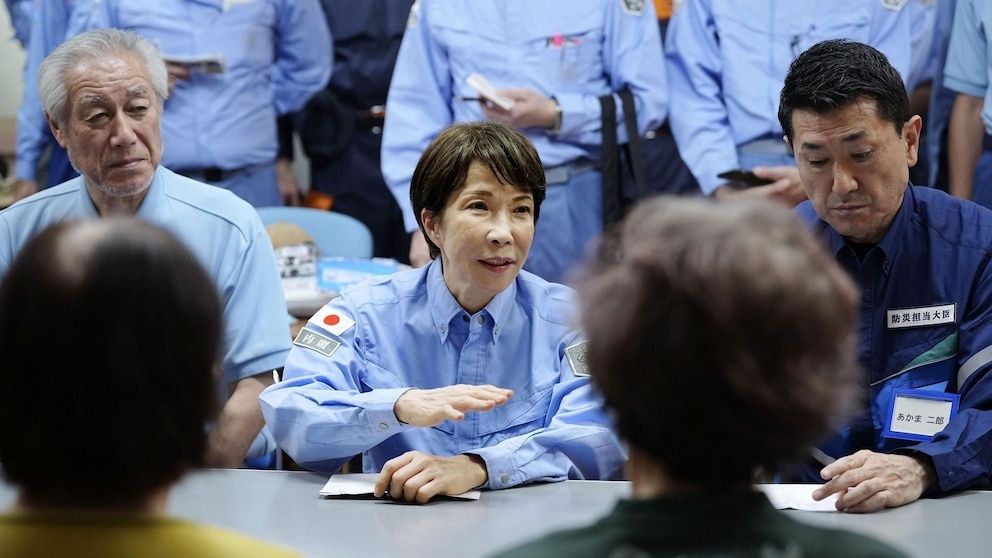
Prime Minister Sanae Takaichi visited Kumamoto Prefecture on Monday as residents in Japan's southwestern region began clearing debris and authorities grappled with mounting humanitarian challenges following a devastating magnitude 7.1 earthquake that struck Kyushu's main island on Tuesday, August 4. The disaster has claimed 38 lives, including deaths from heat-related causes among those taking refuge in vehicles, underscoring how natural disasters in Japan compound when environmental factors become hostile.
The cleanup effort unfolding across Kumamoto represents only the opening phase of what will be a lengthy recovery process. Communities in the towns of Uki and Hikawa have already commenced construction of temporary housing, while some local hotels and inns have opened their doors to provide shelter for displaced residents. However, the physical reconstruction masks deeper logistical crises that threaten public health in the immediate aftermath of the disaster.
Water and fuel supply disruptions have created a dangerous situation as the region experiences extreme temperatures predicted to approach 40 degrees Celsius. More than 46,000 households lack access to clean water, a critical necessity during a period when heat-related illness poses a significant threat to vulnerable populations. The combination of displacement, inadequate sanitation, and scorching temperatures creates conditions that experts have long warned against—and which consistently lead to preventable deaths in post-disaster environments.
Emergency shelter provision remains inadequate for the scale of displacement. More than 8,500 people remain crammed into converted community centers, school gymnasiums, and repurposed classrooms, many without air-conditioning to provide relief from the oppressive heat. Others have resorted to sleeping in parked vehicles at town hall lots and in parks, or attempting to shelter outdoors near their destroyed homes. These crowded, unsanitary conditions breed disease and mental health deterioration, particularly among elderly residents and young children who are most vulnerable to heat stress.
Takaichi's Monday visit included an aerial tour of the affected areas by military helicopter, followed by a visit to one of the prefecture's best-equipped shelters, which features cardboard partitioning, basic beds, and air-conditioning. The carefully curated nature of the site visit drew sharp criticism on social media, with observers noting that the Prime Minister witnessed only an atypical shelter environment rather than the substandard conditions where the vast majority of evacuees actually shelter. This perception gap highlights the tension between political messaging and on-the-ground reality in disaster response.
Kumamoto Governor Takashi Kimura used his meeting with Takaichi to emphasize the extraordinary burden that abnormal heat has imposed on residents already devastated by the earthquake. He specifically requested enhanced government intervention to raise living standards across the network of evacuation centers, highlighting persistent shortages of clean water and adequate medical care. His direct appeal underscores how local officials understand the interconnected nature of the current crisis—structural damage alone does not determine outcome; the secondary effects of heat, dehydration, and disease claim lives just as readily.
Takaichi responded with measured commitment to further examination of government support options, pledging proactive measures once officials assessed the full scope of needs. Her statement reflects the typical bureaucratic approach to disaster response, where thorough evaluation precedes commitment. However, given that temperatures were expected to peak during the period when evacuees faced the greatest exposure, the lag between assessment and implementation posed concrete risks to public health.
A troubling secondary narrative emerged from the collapse of Aeon Mall in the town of Kashima, where an explosion killed two employees and injured dozens of shoppers. Executives from Habita, the company operating a general store inside the mall, attended the wake of 22-year-old Kurumi Otake and acknowledged to her parents that the company had instructed her and a colleague to return to the building following evacuation to secure sales proceeds in a safe. The mother's anguished response—"I wish someone had stopped her. My daughter is not coming back"—captures the human cost of prioritizing business continuity over worker safety in moments of acute danger.
The mall's operator attributed the explosion to a gas leak that occurred after approximately 3,000 shoppers had been evacuated to a parking lot, though employees remained inside to conduct final business operations. Rescue operations ultimately recovered five people alive but also extracted seven bodies from the collapsed structure. This tragic sequence illustrates how post-disaster decisions made under time pressure and pressure to preserve assets can transform a natural disaster into a workplace catastrophe.
The full scale of destruction across Kumamoto Prefecture encompasses approximately 700 destroyed homes and more than 11,300 damaged structures, according to official prefecture counts. An additional 114 people sustained injuries from the quake itself, adding to the strain on healthcare systems already stretched thin by the need to treat heat-related illness and provide medical care to vulnerable evacuees. For Malaysian observers, Kumamoto's experience offers sobering lessons about how well-prepared, wealthy nations with robust disaster management infrastructure still struggle when multiple stressors converge—lessons particularly relevant to Southeast Asian countries with greater exposure to both seismic activity and extreme heat.
The recovery trajectory will extend far beyond the immediate crisis phase now unfolding. Psychological trauma, economic disruption, and the long-term challenge of rebuilding critical infrastructure will occupy Kumamoto for years. The question of whether government response successfully transitions from emergency management to sustainable reconstruction may ultimately prove as important as the initial disaster response itself.

