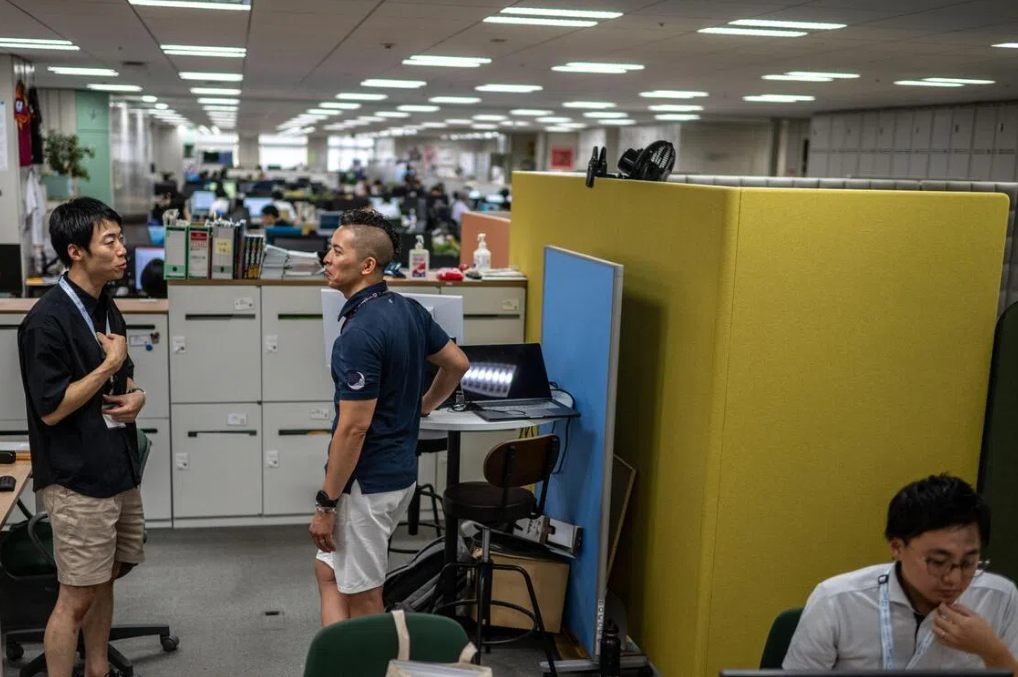
Japan's latest attempt to combat sweltering summer temperatures through relaxed workplace dress codes has collided with an unexpected social friction: the visibility of male colleagues' leg hair. Tokyo's metropolitan government expanded its Cool Biz initiative in April to permit office workers to abandon traditional suits and ties in favour of casual attire including t-shirts, trainers and shorts, a measure intended to help employees endure the punishing heat that regularly grips the nation. Yet the move has triggered debate about workplace acceptability, gender dynamics and what constitutes appropriate professional appearance in Japanese corporate culture.
The backlash centred on a concept that has crystallised online as "leg hair harassment" or "sunehara"—a Japanese term capturing the discomfort some women express at having to view male colleagues' exposed shin hair. This phenomenon reveals deeper anxieties about body presentation and social norms in a work environment where formality has traditionally reigned supreme. Tokyo environmental official Noboru Watanabe defended the initiative to the BBC, framing it as an expansion of choice rather than a directive. "We want to give people more options in the severe heat, not tell them what to wear," he said, adding that the metropolitan government saw no inherent problem provided work attire remained inoffensive to colleagues.
Determining what qualifies as offensive has proven far more complex than anticipated. A June survey commissioned by Gorilla Clinic, a men's cosmetic treatment chain, revealed a near-even split on workplace shorts acceptance: 53.5 per cent of respondents opposed the practice, while 46.5 per cent endorsed it. The obstacles cited by opponents were revealing—concerns about body shape and body hair dominated the list. Notably, women constituted a significantly larger proportion of those surveyed who objected to the change, suggesting deeper reservations among female office workers about witnessing extensive male leg hair in professional settings. This gender disparity hints at unequal standards around body presentation and the gendered nature of workplace discomfort.
The controversy has created unexpected market demand. Gorilla Clinic director Akifumi Funatsu reported increased interest in laser hair removal services, with growing numbers of male clients viewing the procedure not as vanity but as workplace necessity. Many men have apparently internalised the message that visible leg hair could alienate colleagues, transforming a personal grooming choice into an obligation tied to professional courtesy. This shift demonstrates how corporate dress standards extend beyond mere clothing selection to encompass bodily presentation itself, creating pressure to modify physical appearance to conform to emerging social expectations.
Japan's gradual departure from rigidly formal workplace dress began in 2005 when Yuriko Koike, then environment minister, introduced the original Cool Biz campaign. That initial initiative sought to encourage workers to shed jackets and ties in favour of short-sleeved shirts, primarily to reduce corporate air-conditioning consumption. The campaign gained significant traction when then Prime Minister Junichiro Koizumi appeared publicly without formal neckwear, demonstrating that casual presentation could be compatible with high office. This pivotal moment signalled that workplace casualisation would henceforth be acceptable, even desirable, within Japan's traditionally hierarchical business culture.
Following the 2011 earthquake and tsunami, which severely strained Japan's power infrastructure, the government introduced "Super Cool Biz"—an even more relaxed dress code framework. Technology companies and start-ups subsequently embraced casual workplace attire more readily than traditional corporations. The Tokyo government's recent extension to explicitly permit shorts represents a further boundary shift, yet it has exposed the tension between environmental pragmatism and deeply entrenched social conventions surrounding professional appearance and bodily decorum.
The impetus behind the expanded Cool Biz campaign remains rooted in urgent practical concerns. Japan experiences extreme summer temperatures and humidity levels that impair the body's natural cooling mechanisms through perspiration. Between July 6 and 12 alone, Japan's Fire and Disaster Management Agency recorded seven heatstroke deaths and hospitalised 4,580 individuals. Officials are actively promoting hydration, air-conditioning use and gradual heat acclimatisation. Consumers meanwhile have embraced technological solutions including clothing with integrated cooling fans, specialised cooling wipes, heat-reflective umbrellas and portable cooling devices.
For Southeast Asian readers accustomed to tropical climates, Japan's struggle with summer heat adaptation may seem ironic, yet the stakes remain serious. Malaysia and other regional economies similarly grapple with workplace productivity during extremely hot months, and the tension between environmental sustainability, worker welfare and traditional workplace norms reflects challenges across the region. Japan's approach—simultaneously encouraging casual dress for health reasons whilst encountering resistance based on aesthetic and gender-based concerns—illustrates how cultural expectations can impede practical solutions to physical discomfort.
The shorts controversy ultimately reveals how contested professional identity remains, even in a modernising society. While younger Japanese workers may embrace casualisation as liberation from restrictive formality, others perceive it as erosion of standards. The specific fixation on male leg hair, rather than on shorts itself, suggests the issue transcends mere dress code and touches on anxieties about appropriate bodily presentation in shared spaces. Whether Tokyo's expanded Cool Biz campaign successfully normalises shorts, or whether cultural resistance ultimately curtails the initiative, remains uncertain. What is clear is that environmental imperatives alone cannot overcome social conditioning around professional decorum, and that Japan's experience offers cautionary lessons for any organisation attempting to reshape entrenched workplace culture.

