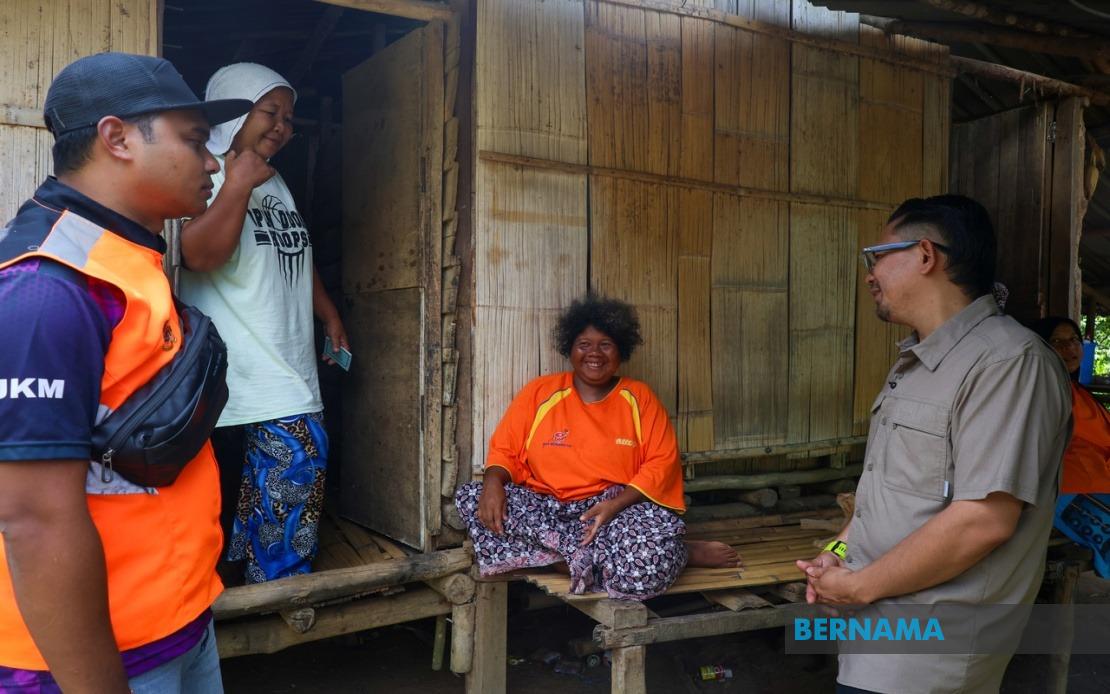
The Gua Musang District Social Welfare Department (JKM) has announced plans to partner with the Ministry of Health (MOH) to complete the verification process for a 40-year-old Orang Asli woman seeking recognition as a person with disabilities. The collaborative effort aims to resolve a lengthy administrative impasse that has prevented Noria Alueg, from the Temiar tribe and resident of Kampung Rejom, from obtaining her Persons with Disabilities (OKU) card and accessing corresponding government support schemes.
According to Gua Musang District Social Welfare Officer Bun Tham Eh Gin, the partnership will streamline a process that has stalled for over a year. Noria's case highlights the intersection of bureaucratic procedure and the practical challenges faced by indigenous communities in accessing welfare services. The officer explained that once JKM and MOH complete their collaborative assessment, confirmation of Noria's disability status will enable immediate progression to OKU card registration, followed by evaluation of eligible assistance programmes tailored to her circumstances.
One such programme is the Cash Assistance for Disabled Persons Unable to Work (BTB), which provides RM300 monthly to qualified recipients. For Noria's household, already stretched by her care needs and limited employment opportunities in her remote village location, this financial support could represent a meaningful improvement in family stability. The ability to access such schemes depends entirely on successful navigation of the initial verification stage, which has proven problematic despite multiple intervention attempts by the welfare department.
The origins of the current delay trace back to a home visit conducted by JKM during the previous year, when officers distributed the OKU card registration form to Noria's household. However, the administrative process faltered at a critical juncture: the family neither returned the completed form nor secured the required medical officer confirmation that would validate the disability assessment. Such gaps in documentation, while appearing straightforward on paper, reflect deeper structural barriers that indigenous families encounter when interfacing with government systems designed without adequate consideration for remote community contexts.
Noraida Sarim, Noria's sister-in-law who functions as her primary caregiver, provided insight into the household dynamics and practical obstacles impeding progress. She described Noria as a dependent requiring constant supervision, with two young children aged five and seven also relying on family care structures. Noraida's account underscores that Noria is not merely an individual case but rather representative of a broader ecosystem of family interdependence within Orang Asli communities. The household's overall resilience rests substantially on Noria's husband's employment activities, leaving limited flexibility for managing additional responsibilities such as navigating medical assessments and bureaucratic procedures.
Transportation emerged as the decisive constraint limiting the family's capacity to advance Noria's application independently. Getting from Kampung Rejom to medical facilities and government offices requires resources—financial, logistical, and temporal—that the family struggles to mobilize. This geographic disadvantage intersects with the absence of mobile or outreach-based assessment services that might bring medical evaluation directly to remote villages. For many indigenous communities in Malaysia's interior regions, such infrastructure gaps systematically perpetuate inequitable access to services that more urbanized populations navigate routinely.
The JKM's commitment to coordinate with MOH represents an acknowledgment of these systemic constraints and an attempt to remove intermediate barriers. By establishing direct liaison between the two government agencies rather than expecting families to independently shuttle between offices, officials can consolidate assessments and reduce the transaction costs imposed on applicants. This interagency approach also potentially improves information flow and reduces the likelihood of further documentation lapses. However, the success of this initiative will ultimately depend on whether field-level implementation matches the coordination framework established at administrative levels.
Noria's situation reflects broader patterns in Malaysia's welfare system whereby eligibility verification procedures, while technically sound, often presuppose resource availability and geographic accessibility that indigenous and rural populations lack disproportionately. The twelve-month delay in her case is neither exceptional nor attributable solely to individual negligence. Rather, it emerges from structural misalignment between service delivery design and the lived circumstances of intended beneficiaries. When marginalized communities must bear all friction costs associated with accessing entitlements nominally theirs by right, the formal eligibility becomes practically unreachable.
The resolution of Noria's case may therefore serve broader instructive value beyond her individual circumstances. If the JKM-MOH partnership successfully completes her assessment and facilitates her OKU registration, it could model an approach applicable to other Orang Asli communities facing similar administrative bottlenecks. The model would demonstrate that proactive interagency coordination and willingness to accommodate geographic constraints represent viable pathways toward more inclusive welfare administration. Conversely, if implementation stalls despite announced cooperation, it would reinforce evidence that structural barriers persist even when political will ostensibly exists.
For Southeast Asia more broadly, Noria's case illuminates recurring challenges in translating welfare policy into practice across indigenous and minority populations. Malaysia's commitment to its Orang Asli populations includes formal recognition of their rights to social protection, yet translating such commitments into accessible services requires deliberate attention to the distinctive circumstances, geographic realities, and social structures characterizing these communities. The JKM-MOH initiative, should it prove genuinely effective, could contribute evidence-based lessons applicable to disability and welfare services throughout the region, where indigenous communities face comparable barriers to service access.
The timeline for completing Noria's assessment remains unspecified, though the announcement suggests movement on a previously frozen case. Her family awaits next steps with understandable caution, having already experienced the frustration of delayed progress. The broader disability rights community in Malaysia will likely monitor this case as a test of institutional responsiveness to systemic barriers affecting marginalized applicants. Success would validate the potential of coordinated governmental response; further delays would underscore the persistence of implementation gaps between stated policy and ground-level reality.

