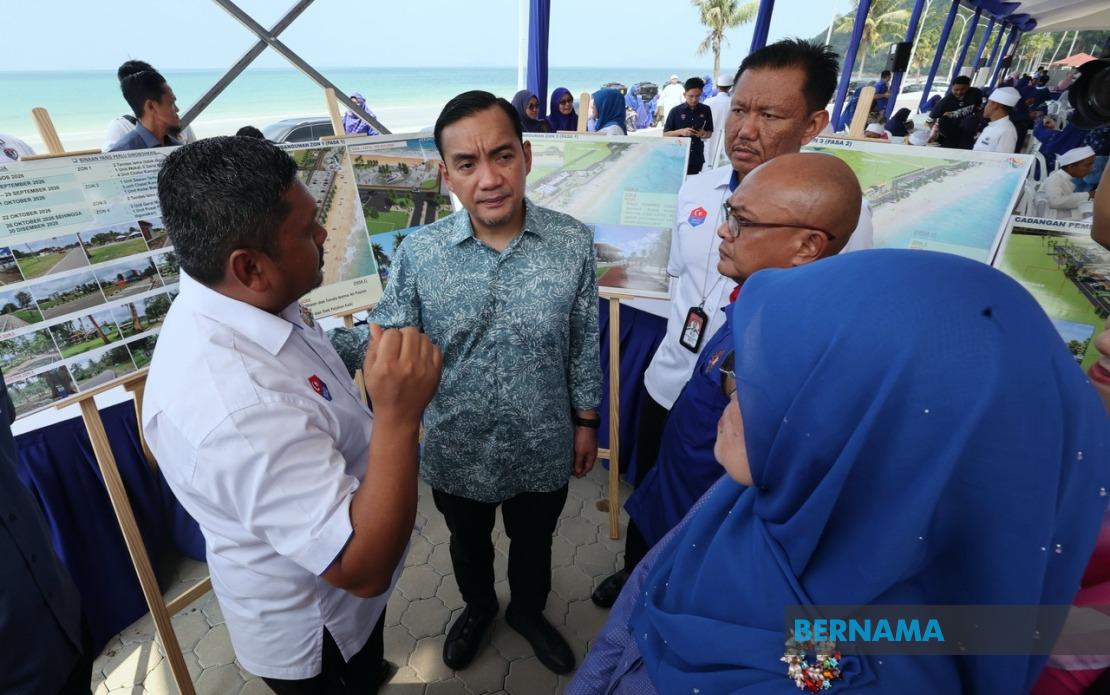
The Johor state government has committed RM1.5 million towards a comprehensive development initiative in Mersing, signalling renewed focus on ensuring that economic gains reach beyond the state capital. Menteri Besar Datuk Onn Hafiz Ghazi announced the allocation to address infrastructure, sports, healthcare, and public utility needs across the district, emphasizing that prosperity must extend to all corners of Johor rather than concentrate in urban centres.
Onn Hafiz articulated a deliberate strategy to replicate the development successes achieved in Johor Bahru throughout the state's other districts. This approach reflects growing recognition among Malaysian state governments that inclusive development—where smaller towns and rural areas share in economic momentum—strengthens overall regional competitiveness and reduces migration pressures toward major urban hubs. Mersing, home to approximately 80,000 residents, has long served as a secondary coastal hub with tourism potential, yet local communities have historically experienced limited direct benefits from state-level economic initiatives.
The Johor Economic Transformation Plan, or JETP, forms the conceptual backbone of this investment strategy. The comprehensive framework establishes short, medium, and long-term targets designed to reinforce the state's economic foundation while simultaneously enhancing living standards for ordinary Johoreans. Crucially, Onn Hafiz framed employment generation—particularly for younger residents—as central to the plan's success, acknowledging that demographic realities require state policy to address youth unemployment and underemployment that often drives migration to other states or overseas opportunities.
The RM500,000 dedicated to upgrading the Mersing Hospital Haemodialysis Unit represents a significant healthcare investment for the district. Dialysis services remain critical infrastructure in aging populations, and improving these facilities in a secondary town reflects state priorities toward equitable healthcare access beyond Johor Bahru. This expenditure also supports the broader Malaysian health system by reducing patient burden on tertiary hospitals in larger cities, allowing specialised services to concentrate resources where they can serve the widest population.
Religious and community facility improvements feature prominently in the allocation structure. The RM200,000 commitment to replace carpets at Kampung Sri Lalang Mosque may appear modest, yet mosque maintenance and upgrades carry cultural significance beyond physical infrastructure—such projects affirm state commitment to supporting faith-based community spaces that anchor social cohesion in smaller towns. This reflects sophisticated understanding that development encompasses not merely economic metrics but community well-being and social fabric preservation.
Sports facility development receives considerable attention within the allocation, with RM200,000 directed toward constructing a futsal court at Taman Sri Mersing and an equivalent sum for repairing the facility in Felda Nitar. An additional RM80,000 will fund a sepak takraw court in Felda Tenggaroh 6. These investments target grassroots sports infrastructure that younger residents can access locally, potentially supporting talent identification and recreational opportunities that compete with less constructive alternatives. For federal land development authority (Felda) settlements particularly, such facilities strengthen community engagement and quality of life.
Onn Hafiz announced installation of solar-powered streetlighting in Orang Asli villages—Kampung Peta and Kampung Tanjung Tuan each receiving RM100,000—demonstrating targeted attention to indigenous communities often marginalised in development planning. Solar infrastructure simultaneously addresses connectivity concerns and environmental sustainability, aligning Johor's development approach with national climate commitments. The KAF building upgrade in Felda Tenggaroh Timur, allocated RM100,000, supports agricultural and cooperative development for Felda families, recognising that rural livelihoods remain central to Mersing's economy.
Strategic longer-term initiatives layered into the announcement suggest more ambitious institutional development. A proposed petrol station specifically serving the Special Forces Group at Camp Iskandar would enhance services for military personnel while generating local economic activity. However, the announcement's most significant components may be the planned Religious Affairs Office and TVET campus establishment, both positioned under JETP frameworks. A dedicated TVET facility in Mersing would address skills training gaps for a coastal district with fishing, tourism, and emerging aquaculture sectors—providing local youth pathways toward employment without requiring migration to Johor Bahru or Kuala Lumpur.
For Malaysian readers, this Mersing announcement carries broader regional implications. Similar state-level development disparities exist throughout the peninsula, where secondary towns often experience resource constraints relative to state capitals. Johor's approach—systematically spreading infrastructure and services across districts through structured economic transformation plans—offers a potential model other states might emulate. The emphasis on youth employment through TVET and the creation of local economic opportunities directly addresses Malaysian concerns about graduate unemployment and rural-urban migration.
The allocation also reflects evolving governance philosophy within Johor under current state leadership. Rather than purely top-down infrastructure projects, the initiative encompasses community consultation through local assemblyman coordination, suggesting attempts at more participatory development planning. Involvement of Tenggaroh assemblyman Mohd Youzaimi Yusof and Endau assemblywoman Alwiyah Talib in the announcement underscores distribution of development benefits across multiple state constituencies, preventing resource concentration that might generate inter-constituency tensions.
Implementation challenges remain significant, however. RM1.5 million, while meaningful for a district of 80,000, represents relatively modest per-capita investment—approximately RM18.75 per resident annually. Sustained, multi-year commitment would be necessary to generate transformative economic impacts. Additionally, successful TVET campus development requires ongoing operational funding, qualified instructors, and industry partnerships extending well beyond initial capital allocation. The petrol station and Religious Affairs Office depend on coordination among state agencies, local government, and federal authorities—institutional alignment that cannot always be guaranteed.
Mersing's development prospects will ultimately depend on whether Johor sustains investments beyond the announced projects and whether these initiatives attract complementary private investment. Tourism infrastructure developments, if coordinated with private hospitality and transportation sectors, could amplify employment effects from public facility improvements. Likewise, TVET training programmes prove successful only when linked to actual job opportunities in emerging sectors—requiring state workforce planning aligned with economic forecasting. For Malaysian observers monitoring state-level development equity, Johor's Mersing initiative provides useful indicators of whether inclusive growth rhetoric translates into meaningful resource redistribution and opportunity creation across geographically dispersed populations.

