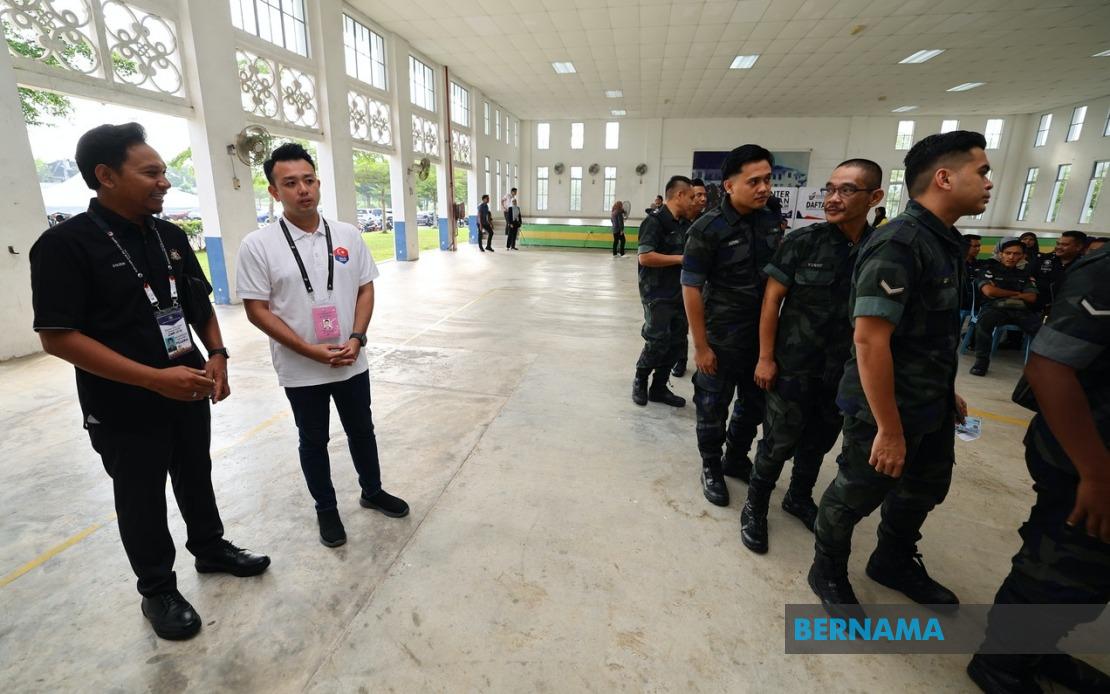
Political candidates across Johor's three major coalitions set aside their intensive campaign activities on Thursday to observe the early voting process at designated centres, underscoring the importance placed on transparency and public confidence in the electoral machinery. The observation visits occurred as more than 20,600 registered security personnel, including members of the Malaysian Armed Forces and their spouses alongside police officers and dependants, exercised their voting rights in carefully managed voting sessions that began from 8 am across 64 early voting centres statewide.
The tri-partisan attendance at early voting locations reflected the competitive and closely watched nature of Johor's electoral contest. At the 5th Battalion General Operations Force Camp in Simpang Renggam, all three contenders for the Layang-Layang seat appeared to monitor proceedings: Guna Balakrishnan representing Pakatan Harapan, Chua Jian Boon fielded by Barisan Nasional, and Abd Mutalip Abd Rahim standing for Perikatan Nasional. Similarly, the three candidates vying for the Tenggaroh seat—Muhamad Amerul Muhamad of Perikatan Nasional, Mohd Youzaimi Yusof of Barisan Nasional, and Md Yusof Dawam of Pakatan Harapan—attended the Iskandar Camp voting centre in Mersing to observe the process firsthand.
Notable individual candidate attendance highlighted the cross-constituency reach of the voting exercise. Lim Chin Eng, identified as the oldest candidate contesting the Johor polls and representing Perikatan Nasional, observed proceedings at the Johor Contingent Police Headquarters. Muhammad Faezuddin Mohd Puad, seeking to represent the Kempas seat under Pakatan Harapan's banner, visited the Kempas Police Station voting centre, while Datuk Jafni Md Shukor, the Barisan Nasional candidate for Bukit Permai, attended the Kulai District Police Headquarters. These visits demonstrated the willingness of candidates across all major political formations to engage directly with the electoral process and validate its integrity before the broader population participates on Saturday.
Military and law enforcement leadership also made visible appearances at voting locations, signalling institutional commitment to the electoral framework. Army Chief General Tan Sri Azhan Md Othman accompanied by Major General Datuk Ahmad Shuhaimi Mat Wajab, commander of the 21st Special Service Group, observed voting procedures at Iskandar Camp in Mersing. Separately, Johor's police chief Datuk Ab Rahaman Arsad cast his own ballot at Dewan Dato Onn within the Johor police headquarters complex, demonstrating the hierarchy's personal participation in the voting exercise.
Field reports from Bernama indicated that despite brief rainfall affecting certain voting locations, the early voting process proceeded without significant disruption or operational delays. Security personnel arrived at designated centres in scheduled waves, maintaining orderly queues and adhering strictly to protocols established by Election Commission officials overseeing the exercise. The staggered arrival pattern ensured that voting centres operated efficiently without creating bottlenecks or congestion, even as weather conditions threatened to cause complications.
The voter registration figures for early voting illustrated the substantial security services participation in this election cycle. The 8,544 military personnel and military spouses registered for early voting, combined with 12,063 police officers and their dependants, represented a significant bloc of the estimated 10 million voters eligible to participate across the state. This scale of early voting for armed and security forces underscores Malaysia's recognition that personnel in these services require special polling arrangements given their operational schedules and deployment patterns that may conflict with standard election day availability.
Logistical coordination across 64 early voting centres operating at varying closure times—between noon and 6 pm depending on location and voter concentration—demonstrated the administrative complexity underlying even preliminary voting exercises. The staggered closure schedule accommodated differences in voter density across geographical areas, ensuring that personnel could complete their civic responsibilities without unduly extending operations at facilities where demand was lighter. This flexibility represents refinements developed through previous electoral cycles in managing the intersection of military operations and democratic participation.
The 16th Johor State Election itself represents a critical political moment for Malaysia's most developed southern state, with 172 candidates competing for 56 seats in the State Legislative Assembly. The contest carries implications extending beyond Johor's borders, as electoral performance may influence national-level political calculations and coalition dynamics. Saturday's polling will determine the composition of the state government and signal voter sentiment regarding the three major coalitions' performance and policy platforms.
The presence of candidates from competing coalitions at early voting locations served a dual strategic purpose: demonstrating commitment to electoral transparency while simultaneously gathering intelligence about voting dynamics and security force preferences. These early voting observations provided participants a preliminary indication of turnout patterns and procedural effectiveness, data that could inform final campaign messaging and turnout mobilisation efforts before Saturday's main polling day. The cross-partisan attendance also conveyed an implicit message of acceptance of the electoral process itself, regardless of anticipated outcomes, reinforcing democratic norms critical to Malaysia's political stability.
As Johor voters prepare for Saturday's decision, Thursday's early voting exercises established the baseline for the larger democratic exercise ahead, with political leadership and security establishment visibly invested in ensuring the electoral process's credibility and efficiency. The smooth conduct of early voting, observed and validated by candidates spanning the political spectrum, provides reassurance that institutional mechanisms remain capable of managing electoral competition while maintaining public confidence in results.

