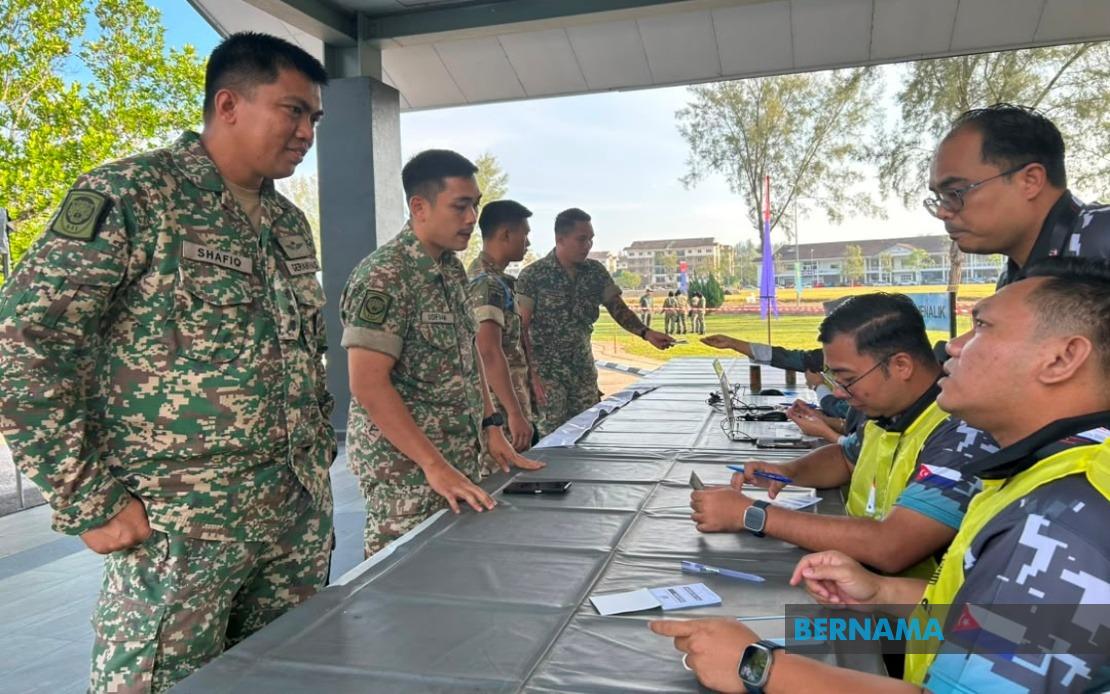
The 16th Johor state election entered its advanced voting phase on July 7 under favourable weather conditions, as security forces and their dependents exercised their constitutional right to vote ahead of the main polling day scheduled for Saturday. Bright conditions greeted the opening of 64 designated early polling centres at 8 am, enabling personnel from the Malaysian Armed Forces, Royal Malaysia Police, and General Operations Force to cast their ballots without the disruptions that inclement weather might have caused. The staggered opening of early voting facilities underscores the logistical complexity of managing electoral participation across a large state with geographically dispersed security installations.
A total of 24,751 eligible early voters participated in the process, comprised of 12,041 military personnel and their spouses alongside 12,710 police and paramilitary officers and their immediate family members. This bifurcation reflects the electoral framework's recognition that uniformed personnel and their households require dedicated voting arrangements, both to accommodate shift patterns and deployment schedules that might otherwise prevent their participation in Saturday's main election. The Election Commission's decision to allocate separate facilities for these voter categories demonstrates careful advance planning to ensure comprehensive democratic participation across different sectors of the population.
The Malaysian Meteorological Department had cautioned state authorities of potential thunderstorms developing across Johor during the afternoon hours, creating a weather-dependent timeline for voting operations. However, the morning's clement conditions allowed security agencies to mobilise their personnel effectively, with staff and voters arriving punctually to the designated locations. This early completion under good weather conditions reduced the risk of disruption that would have complicated the logistics of rescheduling had storms materialised during peak voting hours.
Election Commission officials conducted rigorous preparatory checks at each polling centre before voters arrived, examining voting infrastructure, ballot integrity measures, and administrative protocols to guarantee that the process would function smoothly and transparently. Observation visits to multiple sites, including the 5th Battalion GOF Camp in Simpang Renggam, the Johor Contingent Police Headquarters, and Mahkota Kluang Camp, confirmed that voting proceeded without complications or irregularities. This hands-on verification by commission personnel exemplifies the institutional approach to maintaining electoral credibility.
The staggered closure schedule for early voting centres, with shutdowns occurring between noon and 6 pm according to individual centre capacity and voter registration numbers, reflects the varied demand across different security installations. This graduated approach prevented congestion at any single facility while accommodating the operational requirements of different units. Johor's security apparatus spans multiple districts and deployment zones, necessitating differentiated voting logistics that the commission successfully implemented.
The scale of the broader Johor election underscores why early voting arrangements occupy a significant role in the state's electoral framework. Across the state's 56 assembly constituencies, 2,727,926 registered voters will have access to 1,140 polling centres on election day. The 172 candidates competing for these state assembly seats represent competing visions for Johor's governance and resource allocation, making comprehensive voter participation essential to legitimate electoral outcomes. Early voting for uniformed personnel therefore represents a constitutive element of the democratic process rather than a peripheral administrative convenience.
Johor's electoral significance within Malaysia's broader political landscape amplifies the importance of seamless voting operations. As one of the nation's most developed and economically dynamic states, Johor's governance directly influences regional economic performance and investment dynamics. The composition of the 56-member assembly will determine policy directions affecting commerce, infrastructure development, and inter-state relations within the Iskandar Malaysia development corridor. This context renders voting accessibility and process integrity matters of substantive consequence rather than mere procedural concern.
The success of early voting operations provides a positive indicator for Saturday's main election, suggesting that the Election Commission has effectively mobilised resources and trained personnel to manage the anticipated voter surge. Security installations represent controlled environments with established administrative hierarchies, making them suitable locations for testing operational protocols. Successful execution at these sites demonstrates organisational readiness for the more complex environment of general polling, where diverse voter populations will access neighbourhood facilities with varying demographic characteristics and infrastructure specifications.
Weather considerations feature prominently in electoral planning within tropical Malaysia, where afternoon thunderstorms during monsoon seasons can depress voter turnout and strain polling infrastructure. The Malaysian Meteorological Department's warning prompted contingency considerations among state electoral authorities, though the favourable morning conditions and early completion of security personnel voting reduced pressure on facilities should afternoon storms materialise. This meteorological dimension adds an unpredictable factor to electoral management that distinguishes Malaysian elections from those conducted in temperate climates with more predictable weather patterns.
The early voting results will provide initial indicators of voter enthusiasm and turnout propensities ahead of Saturday's decisive poll. Early voting participation rates, while involving only security sector personnel, reflect broader engagement levels within particular demographic segments and can signal momentum trajectories for the main election. Election observers and political analysts will scrutinise these figures for evidence of shifting voter behaviour or unusual participation anomalies that might presage Saturday's results. The security sector's voting patterns thus acquire analytic significance extending beyond the immediate participation of uniformed personnel.
With early voting procedures concluded successfully and favourable forecasts for Saturday's main election day, electoral authorities can proceed toward the climactic polling event with enhanced confidence in their operational capacity. The absence of complications during early voting suggests that technical systems, procedural training, and logistical coordination have achieved functional adequacy. However, the greater challenge remains Saturday's mass participation event, where the Johor electorate will determine the political composition and policy direction of its state government for the succeeding electoral cycle.

