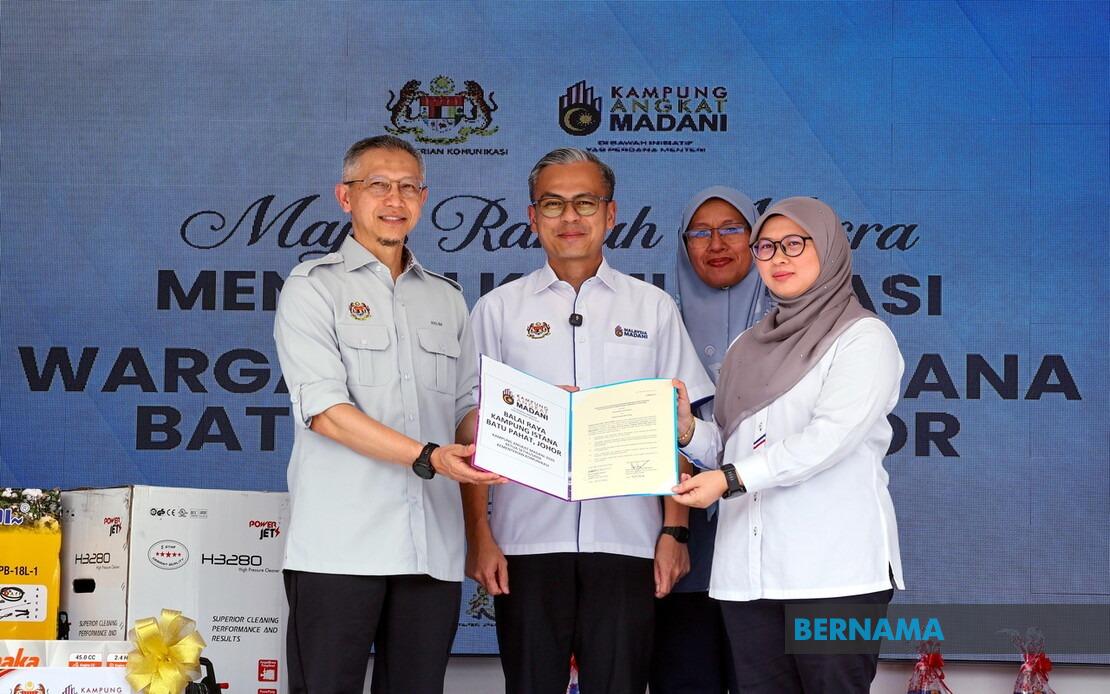
The 16th Johor State Election represents a pivotal moment for voters to select leadership capable of advancing the state's interests, according to Pakatan Harapan Communications Director Datuk Fahmi Fadzil, who sought to redirect public discourse away from personalities and towards substantive governance issues. Speaking in Batu Pahat on July 4, Fahmi stressed that the electoral contest should be understood as a choice about Johor's future direction, rejecting what he characterised as attempts to reduce the poll to an endorsement or rejection of particular individuals.
Fahmi's intervention came in response to comments by Datuk Nazifuddin Mohd Najib, who had suggested that a Barisan Nasional victory would constitute public backing for his father, Datuk Seri Najib Razak, to receive a pardon. The Communications Minister expressed concern at such framing, viewing it as potentially misleading to voters and at odds with how democratic decisions should be made. He argued that citizens casting ballots should base their choices on substantive considerations of policy and competence rather than on sentiments towards individual politicians or historical figures.
Central to Fahmi's argument is the proposition that Malaysian voters are capable of distinguishing between personal sympathies and collective interests. He contended that when confronted with messaging that privileges individual personalities over state development, voters recognise the importance of their electoral power in shaping not merely local outcomes but the country's broader trajectory. This framing appeals to voters' aspirations for tangible improvements in governance and service delivery, positioning the election as fundamentally about competence and vision rather than personality politics.
The PH Communications Director also addressed the widely-discussed question of whether the non-Malay voter base, traditionally aligned with the Democratic Action Party (DAP), remains a guaranteed constituency. Fahmi articulated a perspective that no political coalition should assume electoral support is permanent or earned through historical association alone. Instead, sustained backing requires continuous demonstration of commitment to voter interests and consistent delivery on promises made to communities. This acknowledgment reflects the competitive nature of contemporary Malaysian politics, where traditional voting patterns have become increasingly fluid and responsive to immediate performance.
Fahmi emphasised that public confidence must be actively cultivated through responsive governance and clear articulation of future direction. He suggested that Malaysian voters increasingly evaluate parties based on substantive grounds—economic management, social welfare provision, transparency, and institutional reform—rather than inherited loyalty. When citizens encounter rhetoric that raises concerns about governance priorities or institutional health, such messaging can catalyse reconsideration of voting intentions. In this sense, Fahmi framed the Johor election as a moment when voters might reassess their political preferences in light of broader national and state considerations.
The PH director pointed to endorsements from figures traditionally associated with opposition parties as evidence of his coalition's expanding appeal. He highlighted the public support expressed by former Rengit assemblyman Datuk Dr Mohd Puad Zarkashi, whose backing of a Pakatan Harapan candidate signalled erosion in what UMNO had historically treated as secure political territory. Such crossings-over, according to Fahmi, reflect growing confidence in the Pakatan Harapan-led federal government's economic stewardship and forward-looking agenda. The willingness of opposition-aligned figures to publicly support PH candidates suggests that voter realignment extends beyond DAP constituencies into Malay-Muslim communities traditionally anchored to BN.
Additional evidence of this shifting landscape includes support from Bersatu members for the Pakatan Harapan candidate in Sri Medan, and the public backing Datuk Puad Zarkashi extended to the PH candidate contesting the Rengit state seat. These developments suggest that what Fahmi termed the UMNO "fixed deposit" in Johor—the assumption of assured voter support from particular communities—can no longer be taken as politically guaranteed. The emergence of cross-party endorsements indicates that personality, performance, and policy direction now weigh more heavily than traditional affiliation in voter decision-making. Fahmi suggested such patterns would likely intensify as polling day approached, with additional defections or expressions of support from established political figures potentially reshaping perceptions of momentum.
Fahmi linked this broader political realignment to confidence in Prime Minister Anwar Ibrahim's leadership and the federal government's economic recovery programme. He argued that voter receptiveness to Pakatan Harapan candidates reflects satisfaction with the coalition's macroeconomic management and institutional reforms undertaken since assuming federal office. Johor, as a major economic hub with substantial manufacturing, port, and agricultural sectors, has particular interest in national economic policy. Voters' apparent openness to the PH message, according to this analysis, reflects confidence that continued federal stewardship under Pakatan Harapan would benefit the state's development prospects.
The 16th Johor State Election encompasses 172 candidates competing across 56 seats, representing one of Malaysia's most significant sub-national contests. Polling is scheduled for July 11, with early voting permitted on July 7. The election's scale and the Johor state government's substantial budgetary and administrative responsibilities ensure that voter decisions will have meaningful practical consequences for service delivery, infrastructure development, and local economic policy. This context lends weight to Fahmi's argument that the election should be assessed on governance grounds rather than as a referendum on past figures or personalities.
From a broader Southeast Asian perspective, the Johor election reflects wider patterns of voter volatility and the declining influence of traditional political attachments in the region. As economic performance and institutional credibility become primary electoral considerations, parties across the region confront challenges in maintaining voter coalitions. Malaysia's experience, visible in this Johor contest, suggests that voter bases are increasingly transactional, responding to demonstrated competence and visible developmental outcomes. The erosion of what Fahmi termed "fixed deposits"—presumed voter loyalty regardless of performance—signals maturation of electoral competition and greater voter sophistication in assessing political choices.

