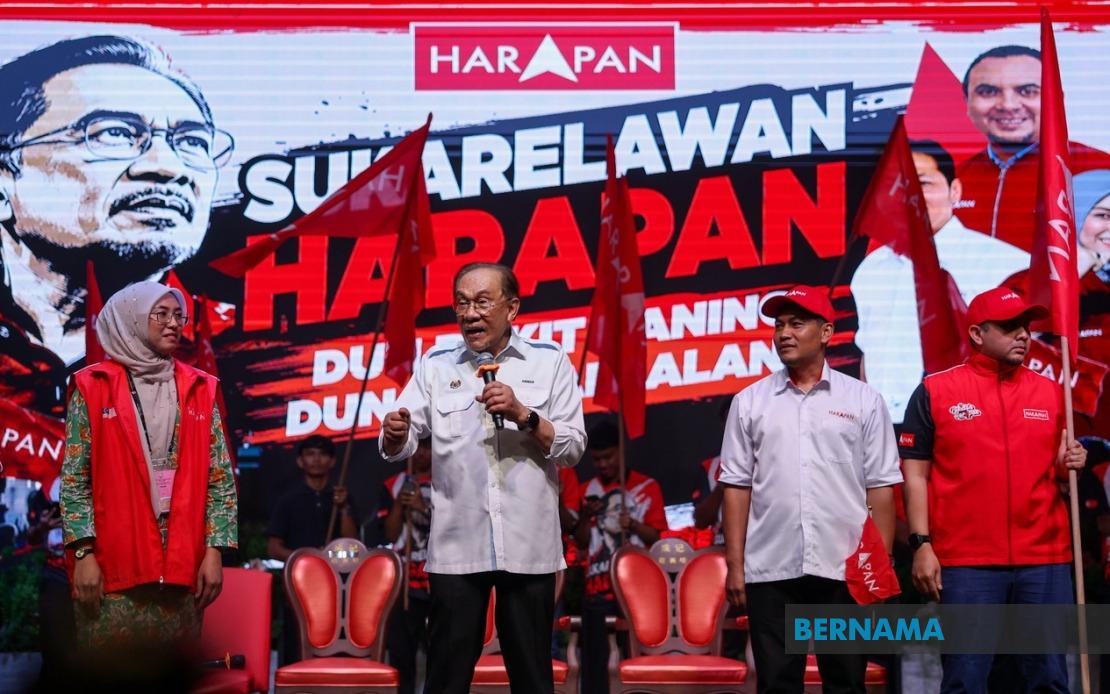
Prime Minister Datuk Seri Anwar Ibrahim has appealed directly to Johor's younger voters to turn away from divisive ethno-political messaging and instead use the upcoming state election as an opportunity to elect leaders genuinely committed to addressing their pressing concerns. Speaking at a volunteer launch in Muar on July 5, Anwar—who leads Pakatan Harapan—emphasised that young people should base their electoral choices on a candidate's track record on issues that shape their daily lives, such as access to quality education, job creation and broader economic development, rather than allowing themselves to be manipulated by appeals rooted in communal fear.
The Prime Minister's intervention reflects a growing recognition within the coalition that younger voters represent both a crucial constituency and a potential counterweight to traditional political narratives built on racial grievance and inter-communal suspicion. By framing the July 11 Johor state election as a watershed moment for generational change, Anwar sought to mobilise youthful idealism while simultaneously delegitimising what he characterised as outdated political strategies that prioritise ethnic mobilisation over substantive governance. This messaging is particularly significant in Johor, a state traditionally dominated by race-conscious politics and a stronghold of the Barisan Nasional coalition.
Anwar was notably blunt in his critique of the political culture he views as obstructing progress. He highlighted how cynical actors deliberately amplify inter-ethnic tensions—portraying the Chinese as threats, stoking resentment against Indian Malaysians, and sowing mistrust between Malays and other communities—while insulating themselves from economic hardship. The Prime Minister suggested that this theatrical conflict serves a specific function: it distracts ordinary citizens from the corrupt enrichment of political elites at the apex of the system. For Malaysian readers accustomed to observing politics through an ethnic lens, this framing represents an attempt to reorient political consciousness toward accountability and performance-based criteria.
Central to Anwar's appeal was an exhortation to Malay youth specifically, alongside Chinese and Indian young voters, to recognise their collective agency in determining the nation's direction. He urged them to resist what he termed the "rotten political system," positioning their electoral participation as an act of national renewal rather than mere voting. This language carries weight in a Malaysian context where youth unemployment, property affordability, educational quality and wage stagnation have become increasingly acute concerns, particularly among university-educated millennials and Generation Z voters who face a labour market shaped by factors including skills mismatches, credential inflation and wage suppression.
The scale of youth engagement at the Muar programme visibly impressed Anwar, who drew attention to the unprecedented turnout as evidence of generational restlessness and readiness for systemic change. He referenced his decade-long campaign experience to underscore how unusual the energy and size of the gathering was, positioning it as a sign that younger voters are awakening to their potential to reshape Malaysian politics. This observation carries implications beyond Johor; if youth mobilisation around anti-corruption, competence-based governance and inclusive development messaging can be sustained and extended to other states, it could fundamentally alter electoral dynamics in the coming years.
The Johor state election itself reflects the competitive intensity of Malaysian politics at the state level. With 172 candidates vying for 56 state seats, the contest has attracted significant national attention, particularly from Pakatan Harapan, which views the state as a platform to demonstrate that its governance model can compete effectively against entrenched incumbent power structures. Early voting commenced on July 7, with main polling scheduled for July 11. For Pakatan Harapan, the Johor contest represents a crucial opportunity to build momentum ahead of potential future national elections while simultaneously testing whether its messaging on institutional reform and performance-based leadership resonates with voters across different age cohorts and ethnic backgrounds.
Anwar also articulated a broader vision of Malaysian nationhood that stands in tension with communal mobilisation strategies. He insisted that divisive ethnic politics have become fundamentally incompatible with the reality of an independent, multi-ethnic Malaysia where Malays, Chinese, Indians and Orang Asli coexist and have built shared institutions and social structures. Framing racial-based political messaging as "poison" and as a relic of outdated thinking, he suggested that such narratives actually undermine the national unity that has historically enabled Malaysia's stability and economic development. This argument carries particular resonance given Malaysia's track record of managing ethnic tensions more successfully than many comparable post-colonial societies, though contemporary observers might debate whether his characterisation of older political narratives as wholly "outdated" adequately accounts for how deeply institutionalised communal politics remain.
The Prime Minister's insistence that younger generations must not remain passive observers but instead actively shoulder responsibility for building an inclusive future represents an attempt to convert electoral participation into broader civic engagement. This framing positions voting not merely as a consumer choice between competing elites but as an act of conscious nation-building. For Malaysian youth facing a complex array of pressures—including economic uncertainty, climate change, technological disruption and geopolitical volatility—this appeal to agency and collective responsibility may resonate more powerfully than traditional party messaging focused on ethnic or religious identity.
The deployment of leaders such as Nazri Abd Rahman (Simpang Jeram candidate) and Md Ysahrudin Kusni (Bukit Naning candidate) alongside Anwar at the Muar programme signals Pakatan Harapan's intention to present a slate of candidates perceived as aligned with the coalition's reform agenda. The selection of relatively fresh faces in state-level contests is a deliberate strategy to contrast with the perception of long-entrenched incumbency and to signal generational turnover within the coalition itself. This approach attempts to address a recurring criticism that Pakatan Harapan, despite its reform positioning, has struggled to fully shed the image of recycled political leadership.
From a Southeast Asian perspective, Malaysia's upcoming Johor election offers instructive lessons about how ethno-nationalist political frameworks face mounting pressure from younger cohorts demanding competence, transparency and results-oriented governance. Similar patterns have emerged in Thailand, the Philippines and Indonesia, where youth voters have demonstrated increasing willingness to punish incumbent parties perceived as corrupt or incompetent regardless of their historical positioning. The extent to which Anwar's messaging gains traction in Johor will provide important data about whether performance-based, inclusive governance narratives can effectively counter deeply rooted communal political structures in the Malaysian context.
The underlying strategic calculation for Pakatan Harapan appears to be that repositioning the Johor election as a choice between an inclusive, development-focused future and divisive, self-enriching politics creates a framework within which the coalition's own reform credentials—however contested—become relatively attractive to younger, urban, and more cosmopolitan voters. Whether this messaging successfully penetrates rural areas, reaches voters prioritising religious or cultural identity questions, and ultimately translates into sufficient electoral gains remains to be seen when voters go to the polls on July 11.

