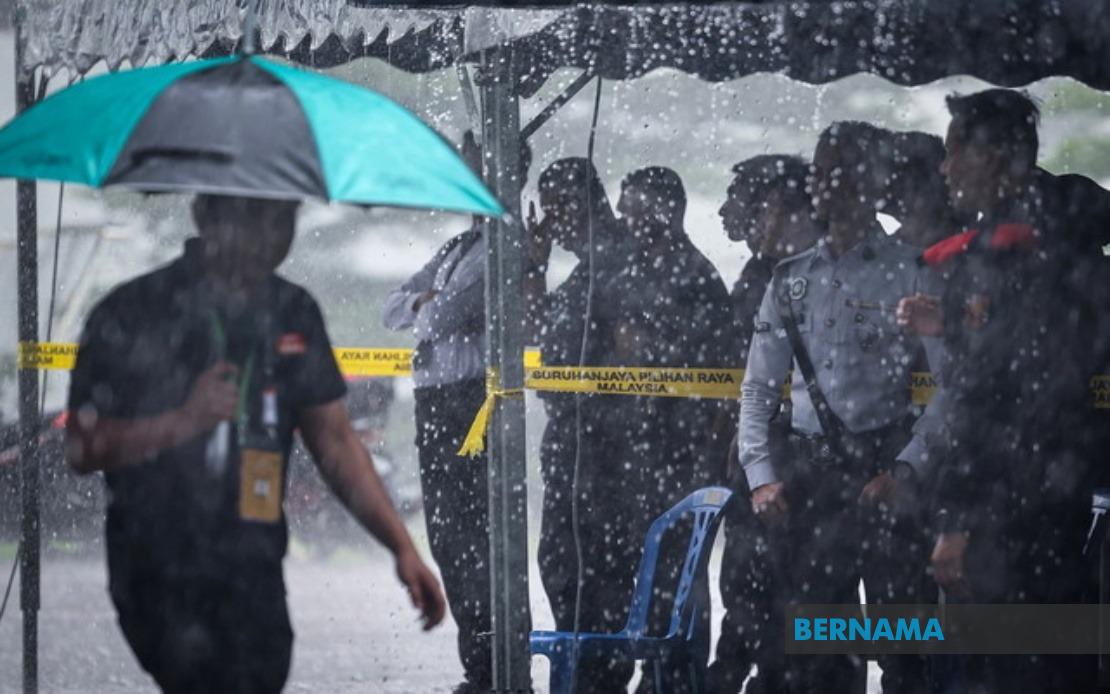
Heavy rainfall that struck Johor Bahru early this morning failed to impede the orderly progression of advance polling for the state's 16th electoral contest, with law enforcement personnel and their relatives demonstrating resilience in carrying out their civic duty at the State Police Contingent Headquarters in the city centre. The downpour, which began around 9.40 am, did not deter the steady flow of voting participants who navigated the wet conditions to reach the polling station, underscoring public commitment to participating in the democratic process despite inclement weather.
Members of the police force who arrived to vote were observed moving quickly through the rain to enter the polling centre, though the weather did not necessitate any operational adjustments to the voting procedures. The election officials and support staff maintained standard protocols without interruption, and the intake of voters proceeded at a consistent pace throughout the morning hours. Such organisation proved crucial given the volume of participants expected to cast their ballots at this particular location.
A total of 12,067 police personnel and their spouses exercised their right to vote in person at designated centres across the state on the day of advance polling. This figure reflects the significant participation rate among the law enforcement community, who are typically granted special voting arrangements prior to general election days due to the demands of maintaining public order during the electoral period. In addition to those voting in person, a further 643 members of the force have opted to vote by postal ballot, a mechanism designed to accommodate those whose duties may prevent them from attending physical polling stations.
The 16th Johor state election represents a comprehensive democratic exercise, with 172 candidates competing for 56 state assembly seats. The breadth of candidacy reflects the competitive nature of electoral contests in Malaysia's second-most populous state, where various political coalitions and independent aspirants have fielded representatives across diverse constituencies. This wide field of competition ensures voters will have meaningful choices in selecting representatives for their respective constituencies.
The main polling day, scheduled for Saturday, is anticipated to draw more than 2.7 million ordinary voters to the ballot. This substantial voter population makes Johor one of the most significant electoral contests in the nation, with the outcome carrying implications not only for the state government formation but also for broader political trends affecting national politics. The turnout figures from advance polling often provide early indicators of voter enthusiasm and engagement patterns.
Media personnel assigned to cover the advance voting process adapted to the weather conditions by establishing a temporary shelter, allowing them to observe and document the proceedings while remaining protected from the rain. Such logistics are essential components of election coverage, ensuring that journalists can maintain oversight of electoral integrity while simultaneously reporting developments to the public. The presence of media witnesses at polling stations forms part of the transparency mechanisms embedded in Malaysia's electoral system.
The early voting arrangement for police and military personnel has become standard practice in Malaysian elections, recognising the operational constraints placed on security forces during electoral periods. By allowing advance voting, the authorities ensure that these personnel can fulfil their democratic rights whilst maintaining the necessary deployment of resources to safeguard election day operations. This balancing of civic participation with operational necessity reflects considered electoral administration.
The conduct of advance polling in Johor proceeded with the efficiency that Malaysian electoral authorities have typically demonstrated in recent years. The ability of the State Police Contingent Headquarters to process thousands of voters within a compressed timeframe, whilst maintaining accurate record-keeping and procedural compliance, demonstrates the institutional capacity that has been developed through successive electoral cycles. Such competence in election administration strengthens public confidence in the integrity of results.
For Malaysian observers tracking developments in Johor politics, the advance polling data provides early signals regarding participation patterns and enthusiasm levels among key voter cohorts. The police contingent represents a demographically distinct group whose voting behaviour may offer insights into broader electoral sentiment. As the campaign period concludes, analysts will examine whether the turnout among early voters correlates with expectations for Saturday's main polling day.
The Johor election carries particular significance within Malaysia's political framework, given the state's economic importance and its substantial parliamentary representation at federal level. The state government's composition has ramifications for coalition dynamics at Putrajaya, making the electoral outcome consequential for national political developments. Johor voters will effectively be making choices that influence both state administration and the broader balance of political forces in the country.
As the election process enters its final stages, the smooth execution of advance voting operations signals an election administration prepared to manage the logistical complexities of a major electoral contest. With Saturday's main polling day approaching, electoral officials across the state will be mobilising resources and finalising arrangements to accommodate the anticipated participation of millions of voters. The foundation laid by orderly advance polling suggests the main election day should proceed with similar efficiency.

