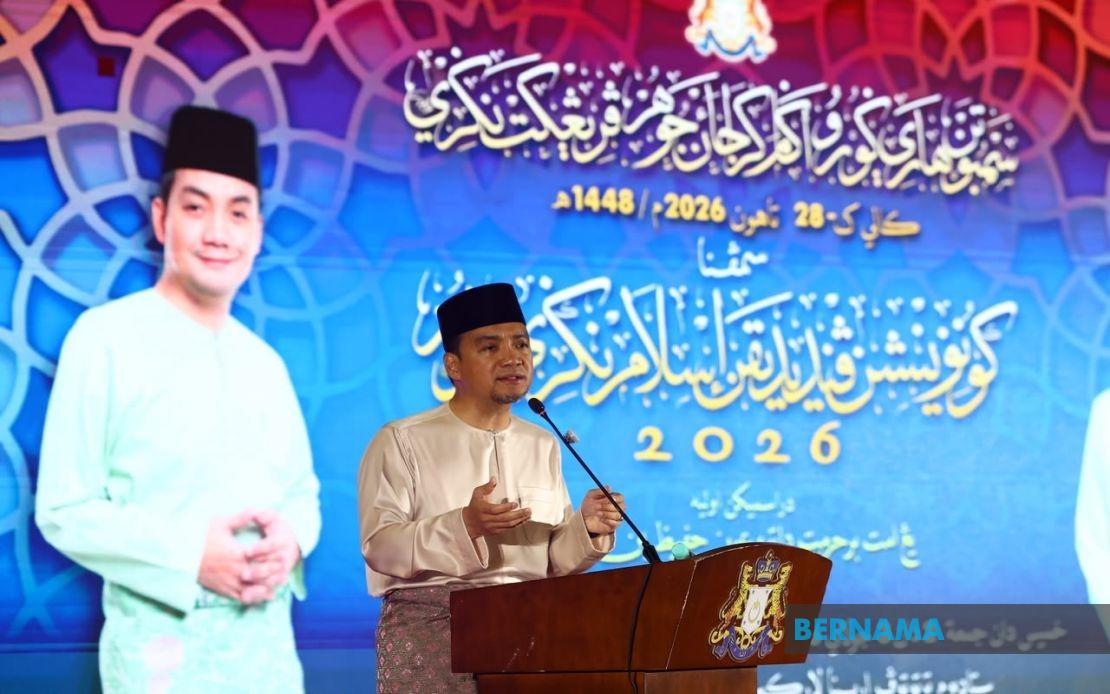
Johor is broadening its ambitious education transformation programme to encompass religious schools, marking a significant expansion of a flagship initiative designed to reimagine how the state approaches learning and institutional development. The government will establish the first Sekolah Agama Rintis Bangsa Johor (SARBJ) this year, extending the proven model of the Sekolah Rintis Bangsa Johor (SRBJ) programme into Islamic education institutions across the state. This move represents a coordinated effort to apply consistent reform principles across all segments of Johor's education landscape.
Menteri Besar Datuk Onn Hafiz Ghazi credited the initiative to Tunku Mahkota Ismail, the Regent of Johor, positioning it as part of a comprehensive vision for educational excellence. The programme has already established a foundation in mainstream schooling through four operational institutions: two primary schools and two secondary schools serving the Johor Bahru and Pasir Gudang areas. The addition of religious schools demonstrates the administration's commitment to ensuring that modernization efforts reach beyond government secular institutions into the traditionally separate religious education sector, historically overseen by different institutional structures and curricula frameworks.
The location selected for the inaugural SARBJ facility is Kota Iskandar, the administrative centre of Johor state. This strategic placement signals intent to create a flagship institution that will serve as both a demonstration project and a model for future expansion. By situating the school at the seat of state government, officials ensure high visibility and accessibility for oversight, professional development workshops, and the documentation of best practices that can subsequently be adopted by other religious schools throughout Johor.
The SRBJ initiative itself is built on several interconnected pillars designed to address perceived gaps in Malaysia's education system. Digital learning infrastructure forms one cornerstone, acknowledging that technological capability increasingly determines competitiveness in the modern economy. The programme simultaneously emphasizes multilingual proficiency, recognizing that Johor's economic position depends on a workforce capable of engaging across multiple language communities. Character development features prominently, addressing concerns about the balance between academic achievement and moral formation. Teacher empowerment and facility modernization complete the framework, grounded in the understanding that institutional transformation ultimately depends on educator capability and infrastructure quality.
The expansion into religious schools carries particular significance within Malaysia's education context. Religious schools occupy a distinct position in the national system, operating under separate administrative frameworks and often facing resource constraints compared to government secular schools. By extending the SRBJ model into this sector, Johor attempts to narrow quality gaps that have historically existed between parallel education streams. This approach implicitly acknowledges that religious education institutions should benefit from the same investment in digital infrastructure, teacher development, and facilities upgrades that mainstream schools receive.
State Islamic Religious Affairs Committee chairman Mohd Fared Mohd Khalid announced the government's formal approval for the SARBJ construction, indicating that this initiative has progressed beyond conceptual stages into concrete implementation planning. The project represents coordination between multiple state agencies, including education authorities and Islamic affairs departments, suggesting an integrated approach to education reform rather than siloed institutional improvement.
Looking forward, Johor government officials indicated intentions to extend the transformation model further into early childhood education by establishing a pilot kindergarten. This downward expansion into foundational schooling stages suggests long-term strategic thinking about building educational excellence from the earliest stages of formal learning. Early childhood development programmes increasingly feature in international education research as critical periods for establishing learning habits, language acquisition, and social development.
The SRBJ initiative in its current form encompasses Sekolah Menengah Kebangsaan Seri Kota Puteri 2, Sekolah Kebangsaan Seri Kota Puteri 4 in Pasir Gudang, and SMK Tasek Utara and SK Tasek Utara in Johor Bahru. These schools serve as operational laboratories for testing and refining the reform model before broader replication. Their locations within major population centres provide sufficient student volume to generate meaningful data on programme effectiveness while remaining manageable for intensive oversight and support.
For Malaysian education observers, Johor's approach offers a potentially significant case study in how states can leverage their constitutional authority over education to implement innovation at scale. While federal policy provides the overarching framework for Malaysia's education system, states retain considerable autonomy over implementation, infrastructure development, and institutional management. Johor's concentrated investment in branded reform initiatives demonstrates how subnational governments can create distinctive education ecosystems that differentiate their competitiveness in attracting investment and talent.
The emphasis on religious school inclusion carries implications beyond Johor itself. Other Malaysian states have struggled to integrate religious and secular education systems into coherent institutional networks with comparable resources and quality standards. Johor's willingness to apply comprehensive reform principles across this traditional divide could influence thinking about education restructuring nationally, particularly as states increasingly recognize that educational outcomes depend on system-wide coherence rather than isolated improvements in particular school types.
The programme's timing reflects broader regional trends in education policy, where states throughout Southeast Asia are adopting digital learning, multilingual competency, and character development as central pillars of education modernization. By framing these initiatives through a distinctive "Bangsa Johor" branding, the state creates local ownership and political identity around educational improvement, potentially building constituencies supportive of sustained investment across electoral cycles.

