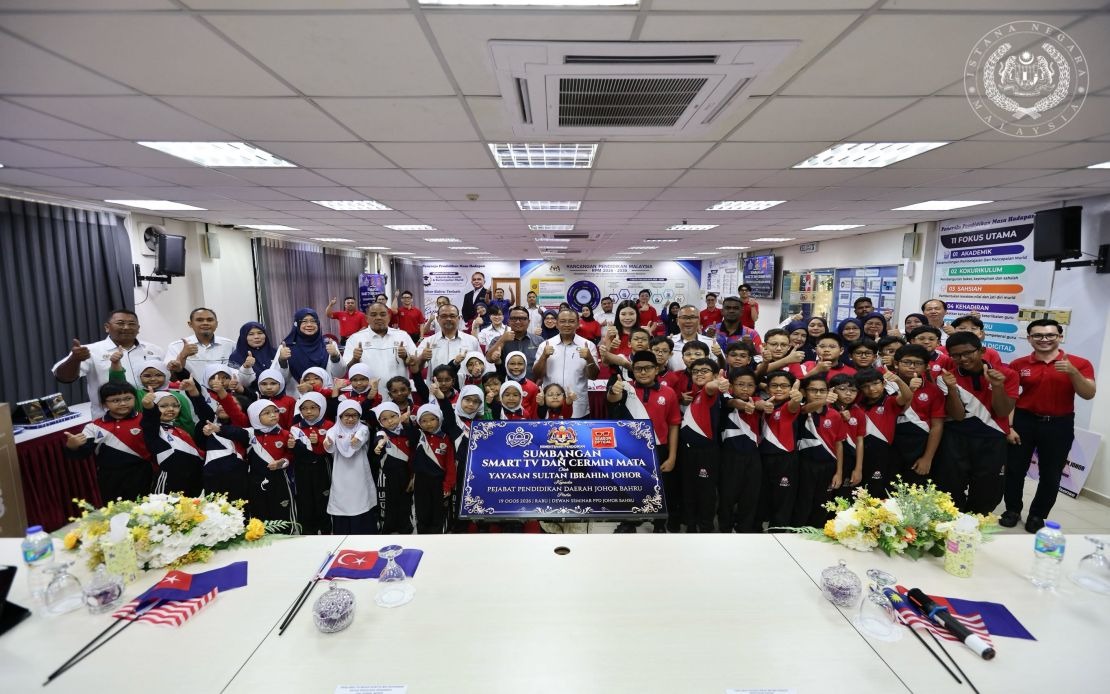
The Yayasan Sultan Ibrahim Johor (YSIJ) has reinforced its commitment to improving educational infrastructure and student welfare by distributing 10 smart televisions and 2,000 pairs of spectacles across selected institutions in the Johor Bahru District, marking another significant step in the foundation's ongoing development initiatives throughout the state. The donation, carried out in partnership with Season Optical and endorsed by Sultan Ibrahim Sultan Iskandar, King of Malaysia, underscores the philanthropic focus on bridging both technological and healthcare gaps within the education system.
The initiative addresses a fundamental challenge in contemporary Malaysian classrooms: the integration of digital learning tools remains inconsistent across institutions, particularly in areas serving economically vulnerable communities. By providing 75-inch smart televisions to ten schools, YSIJ aims to enhance classroom engagement and modernise teaching methodologies, recognising that interactive visual media has become integral to effective pedagogy. The equipment donation represents more than symbolic support; it enables educators to diversify instructional approaches and expose students to technology-enhanced learning experiences that might otherwise remain inaccessible.
Equally significant is the spectacles distribution programme targeting B40 students—those from the bottom 40 percent income bracket—across 20 schools throughout the district. Vision impairment frequently goes undetected and uncorrected among lower-income students, creating invisible barriers to academic performance and classroom participation. By providing 2,000 pairs of quality spectacles, YSIJ directly removes a substantial impediment to educational equity and learning outcomes. The decision to distribute glasses specifically to economically disadvantaged pupils reflects an understanding that access to vision correction remains a luxury many families cannot afford, despite its profound impact on a child's educational trajectory.
The implementation of Columba Vision Screener technology represents an innovative layer to the programme, introducing advanced diagnostic capability into school settings. This eye-scanning device, donated by His Majesty Sultan Ibrahim, streamlines the identification of vision problems by conducting rapid assessments—complete screening within ten seconds—that would traditionally require lengthier optometric examination. Such efficiency gains prove particularly valuable in school environments where time constraints and resource limitations often prevent comprehensive health screening. The technology's speed and accuracy facilitate earlier detection of refractive errors and other visual conditions, enabling timely intervention before academic performance deteriorates.
The quality specifications of the donated spectacles warrant attention; the frames and lenses supplied through Season Optical meet durability standards and design considerations suitable for student use. This attention to practical factors reflects an understanding that mass-produced or low-quality eyewear often fails in school environments, where durability and student acceptance prove essential for consistent wear. Durable, well-designed frames increase the likelihood that students will actually use their spectacles, thereby maximising the real-world educational benefit of the donation.
The partnership structure involving YSIJ, Season Optical, and the Johor Education Department reveals the evolving approach to educational philanthropy in Malaysia, where strategic collaboration between foundations, private sector entities, and government agencies generates more comprehensive solutions than isolated initiatives. Season Optical's involvement extends beyond mere product provision; the company's participation in programme design and implementation brings commercial optometry expertise into dialogue with educational needs, creating a model that might be replicated across other districts facing similar challenges.
For Johor Bahru specifically, the donation arrives as education authorities grapple with post-pandemic recovery in learning outcomes and the persistent challenge of educational inequality within urban districts. While Johor Bahru hosts substantial middle-class populations, significant pockets of low-income communities remain underserved by educational resources, making targeted interventions particularly impactful. The concentration of support within the Johor Bahru PPD jurisdiction reflects strategic prioritisation, though the model potentially offers lessons for comparable urban areas throughout Malaysia.
The ceremony hosting the handover—conducted by YSIJ senior manager Shah Reza Md Kanafe and witnessed by Johor Education Department officials—formalised the transfer within the education bureaucracy. Participation by Johor Bahru PPD chief officer Adnan Samsudin and the Student Development Sector principal assistant director ensured coordination with existing educational infrastructure, reducing implementation friction and integrating the donations within established school support systems rather than positioning them as external initiatives.
Beyond immediate benefits, the programme establishes a precedent for integrating health assessment into educational support frameworks. The deployment of vision screening technology within schools acknowledges an often-overlooked reality: pedagogical improvements cannot fully succeed when students face unaddressed health impediments. By normalising vision screening within school environments through accessible, rapid diagnostic technology, YSIJ contributes to broader recognition that educational equity requires attention to students' physical wellbeing alongside academic resources.
The 2,000 spectacles distributed represent tangible intervention in a widespread but frequently invisible problem affecting Malaysian education. Research from optometry and education sectors consistently demonstrates that uncorrected refractive errors substantially depress academic performance, particularly among disadvantaged populations lacking familial resources for vision care. Through this donation, YSIJ directly improves the material conditions within which thousands of students learn, potentially influencing educational outcomes across multiple subjects and skill areas.
For Malaysian policymakers observing philanthropic initiatives, the YSIJ programme offers insights into effective resource allocation for educational equity. Technology provision alone—the smart televisions—requires complementary investments in teacher training and curricular integration to generate lasting impact. Similarly, spectacle distribution achieves maximum effectiveness when supported by systemic vision screening and follow-up care pathways. The dual-component approach adopted here—combining diagnostic infrastructure with corrective provision—more comprehensively addresses underlying educational barriers than either intervention independently.
Looking forward, the success of this initiative may encourage expanded replication across other Malaysian districts, particularly those confronting similar concentrations of B40 families and educational infrastructure gaps. The involvement of the royal foundation and the King's personal endorsement additionally signal sustained commitment to educational development as a priority within Johor's governance framework, potentially influencing resource allocation and policy attention across subsequent budget cycles and development planning.
The donations ultimately reflect recognition that educational advancement in Malaysia cannot proceed solely through curriculum revision or teacher capability building. Addressing the material foundations—functional learning environments equipped with modern tools, and students whose basic health needs enable them to benefit from instruction—remains essential to meaningful improvement in educational outcomes and the reduction of inequality within the system.

