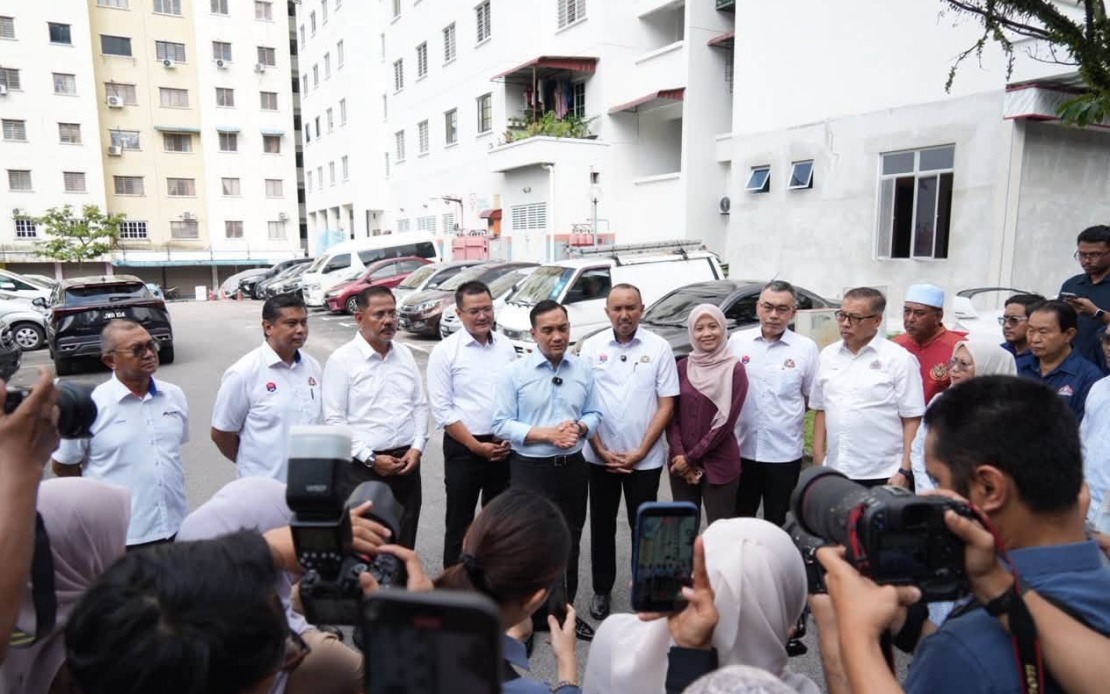
Johor's state government has unveiled an ambitious RM50 million initiative to repaint low-cost housing, privately owned low-medium-cost flats, and public residential blocks throughout the state, positioning the initiative as a tangible demonstration of its commitment to enhancing living standards for lower-income households. The programme represents one of the most significant housing maintenance efforts launched in the state, targeting residential environments that house some of Johor's most vulnerable populations.
The scope of this undertaking is substantial. The repainting project encompasses 170 housing blocks containing 11,693 individual residential units distributed across 26 strategic locations throughout Johor. This geographical spread ensures that communities across both urban centres and surrounding districts will benefit from the initiative. The scale indicates a coordinated, state-wide approach rather than piecemeal interventions at isolated locations, suggesting the government views housing maintenance as a systematic priority rather than an ad-hoc response to complaints.
According to Datuk Mohd Jafni Md Shukor, the Housing and Local Government Committee chairman, the programme is projected to directly improve conditions for approximately 46,772 residents. This figure underscores the potential multiplier effect of such initiatives within densely populated residential complexes typical of Malaysian low-cost housing schemes, where individual units often accommodate extended families. The benefits extend beyond the immediate residents, as improved housing conditions typically create positive spillover effects throughout surrounding neighbourhoods and commercial areas.
Mohd Jafni articulated a broader vision for the programme during an inspection at Desa Muafakat Apartments, where he was accompanied by Johor Menteri Besar Datuk Onn Hafiz Ghazi. He emphasised that repainting work transcends mere cosmetic intervention, arguing instead that fresh, well-maintained residential environments foster psychological comfort and reinforce residents' confidence in government responsiveness. This framing reflects an emerging understanding among Malaysian policymakers that housing quality directly impacts social cohesion, mental wellbeing, and community stability—considerations often overlooked in purely utilitarian assessments of public housing programmes.
The execution framework involves multiple state agencies working in concert, including the Johor State Housing Development Corporation (PKPJ) and the Local Government Division of the Johor State Secretary's Office. Municipal authorities including the Johor Bahru City Council (MBJB), Iskandar Puteri City Council (MBIP), Pasir Gudang City Council (MBPG), and Kulai Municipal Council (MPKu) will provide support and coordination. This multi-institutional approach reflects the complexity of managing housing maintenance across municipalities with varying administrative capacities and budgetary resources.
The inspection visit revealed that housing maintenance concerns extend beyond aesthetic deterioration. Officials identified slope subsidence near apartment parking areas and damage to internal roads within the housing complex, indicating that the broader maintenance programme must address structural and infrastructural issues alongside cosmetic improvements. These discoveries suggest that comprehensive housing assessments may precede and inform future maintenance allocations, ensuring that visible work addresses underlying problems rather than masking them temporarily.
Quality assurance has emerged as a central concern for implementing agencies. Mohd Jafni explicitly warned contractors and government agencies against producing projects that appear satisfactory upon completion but subsequently deteriorate rapidly or introduce new complications for residents. This warning reflects accumulated frustration with public works projects that fail to deliver lasting value, a persistent challenge in Malaysian infrastructure development. He mandated strict adherence to stipulated timelines, technical specifications, and quality benchmarks throughout project execution.
The visit also encompassed inspection of a Tabika KEMAS Bangsa Johor construction site at Desa Muafakat Apartments, suggesting that housing estate improvements form part of a broader community development strategy incorporating educational and childcare infrastructure. This integrated approach indicates recognition that housing quality improvements achieve maximum social impact when coordinated with complementary service provision.
For Malaysian readers, this initiative carries implications extending beyond Johor's borders. As one of Malaysia's most densely populated states with significant concentrations of lower-income households, Johor's housing maintenance strategies often establish benchmarks adopted by other state governments. The RM50 million allocation, while substantial, also serves as a reference point for assessing whether other states are adequately resourcing similar programmes. For residents in comparable housing schemes nationwide, Johor's initiative raises expectations that state governments should prioritise systematic maintenance funding rather than reactive repairs.
The programme also reflects broader Southeast Asian trends toward acknowledging that housing quality correlates with social stability and economic productivity. As regional economies compete for skilled workers and household consumption, housing conditions increasingly influence workforce retention and residential mobility decisions. Johor's investment therefore represents not merely compassionate governance but pragmatic recognition that improved residential environments support economic development objectives.
Implementation timelines remain undefined in current announcements, though the coordination mechanisms established suggest phased rollout across multiple quarters. The success of this initiative will likely depend on contractor accountability, sustained political commitment through budget cycles, and effective coordination among four municipal authorities with potentially divergent priorities. These implementation challenges will determine whether the RM50 million investment delivers the promised environmental and social transformation or becomes another example of ambitious policy that falters during execution.

