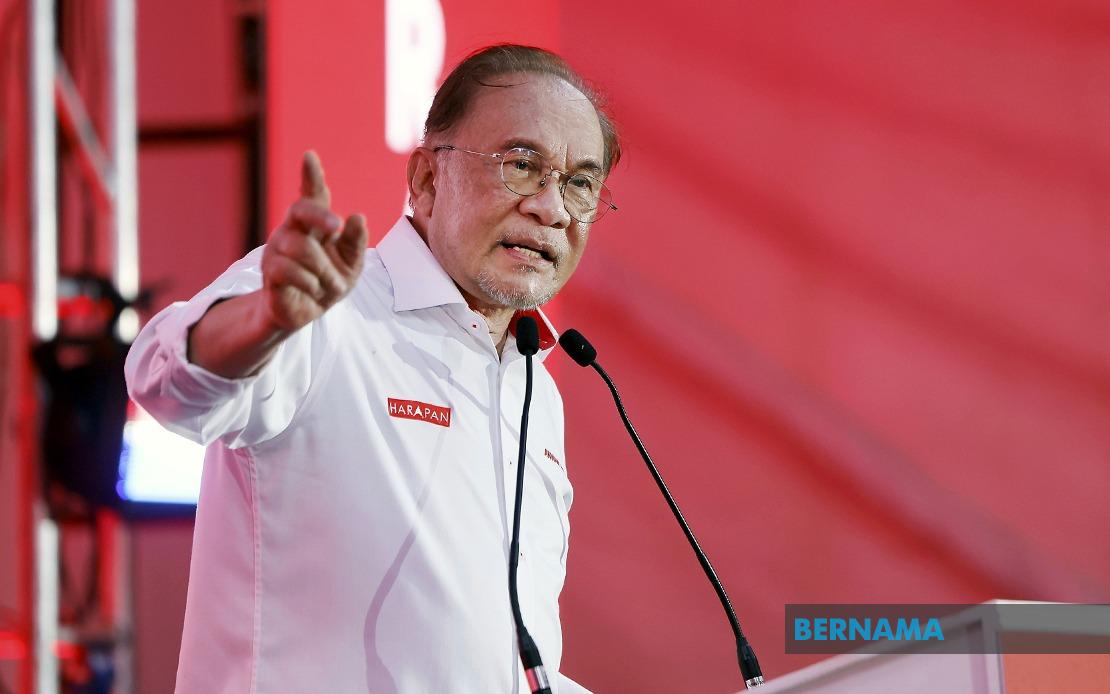
Prime Minister Datuk Seri Anwar Ibrahim has made a direct appeal to Johor voters to support elected representatives who combine thoughtful governance with bold decision-making, arguing that the state's future prosperity depends on choosing leaders truly attuned to community needs. Speaking during Pakatan Harapan's opening day of campaigning in Johor Bahru on July 4, Anwar framed the upcoming state election as a choice between conventional politics and transformative leadership. His message underscores growing expectations among Malaysian voters for representatives who can move beyond rhetoric and deliver tangible results, a sentiment that reflects broader pressures facing state and federal governments across the region.
Anwar's emphasis on "wisdom in assessing priorities" signals PH's attempt to position itself as a pragmatic alternative in Johor's political landscape. The Prime Minister's language suggests an implicit critique of incumbent administrations, though he stopped short of directly naming competitors. Instead, he focused on what he characterised as the core attributes voters should demand: representatives who listen to diverse constituencies—Malays, Chinese, and Indians alike—and collaborate across ethnic lines to advance shared development goals. This inclusive framing reflects PH's broader coalition strategy, which relies on multi-ethnic cooperation to govern effectively in increasingly diverse states.
The scope of PH's campaign effort in Johor underscores the coalition's determination to make significant gains in a state where it has historically faced strong competition. Anwar personally led seven campaign events across different areas on the opening day, demonstrating the intensity of the party machinery's commitment. These engagements, ranging from town halls and community forums to direct voter interactions, follow a proven template for building grassroots momentum. The coalition's strategy appears designed to establish personal connections between candidates and voters before the formal campaign period intensifies, allowing representatives to build trust and demonstrate their understanding of local issues.
Pakatan Harapan's candidate slate reflects internal power-sharing arrangements among its three main component parties. The coalition has fielded 20 candidates from PKR, 19 from Amanah, and 17 from DAP across all 56 state constituencies. This distribution, while mathematically balanced, carries political significance in how different communities perceive the coalition's commitment to representation. PKR's slight numerical advantage reflects its position as the largest party within PH, while DAP's smaller contingent nonetheless ensures the coalition maintains Chinese representation in the state legislature, a critical element of PH's coalition viability.
The broader election context in Johor reveals a highly competitive political environment. With 172 candidates contesting for 56 seats, voters face genuine choices, and the average of roughly three candidates per constituency suggests fragmented competition. This scenario benefits parties with strong ground organisation and voter identification systems, areas where established coalitions typically hold advantages. The relatively high number of candidates also indicates that multiple political players—beyond just PH and its expected main rivals—view Johor as a battleground worth contesting, reflecting the state's importance as both an economic hub and a bellwether for national political trends.
Anwar's framing of the election around leadership qualities rather than specific policies reveals a strategic choice to emphasise character and competence over detailed manifestos. This approach can be particularly effective when incumbent administrations face criticism for slow delivery or perceived disconnection from grassroots concerns. By calling for leaders who truly "understand the pulse of the people," Anwar implicitly suggests that existing representatives may lack this crucial quality. For Malaysian voters accustomed to election campaigns centred on infrastructure projects, fiscal transfers, and targeted subsidies, this emphasis on leadership qualities represents a relatively novel pitch that appeals to longer-term governance concerns.
The electoral mechanics of the Johor polls carry procedural implications that can affect turnout and candidate viability. With early voting scheduled for July 7 and polling day on July 11, the compressed timeline may advantage parties with superior voter mobilisation systems. Early voting, increasingly important in Malaysian elections, tends to favour working professionals and mobile voters, demographics that can vary significantly across constituencies. Parties that can efficiently guide their supporters to early voting stations gain practical advantages in managing campaign resources during the final stretch before polling day.
From a regional perspective, the Johor election carries significance beyond state boundaries. Johor's political complexion influences calculations about PH's viability at the federal level and its capacity to govern diverse states. Successful performance in Johor would strengthen PH's narrative about being a coalition capable of managing multi-ethnic societies and delivering broad-based development. Conversely, weakness in Johor would provide ammunition to critics who question whether PH can sustain its federal coalition in the face of state-level electoral pressures. This interconnection between state and federal politics means that the July 11 election will be closely watched by political analysts assessing PH's resilience.
Anwar's personal campaign involvement in Johor reflects the Prime Minister's strategic calculation that his direct engagement can influence outcomes. As the coalition's chairman and national leader, his presence at campaign events signals that PH views Johor as sufficiently important to warrant his time and political capital. This investment also serves to unify the coalition's diverse components around common messaging and candidate selection, preventing the kind of internal friction that sometimes undermines coalition cohesion during elections. His presence reassures PH's component parties and candidates that the central leadership remains committed to the campaign's success.
The emphasis on unity and collaborative governance in Anwar's messaging speaks to a deeper concern within Malaysian politics about community relations and inclusive development. His repeated references to Malays, Chinese, and Indians working together reflect acknowledgment that any government claiming legitimacy must demonstrate genuine commitment to multiethnic representation and benefit-sharing. This theme resonates particularly in Johor, which combines significant Malay-Muslim populations with substantial Chinese and Indian communities, requiring any successful administration to manage diverse interests and maintain social cohesion while pursuing development objectives.
Looking ahead to July 11, the Johor election will test whether PH's messaging about leadership quality and inclusive governance resonates with voters. The coalition's decision to contest all 56 seats demonstrates confidence in its organisational capacity and polling data, but also reflects an understanding that appearing weak or unprepared in any constituency can have cascading effects on voter perception. The intensity of Anwar's opening campaign push suggests PH's leadership recognises that early momentum and candidate visibility can meaningfully influence final vote tallies, particularly in constituencies where political alignments remain fluid or where community concerns about development, services, and representation remain unresolved.

