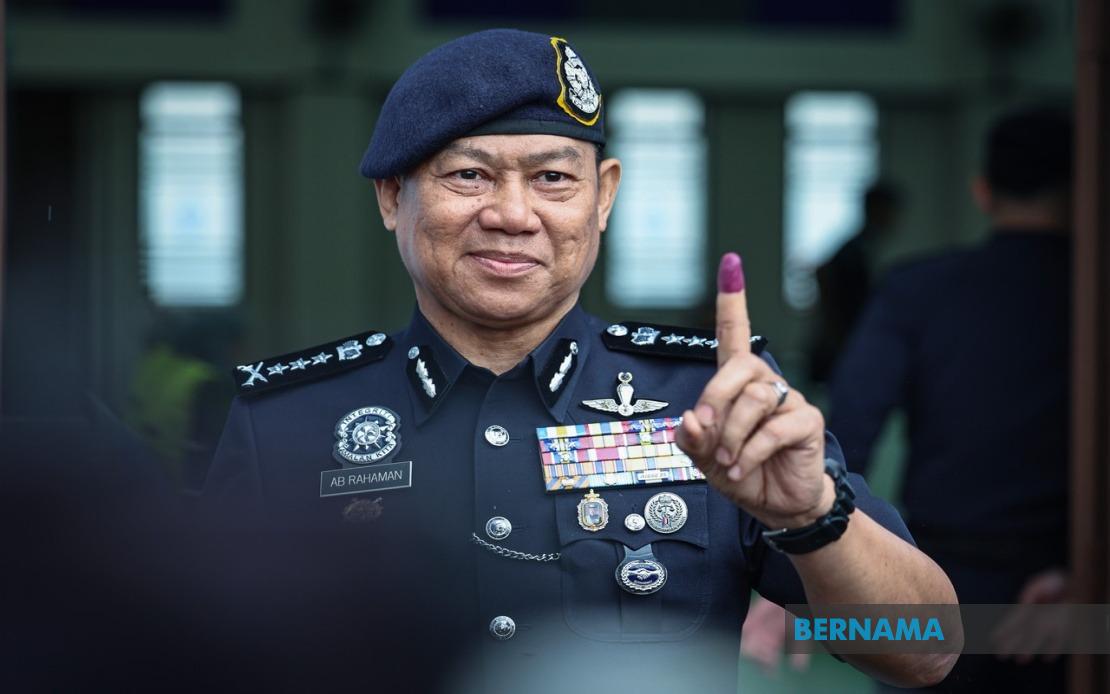
The advance polling phase for Johor's 16th state election unfolded smoothly on July 7, with law enforcement personnel demonstrating substantial participation in the democratic process. By mid-morning, approximately 4,257 police officers had already voted across the state, translating to a 36.3 per cent participation rate among those eligible to cast ballots early. This contingent of uniformed personnel and members of the Malaysian Armed Forces represented a significant portion of the 20,607 registered early voters who had access to 64 polling centres that opened simultaneously at 8 am.
Johor's top police official, Datuk Ab Rahaman Arsad, underscored the orderly nature of the proceedings when speaking to media representatives after completing his own vote at the Johor Police Contingent Headquarters in the state capital. His assessment focused on the seamless coordination across all 53 early voting centres statewide, highlighting the absence of disruptions that might otherwise compromise the electoral process. The security chief's confidence in the administration's handling of the vote reflected broader confidence in the institutional machinery managing what represents a critical democratic moment for the southern state.
The early voting arrangement, which accommodates uniformed personnel whose duties may conflict with regular polling day schedules, reflects electoral management practices designed to balance operational necessities with democratic participation. The staggered closure schedule for polling centres—ranging from noon through 6 pm depending on location and voter registration numbers—demonstrated administrative flexibility to accommodate varying circumstances across Johor's diverse geography. This logistical approach has become standard practice in Malaysian electoral administration, recognising that uniformed services require special consideration to ensure their voice in the democratic process.
Security concerns during the campaign phase appear modest in scope, with police documentation focusing primarily on property damage rather than more serious electoral offences. Campaign-related vandalism targeting political signage, including party flags and billboards, constituted the bulk of reported incidents during the mobilisation period. This pattern suggests that while political tensions run through Johor society, they have not escalated into confrontational or violent conduct that might undermine the election's legitimacy or the public's confidence in the process.
More significantly, investigations initiated in response to claims by former Johor State Assembly Speaker Datuk Dr Mohd Puad Zarkashi regarding alleged palace interference in the assembly's dissolution remained ongoing at the time of early voting. The police had recorded 153 reports nationwide concerning these allegations, indicating the gravity with which electoral authorities and the public regard questions about procedural propriety at the highest levels. Such investigations, though routine in electoral administration, carry particular weight in Johor given the constitutional role of the state monarchy in governance frameworks.
The 16th Johor state election represents a significant electoral exercise involving 172 candidates vying for 56 seats across the state parliament. The contest engages more than 2.7 million registered voters, making it a substantial democratic undertaking with potential implications extending beyond Johor's borders into Malaysian federal politics. The scale of participation in early voting among police and armed forces personnel offers an early indicator of broader engagement, though final turnout figures would only emerge after all polling concluded on Saturday.
For Malaysian observers and Southeast Asian analysts monitoring electoral health in the region, early voting performance serves as a barometer for institutional capacity and public willingness to participate in democratic processes. High participation rates among eligible early voters suggest confidence in electoral mechanics and genuine interest in determining state leadership. The absence of reported irregularities at polling centres demonstrates that Malaysian electoral commissions, despite occasional criticism, continue to execute core democratic functions competently.
The implications for regional electoral observers merit consideration. Johor, as Malaysia's most populous state and an economic powerhouse, sets precedents in how state-level elections operate. The smooth administration of early voting and the orderly participation by security forces signals institutional maturity in managing electoral competition without compromise to process integrity. This capacity becomes increasingly important as Malaysia navigates broader questions about democratic resilience and institutional independence.
Looking toward Saturday's main polling day, attention will focus on whether the strong early participation rate among police and armed forces translates into competitive dynamics affecting seat distribution and coalition composition in the state assembly. The pattern of incidents and investigations documented during the campaign period suggests that while electoral competition generates political heat, it remains channelled through established institutional frameworks rather than erupting into extra-systemic challenge. Such institutional robustness, particularly in managing transitions of power and adjudicating electoral disputes, constitutes a foundation upon which effective governance ultimately depends.

