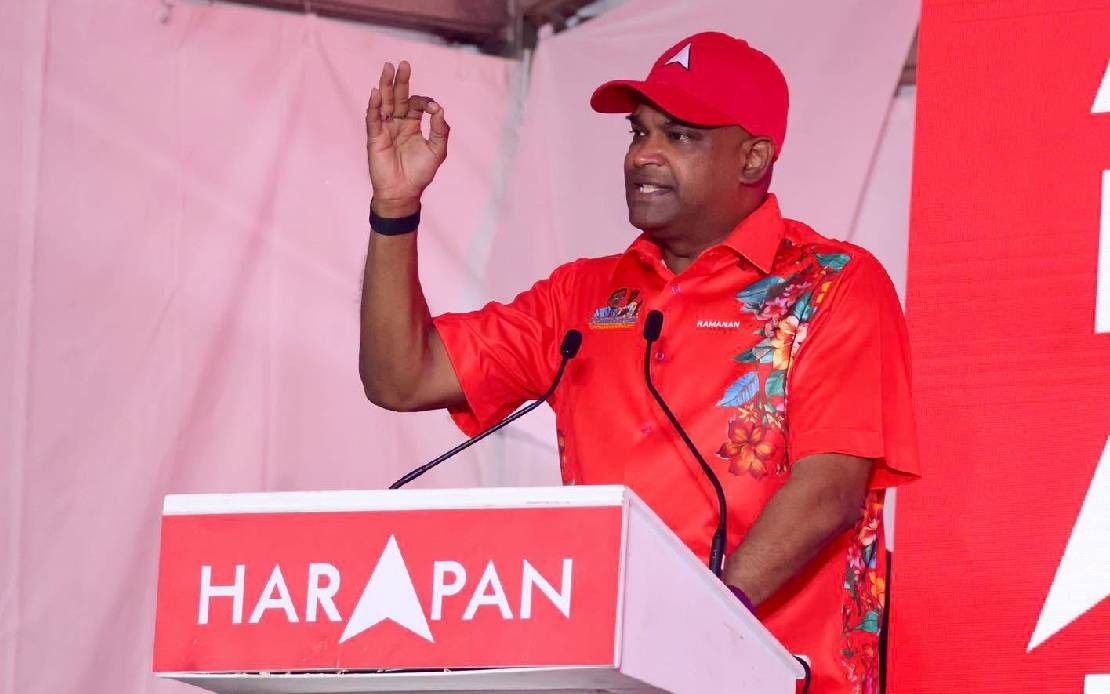
Johor continues to occupy a prominent place in the Federal Government's development agenda, with substantial investments and large-scale infrastructure initiatives being directed toward improving living standards across the state. This assurance came from PKR Vice-President Datuk Seri R Ramanan during a campaign event in Simpang Renggam, where he underscored the administration's sustained focus on ensuring that residents benefit equitably from national economic growth and development programmes.
Ramanan's remarks reflect the broader political messaging emerging from Pakatan Harapan as the coalition seeks to consolidate support ahead of the Johor state election scheduled for July 11. The roadshow programme, titled Johor Ke Depan, Undi Harapan, represents part of a wider campaign strategy aimed at reminding voters of the federal government's track record and future plans for the state. By framing development as a shared responsibility between federal and state administrations, Ramanan attempted to build a narrative around the benefits of political alignment between different levels of government.
The emphasis on assistance programmes and infrastructure projects speaks to a deliberate effort to translate abstract notions of federal priority into tangible outcomes that residents can recognize in their daily lives. Roads, schools, healthcare facilities, and social welfare initiatives form the backbone of such development discourse, particularly in state election campaigns where voters seek concrete evidence of government effectiveness. Ramanan's statement suggests that Pakatan Harapan intends to position itself as the steward of Johor's continued development, contingent on maintaining electoral support.
For Malaysian readers, the timing and context of this announcement warrant careful consideration. Johor has historically been a significant economic and political battleground in Malaysia, given its size, population, and strategic location near Singapore. The state's development trajectory therefore carries implications not only for its residents but for broader regional stability and competitiveness. Any government claiming Johor as a priority must demonstrate not merely rhetorical commitment but delivery on measurable indicators such as employment creation, infrastructure quality, and service provision.
The campaign event brought together several prominent Pakatan Harapan figures, including Amanah Secretary-General Faiz Fadzil and three state-level candidates contesting seats in Machap, Benut, and Layang-Layang. The presence of multiple coalition partners and candidates underscores the collaborative approach that Pakatan Harapan has adopted in contested states, where internal coalition dynamics must be carefully managed to present a unified front to voters. Such arrangements often reflect weeks or months of negotiation over candidate selection and resource allocation.
Ramanan's explicit appeal for electoral alignment between state and federal administrations highlights a recurring debate in Malaysian politics regarding the efficiency gains that flow from unified governance. The argument posits that when a single coalition controls both levels of government, policy implementation accelerates because coordination challenges diminish and development projects can proceed without the friction that sometimes emerges from divided administrations. However, voters may reasonably evaluate this claim against their lived experience and against alternative narratives offered by competing parties.
The election itself will determine the composition of the Johor State Assembly, with 172 candidates vying for seats across the state. Early voting is scheduled for July 7, allowing certain categories of eligible voters to cast their ballots before the main election day. This staggered voting arrangement is standard practice in Malaysian elections, designed to accommodate shift workers, security personnel, and others with legitimate reasons to vote outside the scheduled election date. The logistics of managing such elections underscore the complexity of conducting democratic exercises in a large, diverse state.
From a regional perspective, state elections in Malaysia serve as important indicators of political sentiment and shifts in voter preferences. Johor's election will provide insights into whether Pakatan Harapan has maintained the momentum from the 2022 federal elections or whether other factors—including local economic conditions, grievances, and the performance of local administrations—have altered the political landscape. Political analysts across Southeast Asia often monitor Malaysian elections closely, as they reflect patterns of governance, coalition-building, and voter behavior that resonate across the region.
The broader context of federal-state relations in Malaysia suggests that development priorities are often negotiated and contested terrains. States with different political leadership than the federal government may receive differential treatment in resource allocation, a dynamic that has been documented across multiple election cycles. Conversely, states governed by coalitions aligned with the federal government may benefit from preferential access to funds, approvals for projects, and administrative support. Ramanan's emphasis on alignment thus carries implications that extend beyond rhetorical preference into practical governance outcomes.
The assertion that assistance programmes and development projects have already been implemented and continue to roll out invites scrutiny regarding actual outcomes and beneficiary satisfaction. Campaign claims must ultimately be evaluated against measurable data: employment figures, poverty reduction, wage growth, infrastructure completion rates, and public service quality metrics. Voters in Johor, like those elsewhere, respond to evidence of tangible improvements in their economic circumstances and access to quality public services.
Looking ahead, the election results in Johor will shape not only the state's governance for the coming term but also carry implications for the broader political balance in Malaysia. A decisive victory for Pakatan Harapan would strengthen the coalition's national position, while a setback might signal weakness or shifting voter preferences that could influence future federal-level politics. The state's economic importance means that investor confidence and business sentiment may also be affected by the election outcome, making Johor's political trajectory a matter of more than parochial concern.
For Malaysian readers across the country, the Johor election represents an opportunity to observe how competing political forces articulate their visions for state development and how voters respond to those competing claims. It also demonstrates the centrality of state elections in Malaysia's federal democracy, where subnational contests often serve as barometers of national sentiment and testing grounds for political messaging and strategy.

