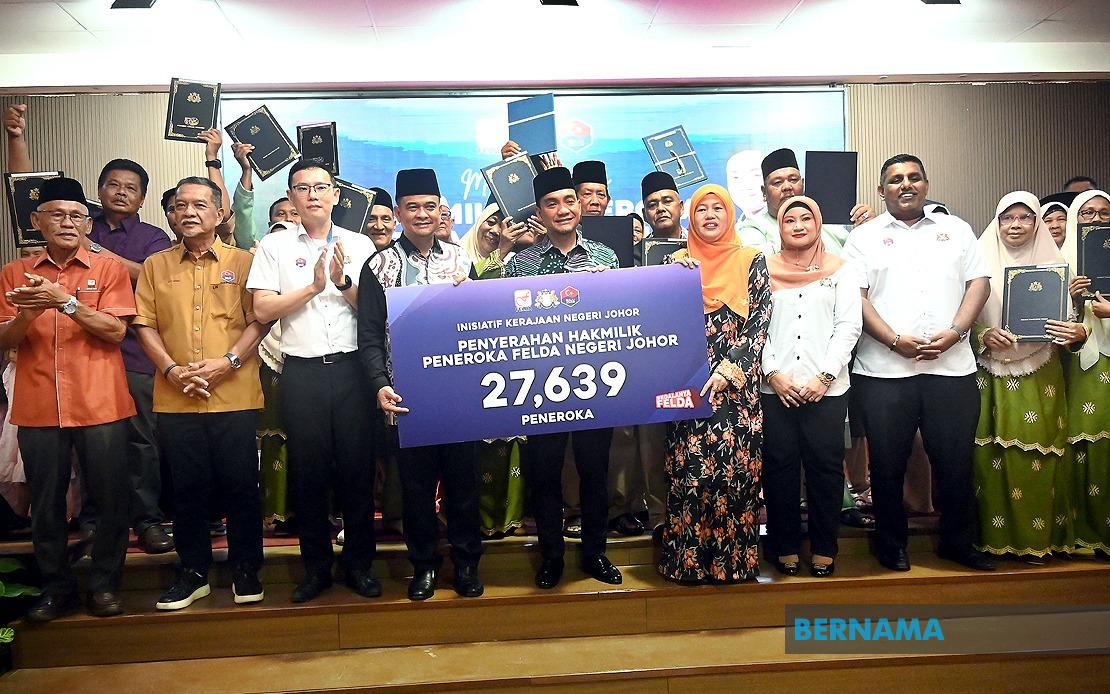
The Johor state government has substantially cleared a backlog of property ownership disputes that have plagued Federal Land Development Authority (FELDA) communities for generations, with Menteri Besar Datuk Onn Hafiz Ghazi confirming that 27,639 out of 27,642 applications have now been resolved. The achievement was marked during a formal ceremony in Kluang where 210 settlers from three districts received official documentation confirming their ownership rights, signalling a turning point in efforts to formalise land rights across FELDA schemes throughout the state.
The resolution of land title applications represents far more than a bureaucratic completion; it addresses a foundational issue that has constrained economic mobility and social stability within FELDA communities. Many settlers have occupied and worked their allocated plots for decades without formal legal documentation, a vulnerability that has prevented them from accessing credit, transferring inheritance reliably, or pursuing development initiatives with confidence. By regularising these relationships between the state and its agricultural pioneers, Johor has removed a significant barrier that has historically limited the capacity of rural families to build economic security.
Datuk Onn Hafiz characterised the initiative as integral to the state government's broader rural development strategy, framing it as evidence of sustained commitment to addressing historical grievances within FELDA settlements. His remarks emphasised that outstanding issues within these communities would continue to receive state-level attention, signalling a shift towards treating settler welfare as a core governance priority rather than a marginal concern. The completion rate of 99.99 per cent effectively resolves the matter from a policy perspective, though the single remaining application indicates that comprehensive closure remains just beyond reach.
The distribution of titles across Kluang, Kota Tinggi and Mersing reflects the geographic breadth of FELDA's presence in Johor, with these three districts encompassing significant agricultural communities that have contributed substantially to the state's rural economy. The ceremonial presentation method—gathering settlers to formally receive documentation—serves both practical and symbolic purposes, affirming state recognition of their rights while creating a public record of government action on this long-standing issue.
FELDA itself, established in the 1950s as a pioneering institution for rural development and land colonisation, has traditionally focused on developing smallholder agriculture and improving living standards in remote areas. However, the delayed formalisation of land titles within these schemes created persistent uncertainty for families whose livelihoods depended entirely on their relationship with these plots. The backlog likely accumulated over decades due to administrative capacity constraints, bureaucratic complexity, and periodic shifts in government priorities, meaning that multiple generations of settlers operated without the security that formal documentation provides.
For Malaysian policymakers and regional observers, Johor's resolution of this issue offers important lessons about the challenges of retrofitting administrative systems to address historical injustices. The near-total clearance suggests that with sustained political will and administrative focus, even deeply entrenched procedural problems can be resolved within a reasonable timeframe. This success may provide momentum for addressing similar land title disputes in other Malaysian states with significant FELDA populations, including Pahang, Perak and Sabah.
The practical implications for the affected settlers are substantial. Formal land titles enable access to agricultural credit from both conventional and Islamic financing institutions, facilitating investment in improved farming techniques, equipment and infrastructure. Documentation also clarifies inheritance pathways, allowing families to plan succession within their agricultural enterprises and protect assets across generations. Additionally, formally documented property rights enhance the bargaining position of smallholders in negotiations with agricultural buyers, processors and cooperative societies.
Datuk Zahari Sarip, the chairman of Johor's Agriculture, Agro-based Industry and Rural Development Committee, was present at the ceremony, indicating institutional alignment across the state's rural governance structures. This cross-portfolio coordination suggests that the land title resolution was not an isolated initiative but rather part of a integrated rural development framework that recognises land security as foundational to broader agricultural and economic progress.
The single outstanding application among 27,642 remains unexplained in public statements, but its existence underscores that even apparently resolved administrative matters sometimes retain minor complications. These might involve disputed boundaries, unclear ownership histories, or applicants who could not be located, each requiring individualised investigation and resolution. The identification of these 3 remaining cases demonstrates the granular nature of land administration and the difficulty of achieving perfect completion in systems handling thousands of individual property relationships.
Moving forward, the completion of this major land title initiative positions Johor to advance more ambitious rural development objectives. With property security established, the state can focus on value-chain improvements, cooperative strengthening, and market access initiatives that enhance returns for FELDA farmers. This sequencing—establishing secure foundations before pursuing higher-value activities—reflects pragmatic development thinking and may offer insights for policymakers in other states pursuing rural modernisation agendas.
The resolution also carries symbolic weight within Malaysia's political economy. Rural constituencies, particularly those with significant FELDA populations, have historically represented crucial voting blocs, and addressing longstanding grievances demonstrates responsiveness to constituent concerns. By prioritising this issue, the Johor government has invested political capital in building trust within communities that often experience governance as remote and unresponsive, potentially strengthening the foundation for broader development initiatives requiring community cooperation and participation.