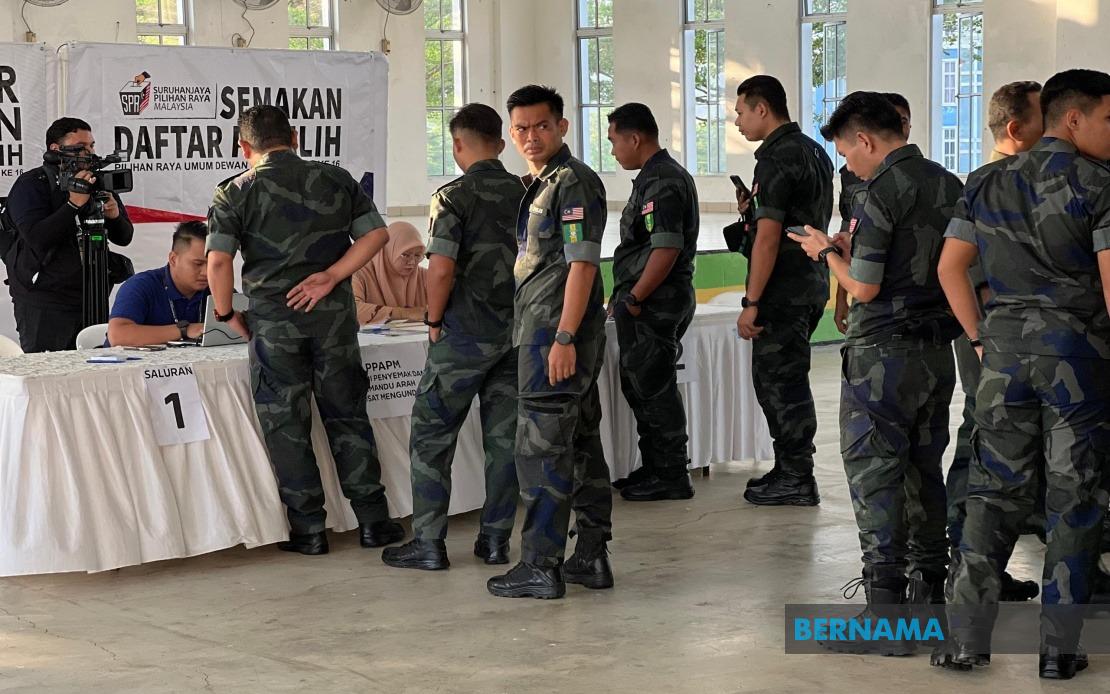
Security forces in Johor cast their ballots ahead of the general state election scheduled for Saturday, with the Election Commission establishing 64 early voting centres to manage the unique voting requirements of military and police personnel. The decision to hold advance voting reflects the operational demands placed on security agencies, which must maintain their regular duties during major electoral events. A total of 24,751 eligible voters from the Malaysian Armed Forces, Royal Malaysia Police, and General Operations Force exercised their franchise through this staggered voting process, beginning at 8 am on July 7.
The Electoral Commission divided the security force contingent into two distinct groups, each with separate venue allocations and voter counts. Members of the Malaysian Armed Forces, together with their authorised spouses, comprised 12,041 of the early voters and were directed to 11 designated polling stations across the state. This arrangement allowed the military institution to manage its personnel efficiently whilst ensuring their democratic participation remained uncompromised. The relatively smaller number of centres for armed forces personnel suggests these locations were strategically positioned to serve military establishments and barracks across the region.
The larger portion of early voters, numbering 12,710 individuals, consisted of personnel from the Royal Malaysia Police and the General Operations Force alongside their family members. These security sector employees utilised a network of 53 polling stations dispersed throughout Johor. The significantly higher number of voting centres for police and paramilitary forces reflects the broader geographical distribution of these agencies across urban and rural districts, requiring more dispersed voting infrastructure than military concentrations alone would demand.
The staggered closure schedule implemented by the Election Commission allowed voting to proceed throughout the day, with centres shutting down progressively from noon onwards until 6 pm. This phased approach prevented congestion at individual polling stations whilst accommodating voters whose shifts or operational commitments prevented them from voting during standard morning hours. Such flexibility recognises that security personnel cannot simply abandon their posts on election days, making early voting not merely a convenience but a necessity for maintaining national security and public order during electoral exercises.
Geographical conditions across several Johor districts appeared favourable for the voting process. Reporting from areas including Batu Pahat, Muar, Pontian and Tangkak indicated sunny weather throughout the day, which likely facilitated smooth voting operations at outdoor or semi-outdoor polling stations. Weather stability is a practical consideration for election administrators, as inclement conditions can reduce turnout and create logistical complications at polling centres. The comfortable conditions reported suggest no weather-related disruptions hindered the early voting exercise.
This advance voting mechanism serves a broader electoral framework in which the 16th Johor state election engages approximately 2.7 million ordinary voters across 56 state assembly constituencies on the following day. The security forces' early voting represents a small but symbolically important segment of the electorate, emphasising that even those tasked with maintaining order and security during elections retain their fundamental voting rights. The separation of security personnel voting from the main election day also ensures that substantial portions of the police and armed forces remain available for election-day duties, minimising disruption to public order and safety.
Malaysia's approach to early voting for uniformed services reflects a mature democratic practice found in various democracies worldwide. By accommodating security personnel's voting requirements separately, the system acknowledges that absolute impartiality and security are paramount during elections. Personnel who might otherwise face operational conflicts between their professional obligations and civic duties instead participate freely and directly, strengthening the democratic legitimacy of electoral outcomes. This mechanism has become standard practice across Malaysian state and federal elections where large numbers of security force members require accommodation.
The Election Commission's administration of the early voting process demonstrates the logistical complexity underlying seemingly straightforward electoral events. Managing 24,751 voters across 64 centres whilst maintaining security, preventing fraud, ensuring transparency, and maintaining strict voter confidentiality requires substantial planning, training, and resource allocation. The commission's successful execution of these early voting arrangements provides a foundation for the larger main election scheduled for Saturday, when regular voting procedures would replace these specialised arrangements.
The participation of security forces in Johor's electoral process holds particular significance given the state's economic importance and strategic position within Malaysia. Johor hosts substantial military installations, naval bases, and police operations centres, making the engagement of security sector voters politically and administratively significant. The smooth conduct of early voting for these cohorts signals the Election Commission's readiness to manage the main polling exercise across the state's diverse constituencies, many of which represent closely contested political battlegrounds with implications extending beyond state-level governance.

