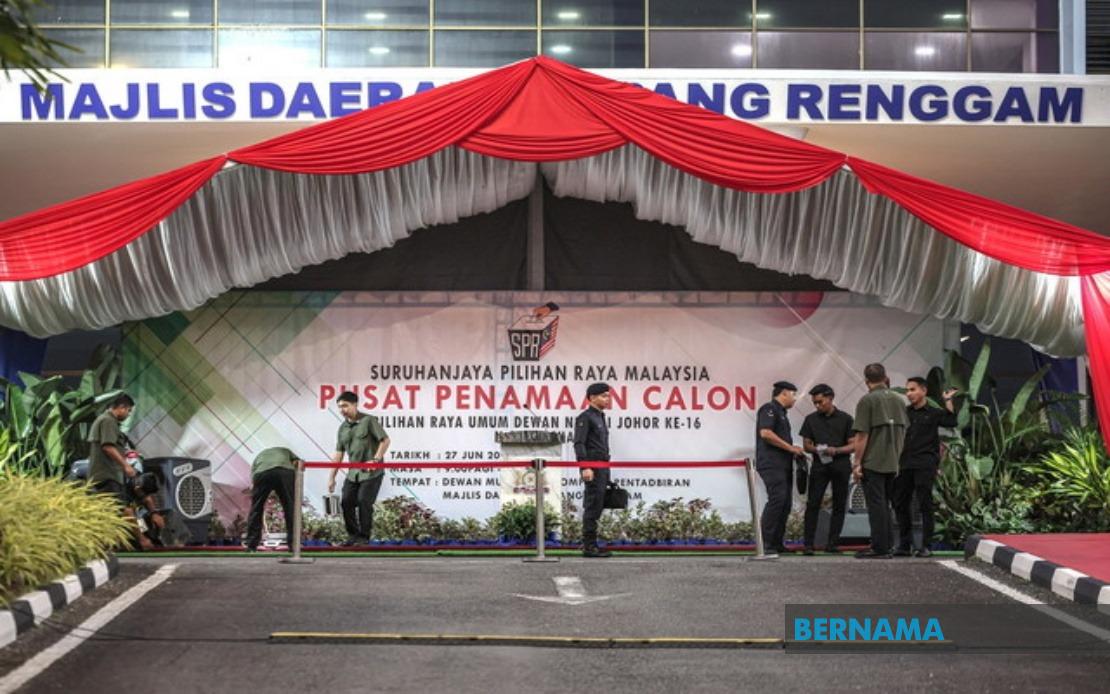
The 16th Johor State Election officially launched its candidate registration phase this morning, with all 56 nomination centres commencing operations at 9am across the state. The simultaneous opening marked the beginning of a crucial procedural stage that will determine which contenders are approved to contest in what has emerged as a significant electoral event for Malaysia's southernmost state.
Candidates faced a tight one-hour window, concluding at 10am, to formally lodge their nomination documents with the returning officers stationed at their respective centres. This compressed timeframe, while standard for Malaysian electoral processes, requires meticulous coordination and advance preparation by political parties and independent hopefuls. The nomination papers must be submitted either by the candidate themselves alongside both a proposer and seconder, or alternatively by any combination of two or even one of these representatives, providing flexibility in the submission process while maintaining procedural integrity.
Following the completion of verification procedures by the Election Commission, a 14-day campaign period commences, extending through to 11:59pm on July 10. This designated timeframe permits political parties and candidates to conduct their electoral outreach, policy advocacy, and grassroots mobilisation efforts. The compressed campaign schedule reflects the Electoral Commission's carefully calibrated approach to balancing candidate preparation time with voter engagement periods, a pattern consistent with recent Malaysian state elections.
Party supporters demonstrated their enthusiasm from the earliest hours, with groups assembling outside nomination centres as early as 6:30am to demonstrate backing for their favoured candidates. This early mobilisation underscores the competitive intensity surrounding the Johor election, where multiple political coalitions have invested considerable organisational resources. The visual presence of party workers and sympathisers at nomination venues serves both symbolic and practical purposes, generating media coverage whilst simultaneously projecting organisational capacity to potential voters.
The Election Commission's registered voter data reveals substantial participation potential, with 2,727,926 individuals eligible to vote in this election. This electorate comprises 2,703,175 ordinary civilian voters, augmented by 12,041 military personnel and their spouses, and 12,710 police personnel and their spouses. The inclusion of security forces in the electoral roll reflects Malaysia's constitutional framework permitting these cohorts to participate in state and federal elections, a practice that carries particular significance in strategically important states like Johor.
Weather conditions presented a variable backdrop across Johor's diverse geography on nomination day. The Malaysian Meteorological Department had forecasted rainfall in urban and semi-urban districts including Johor Bahru, Muar, Batu Pahat, Kota Tinggi, Pontian, Tangkak and Kulai throughout the morning hours, while interior districts such as Segamat, Kluang and Mersing were anticipated to experience clear skies. Afternoon meteorological predictions anticipated thunderstorm development across most districts, including Johor Bahru, Segamat, Kluang and Kota Tinggi, potentially affecting voter visibility and party campaign activities in the succeeding days.
Security arrangements reflected the Election Commission's commitment to ensuring orderly proceedings and preventing disruptions. Police forces, operating in coordination with the People's Volunteer Corps (RELA), established comprehensive security perimeters and implemented traffic management protocols around all nomination centres. These precautions aimed to create controlled environments facilitating legitimate candidate registration whilst preventing potential confrontations between rival party supporters or breaches of electoral regulations.
The electoral calendar for Johor's 16th state election encompasses two subsequent key dates. Early voting is scheduled for July 7, accommodating voters with mobility constraints, overseas Malaysian citizens unable to vote on polling day, and security force personnel with operational commitments. Ordinary polling day has been designated as July 11, when the majority of the state's electorate will cast their ballots at designated voting centres. This phased voting approach, increasingly adopted across Malaysian electoral administration, distributes voter flows and reduces congestion at polling stations.
For Malaysian observers and regional analysts, the Johor state election carries significance beyond routine electoral administration. As Malaysia's most developed southern state and a crucial economic zone, political developments in Johor influence broader federal political calculations. The nomination outcomes, once verified and announced, will clarify which coalitions have successfully mobilised candidate support and consolidated party unity. The subsequent campaign period will reveal evolving policy priorities, demographic targeting strategies, and the extent to which federal political dynamics permeate state-level contests, particularly relevant given Malaysia's complex constitutional division between state and federal authority.

