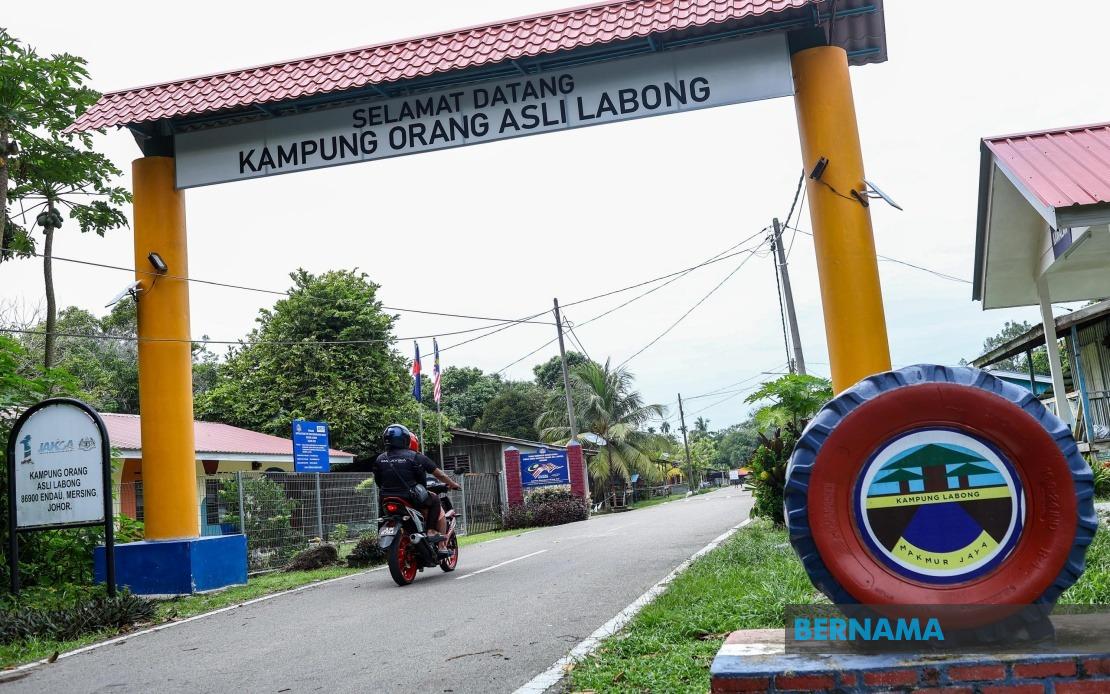
The Johor state government's commitment to advancing the welfare and socioeconomic standing of Orang Asli communities is yielding measurable results across the state's indigenous settlements, according to local leaders and residents interviewed in Mersing. Through a sustained partnership with the Department of Orang Asli Development (JAKOA), the state has introduced a suite of targeted interventions aimed at building institutional capacity within villages while simultaneously addressing immediate material needs affecting these historically marginalised communities.
At Kampung Orang Asli Labong in Mersing, village head Mabot Sela, 80, describes how government-sponsored programmes have fundamentally altered his ability to lead effectively. Having participated in formal leadership training courses organised by JAKOA, Mabot has acquired administrative skills and governance knowledge that he applies directly to village operations. He emphasises that these courses have provided him with practical tools for managing community affairs and serving as a functional intermediary between residents and state government agencies—a role that previously operated largely on tradition and informal arrangement rather than structured capability.
Beyond capacity-building, the state has moved to increase monthly allowances for village heads and other Orang Asli leaders. Mabot notes that this financial uplift has created tangible relief in household budgets, particularly in meeting healthcare expenses and medication costs. For an 80-year-old community leader managing both leadership responsibilities and personal health challenges, the additional income represents meaningful support that allows him to focus on village matters without compounding financial stress.
The broader development framework deployed by Johor encompasses multiple dimensions of community improvement. Last year, the state allocated RM3.8 million to fund nine distinct initiatives benefiting more than 18,000 Orang Asli residents across Johor. These programmes span welfare support, educational advancement, infrastructure development, and community-level social projects. The integrated approach reflects a recognition that sustainable development requires simultaneous attention to immediate welfare needs and longer-term capacity and opportunity building.
Yet challenges remain pressing at the village level. Mabot identifies recurring agricultural difficulties stemming from wildlife conflict, particularly crop destruction caused by wild elephants migrating through settlement areas. Additionally, free-roaming cattle pose hazards to motorists and villagers alike. These issues illustrate how Orang Asli communities remain particularly vulnerable to environmental stressors that urban and organised agricultural communities often manage through established coordination mechanisms or protective infrastructure.
For Sekoi Janja, a 68-year-old resident of Kampung Orang Asli Labong, the trajectory of development represents generational transformation. She reflects on how Orang Asli livelihoods historically centred on direct forest dependence and subsistence engagement with immediate surroundings. Today, with shifting economic realities and changing land-use patterns, she emphasises the critical importance of ensuring younger community members acquire skills and knowledge enabling them to transition toward more diversified livelihood pathways. Her perspective underscores that development programmes must accommodate intergenerational mobility aspirations rather than merely sustaining current living standards.
Skill development emerges as a particularly significant concern among residents. Norma Lonchai, a 44-year-old trader, articulates a sentiment reflected across many Orang Asli communities: while financial assistance and welfare transfers provide necessary support, they do not fundamentally alter earning potential or create pathways toward independent income generation. She calls for expanded skills training and livelihood development initiatives that would enable Orang Asli individuals to acquire marketable competencies, establish small enterprises, or access employment opportunities offering genuine career progression rather than permanent dependence on state assistance.
The Johor government's multi-sectoral assistance framework—encompassing welfare, education, infrastructure, and community development—represents an attempt to address this complexity. However, translating allocated resources into sustainable outcomes requires sustained implementation quality, community engagement, and coordination across multiple government agencies. The presence of JAKOA as a dedicated institutional vehicle for Orang Asli development matters considerably, yet complementary support from education, health, economic development, and infrastructure sectors remains essential for achieving comprehensive uplift.
For Malaysian policymakers and regional observers, the Johor experience offers instructive lessons regarding Orang Asli engagement. The combination of institutional capacity-building for community leaders with direct welfare support acknowledges both the structural constraints these communities face and their agency in driving their own development trajectories. By investing in leadership capability alongside material assistance, Johor attempts to move beyond patronage models toward more sustainable community-directed progress. However, whether these initiatives achieve meaningful long-term transformation will depend substantially on consistent resourcing, alignment with community-identified priorities, and genuine economic opportunity creation rather than reliance on permanent state transfers.
The sentiments expressed by residents suggest openness to development initiatives provided they address locally identified needs and create genuine opportunity pathways. Environmental protection, skills development, and livelihood diversification emerge as priority areas where further targeted investment could yield significant returns. As Johor continues this journey, neighbouring states facing similar Orang Asli development challenges may find the approach instructive, particularly in demonstrating how systematic government engagement can complement rather than undermine community agency.

