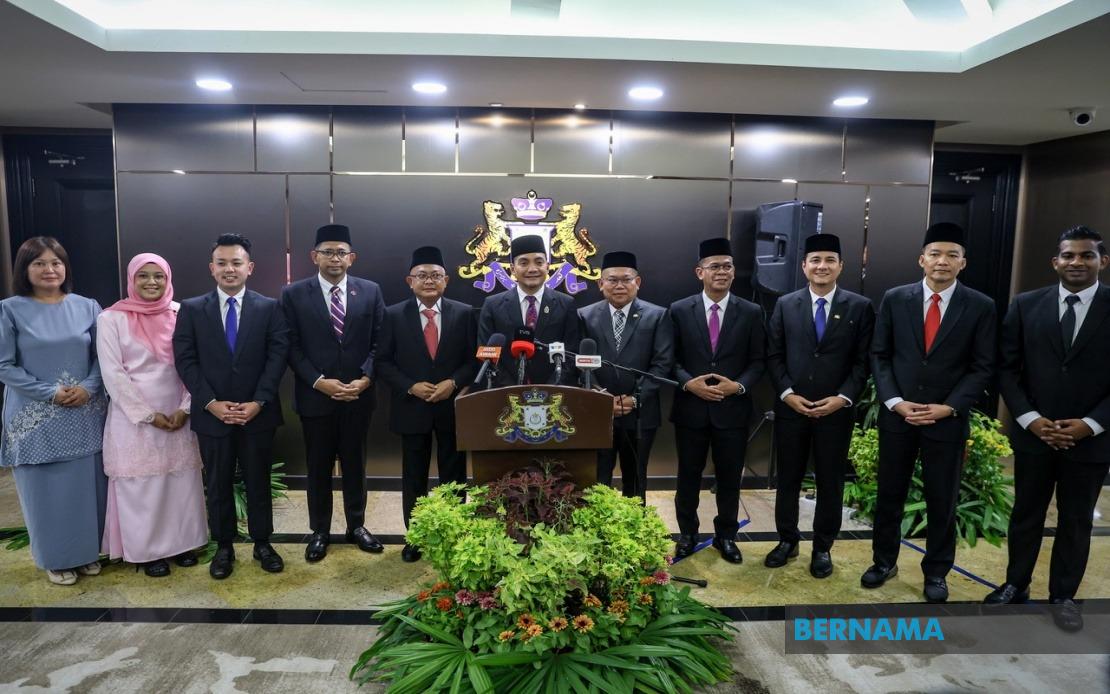
Johor has taken a structural step to reinforce its governance machinery by appointing 10 deputy chairmen to its State Executive Council committees. The announcement by Menteri Besar Datuk Onn Hafiz Ghazi at Kota Iskandar on July 22 signals the state government's recognition that expanding the leadership pipeline is essential as Johor pursues increasingly ambitious development targets. The move reflects a deliberate strategy to distribute oversight responsibilities and ensure that decision-making reaches deeper into the administrative hierarchy.
The appointments carry the blessing of the Regent of Johor, Tunku Mahkota Ismail, underscoring their formal legitimacy within the state's constitutional framework. This endorsement from the palace is significant, as it demonstrates alignment between the executive branch and the institution of the sultanate—a critical foundation for smooth governance in Malaysia's federal structure. For a state like Johor, which aspires to play a leading economic role in the region, such institutional coherence sends reassuring signals to investors and development partners.
Onn Hafiz framed the restructuring as essential to the state's broader modernisation agenda. He emphasised that the appointments would enhance the administration's capacity to handle an expanding workload, resolve public grievances more swiftly, and ensure that development initiatives are rolled out with consistency across all districts. This rationale reflects a common challenge in Malaysian state governance: as economies grow and urbanisation accelerates, administrative structures designed for simpler times often strain under the weight of contemporary demands. By creating deputy-level positions, Johor is attempting to create bandwidth for more granular oversight without necessarily doubling the size of its executive council.
The appointments are explicitly tied to Johor's 'Maju Johor 2030' strategic framework and the Johor Economic Transformation Plan (JETP), both of which aim to position the state as a developed economy within the decade. These are ambitious blueprints that encompass infrastructure development, industrial diversification, human capital enhancement, and digital transformation. The expansion of the committee structure suggests that policymakers believe the existing architecture cannot adequately manage the complexity of implementing such sweeping reforms across a state of Johor's scale and heterogeneity.
For Malaysian observers tracking governance trends across states, this move illustrates how different administrations are grappling with similar structural questions. While some states have experimented with reducing the size of their exco, Johor's approach is expansionist, betting that additional deputy-level positions will create clarity, accountability, and operational efficiency. The deputy chairmen are expected to function as liaison officers between committee leadership and working departments, monitor project timelines, coordinate field-level activities, and ensure that grassroots communities receive the full benefit of state programmes. This middle-management emphasis suggests that Johor's leadership views implementation gaps as a critical bottleneck.
The emphasis on close collaboration between deputy chairmen, their committee counterparts, and relevant government agencies points to Onn Hafiz's understanding that structural appointments alone do not guarantee effective governance. The real test lies in whether these individuals can establish working relationships that transcend hierarchical formality and enable rapid information flow, problem-solving, and adaptive management. In the Malaysian context, where personal networks and political alignment often matter as much as formal authority, the chemistry between these newly appointed deputies and their superiors will be crucial.
From a regional perspective, Johor's recalibration of its administrative structure carries implications beyond the state itself. As the wealthiest and most strategically positioned state in Malaysia—bordering Singapore and serving as a gateway to Thailand—Johor's governance capacity directly affects the broader ASEAN economy. Any improvements in implementation efficiency or policy responsiveness could have ripple effects on the region's infrastructure connectivity, trade facilitation, and investment climate. Conversely, administrative bottlenecks in Johor would constrain initiatives affecting cross-border development corridors and regional supply chains.
The appointment process also reflects evolving practices in meritocratic versus patronage-based selection within Malaysian politics. Onn Hafiz's framing of these positions as ones carrying both responsibility and trust suggests that qualifications and track record should matter, though the actual selection criteria remained undisclosed. This opacity is characteristic of Malaysian governance, where executive discretion in appointments typically faces limited public scrutiny. For those seeking greater transparency in state administration, the lack of published profiles or competency frameworks for these deputy positions represents a missed opportunity for benchmarking and accountability.
Looking ahead, the success of this reorganisation will likely be measured against tangible outcomes: faster project completion timelines, reduced processing times for public services, improved coordination across district-level initiatives, and measurable progress toward the 2030 development targets. If the deputy chairmen positions become genuine operational hubs that accelerate decision-making and implementation, the model could be replicated in other states. Conversely, if they devolve into ceremonial roles or layers of bureaucratic friction, the exercise will be remembered as administrative bloat disguised as reform.
The appointment decision also touches on broader Malaysian debates about government size and efficiency. While some argue that expanding administrative structures inevitably leads to waste and duplication, others contend that appropriate staffing at mid-management levels is precisely what distinguishes functional from dysfunctional bureaucracies. Johor's experiment offers a case study in this ongoing tension. The state is essentially betting that with the right people in place, additional structure enhances rather than impedes performance. Whether that wager pays off will inform governance discussions across Malaysia for years to come.

