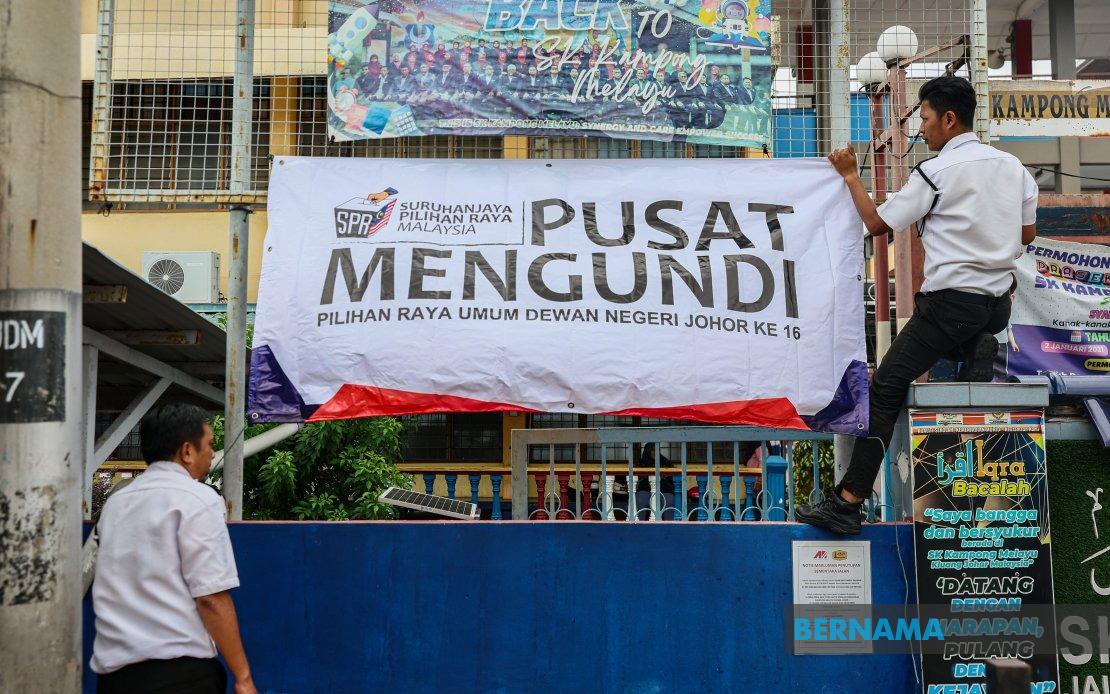
Johor reached a significant democratic milestone today as more than 2.7 million eligible voters participated in the state's 16th legislative election, determining the composition of the State Legislative Assembly across all 56 contested seats. The election represented a crucial moment for the southern state, with voters selecting representatives who would shape policy direction and governance in Malaysia's second-largest state by population.
Election administration proceeded with considerable logistical scale. The Election Commission established 1,076 polling centres staffed by 43,036 election workers to facilitate voting across Johor's diverse constituencies and island regions. Voting commenced uniformly at 8 am across all stations, with 4,889 individual voting streams organised to manage demand and minimise queuing. The staggered closure schedule accommodated geographic variations, with remote island locations closing as early as 11 am—polling at Pulau Besar concluded at that time, while Pulau Aur and Pulau Pemanggil closed at noon—and inland centres remaining open until 6 pm. This arrangement reflected the practical realities of voting in states with significant maritime components.
The election followed the prescribed campaign period, which concluded at midnight the previous evening, marking the official transition from campaigning to voting. In the run-up to polling day, 20,607 early votes were cast by police, armed forces personnel and their spouses on Tuesday, establishing an initial engagement baseline for the election. Vote-counting commenced as polls closed progressively throughout the afternoon and evening, with the Election Commission targeting full results by 10 pm, contingent on efficient processing across all centres.
The postal ballot component, while smaller in aggregate numbers, represented an important democratic mechanism. Approximately 24,677 postal votes required return by 6 pm to factor into the final count, necessitating coordination between election officials and voters exercising this convenience voting option. This mechanism particularly accommodated voters unable to attend physical polling locations on election day.
The Election Commission targeted a voter participation rate of approximately 70 per cent, reflecting ambitious expectations compared to historical precedent. The previous state election in 2022 recorded a turnout of 54.92 per cent, indicating that achieving the 70 per cent target would represent a meaningful increase in electoral engagement. Enhanced voter participation would strengthen the democratic legitimacy of the elected assembly and the mandate conferred upon successful candidates.
Weather presented a variable factor across the state's geography. The Malaysian Meteorological Department forecast morning rainfall in Johor Bahru, Batu Pahat, Kulai, Muar, Pontian and Tangkak, with conditions improving into the afternoon and evening hours. More volatile conditions threatened the eastern constituencies, with thunderstorms predicted for Kluang, Kota Tinggi and Segamat during afternoon hours, and afternoon-to-evening storms anticipated in Mersing. Despite these meteorological considerations, authorities proceeded with the scheduled election, accepting that tropical weather patterns were manageable within standard polling protocols.
Employers received explicit reminders to accommodate employee voting requirements, reflecting the government's commitment to facilitating universal participation and preventing workplace obstacles from suppressing voter engagement. This administrative guidance sought to ensure that employment responsibilities would not compromise citizens' ability to fulfil their electoral obligations.
The candidate field encompassed 172 contestants representing diverse political formations, reflecting Malaysia's pluralistic political landscape. The two major coalitions contested all 56 seats each: Pakatan Harapan fielded a complete slate mirroring Barisan Nasional's comprehensive coverage. Perikatan Nasional presented a substantial challenge with 33 candidates, while Parti Bersama Malaysia mounted a moderate campaign with 15 contenders. Smaller entities included the Malaysian United Democratic Alliance with four candidates, Parti Orang Asli Malaysia and Parti Sosialis Malaysia each with single candidates, alongside six independent hopefuls. This diverse candidacy pattern demonstrated the competitive intensity and ideological breadth characterising the contest.
The electoral competition occurred against a backdrop of shifting political fortunes. Before the dissolution of the State Legislative Assembly on June 1, Barisan Nasional controlled the state with 40 seats, substantially ahead of Pakatan Harapan's 12 seats, while Perikatan Nasional held three seats and MUDA retained one seat. This distribution indicated that the incumbent coalition faced a significant defensive challenge while opposition forces sought to reconfigure Johor's political composition. The 2024 election thus represented a potential realignment moment for the state's political trajectory.
For Malaysia's broader political context, the Johor election carried significance extending beyond state boundaries. As a historically strategic state with substantial population and economic importance, electoral shifts in Johor frequently signal broader national political currents. The outcome would provide valuable indicators regarding voter sentiment concerning incumbent performance, opposition momentum, and the reception of various political narratives circulating in the national discourse. Political analysts across Malaysia monitored results intently, recognising that Johor's verdict would inform assessments of the political landscape heading toward potential future national elections.

