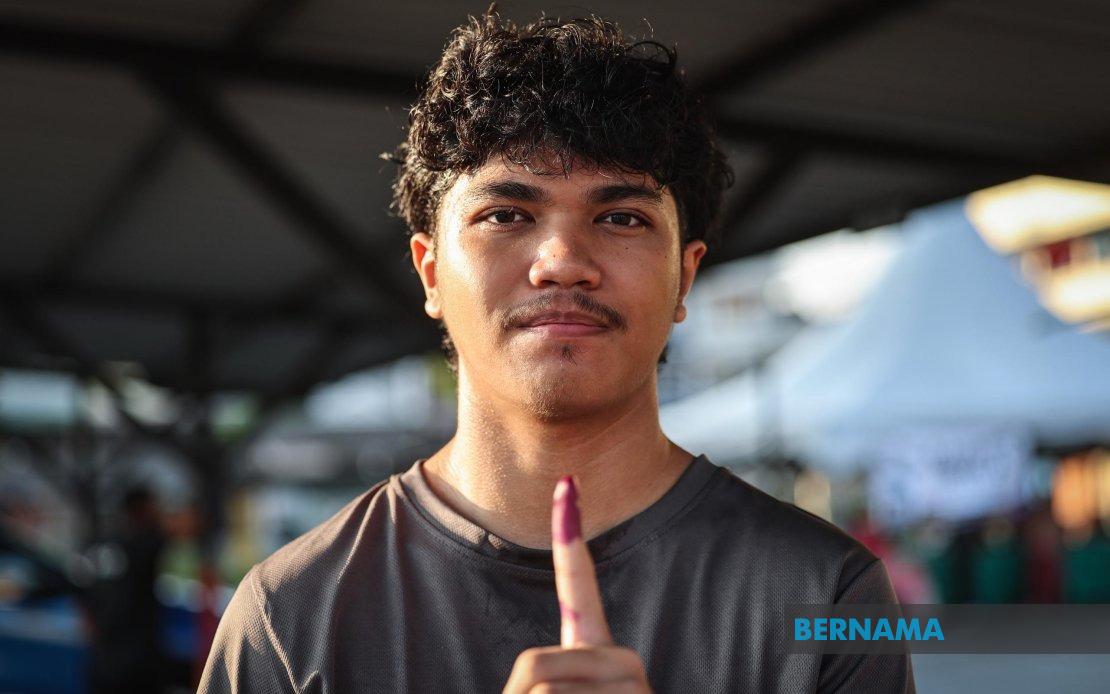
Across Johor's 1,076 polling centres on election day, a consistent message emerged from first-time voters: they want leaders who transform communities, not those who merely articulate promises during campaign seasons. This sentiment, expressed by teenagers and young adults throughout the state, reveals a pragmatic electorate less swayed by traditional party politics and more focused on tangible governance outcomes.
The 16th Johor State Election brought more than 2.6 million registered voters to the polls to elect representatives for the state's 56 legislative seats. Among these participants were a notable cohort of first-time voters, many of whom demonstrated remarkable civic engagement by arriving early to cast their ballots, despite potential traffic disruptions. Their presence at polling stations across constituencies from Larkin to Johor Jaya underscores a youth demographic actively involved in shaping their state's political future.
Ahmad Irfan Harith Ahmad Izwan, an agriculture diploma student aged 19 at Universiti Putra Malaysia Sarawak, exemplified this conscientious approach. Rather than treating his first vote as a ritual, he conducted careful assessments of candidates' campaign performance and their demonstrated capacity to deliver. His expressed preference for representatives capable of improving residents' lives reflects a generation evaluating politicians on measurable capacity rather than ideological positioning or family tradition.
The emphasis on integrity and commitment over party badges represents a significant departure from historical Malaysian voting patterns. Jolin Tan Pei En, a 20-year-old entrepreneur operating an online clothing business, articulated this shift clearly. Her observation that party affiliation has diminished in importance among her peer group indicates younger voters are fundamentally reassessing their relationship with Malaysia's political organisations. Instead, they prioritise work ethic, genuine public service motivation, and demonstrable commitment to constituency improvement.
This recalibration of electoral criteria holds implications extending beyond Johor. As Malaysia's youth increasingly comprise larger portions of the electorate, politicians may find traditional party machinery less effective at securing support. The demand for performance-based evaluation suggests future campaigns will need to emphasise concrete achievements and forward-looking development plans rather than relying on historical party narratives or symbolic gestures.
Filzah Maisara Mohd Fuad, a culinary student participating in elections for the first time, characterised her voting experience as both thrilling and profoundly meaningful. Her hopes that elected representatives would prove trustworthy and capable of driving Johor's progress reflect aspirations common among her generation. These young voters are not merely exercising a constitutional right; they are exercising oversight and demanding accountability from those seeking public office.
The geographic spread of this sentiment—from Larkin to Johor Jaya to Puteri Wangsa—suggests these attitudes are not isolated to particular constituencies but represent a broader generational phenomenon across the state. The consistency of messaging from different polling centres indicates this is not an anomaly but a structural shift in how younger Malaysians approach electoral decisions.
Malaysia's youth have come of age in an era of unprecedented information access. Unlike previous generations reliant on mainstream media and word-of-mouth, today's first-time voters can readily research candidates' backgrounds, scrutinise campaign promises against past performance, and engage in peer discussions through digital platforms. This information abundance has fostered higher expectations of political candidates and reduced tolerance for rhetoric unmoored from demonstrated capacity.
The 14-day campaign period preceding election day provided candidates ample opportunity to showcase their qualities and vision. Young voters' emphasis on evaluating performance during this period suggests they were actively watching, assessing, and forming judgments based on observable behaviour rather than accepting preset narratives. This scrutiny places pressure on political parties to field candidates with stronger track records and more coherent policy positions.
For the broader Malaysian political landscape, the Johor election results—when examined through the lens of youth voter behaviour—will likely indicate whether traditional political structures can adapt to these evolving expectations. Should candidates prioritising genuine service delivery and transparent governance perform strongly with first-time voters, this signals parties must fundamentally reconsider their candidate selection and campaign strategies.
The polling process itself, involving 4,889 voting streams opening simultaneously at 8 am, was structured to accommodate Malaysia's large electorate efficiently. Johoreans continued casting votes until 6 pm, reflecting the democratic infrastructure required to manage comprehensive electoral participation. The scale of this exercise—millions voting across diverse constituencies—demonstrates the logistical investment Malaysia's electoral system demands.
These first-time voters entering Malaysia's political process bring fresh energy and revised criteria for evaluating leadership. Their demand for integrity, demonstrated competence, and tangible results suggests the coming years will witness intensified pressure on politicians to move beyond traditional party politics toward performance-based governance. Whether Malaysian political institutions can meaningfully adapt to these expectations will significantly shape the country's political trajectory and the type of leaders future generations elect to represent them.

