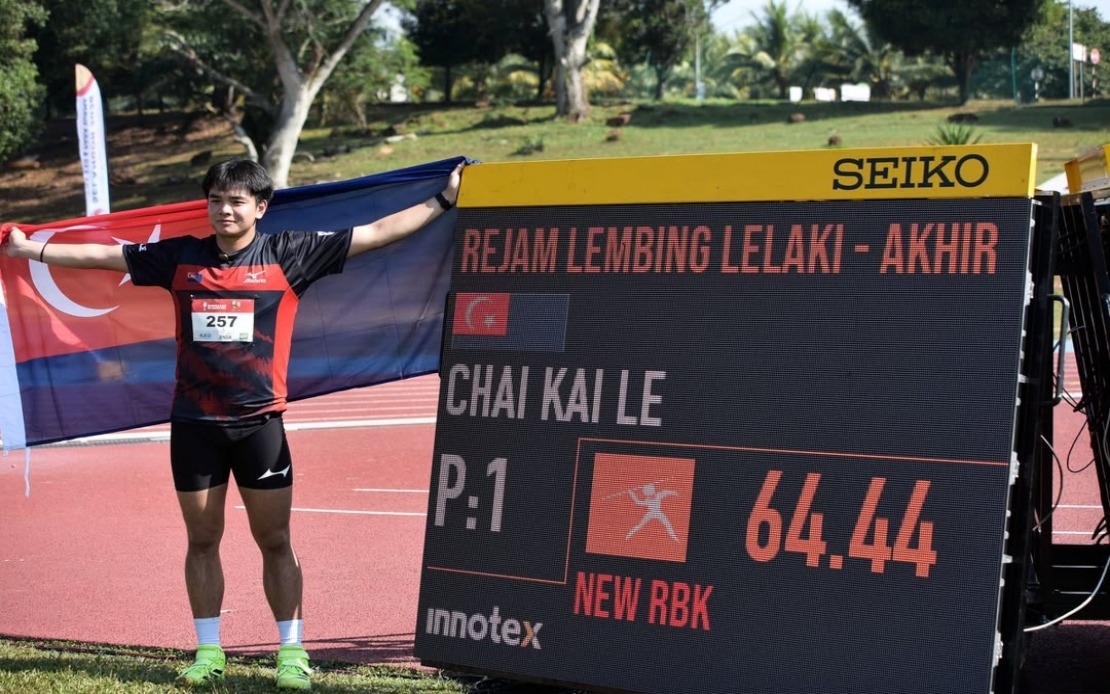
Johor's Chai Kai Le has rewritten the Malaysia Games record books, unleashing a javelin throw of 64.44 metres to secure the men's gold medal and erase a 26-year-old benchmark at the Selangor 2026 edition of SUKMA held at the Universiti Putra Malaysia Sports Centre in Serdang. The 18-year-old's commanding performance on his second attempt surpassed the previous Games record of 62.33 metres, established by Sarawak's Kho Mei Kuan during the 2000 Penang Games, marking a significant breakthrough for Malaysian athletics on the track and field stage.
The podium positions reflected Johor's dominance in the javelin competition, with Kai Le's teammate Mohd Noor Iman Norman claiming the bronze medal courtesy of a 59.04-metre throw. Penang's Tan Chun Wei completed the medal sweep with a silver-medal effort of 60.43 metres, though his performance fell well short of Kai Le's record-shattering mark. The distribution of medals across different states underscores the competitive depth emerging in Malaysian field events, a positive indicator for the national athletics programme as it seeks to develop world-class throwers.
Kai Le's achievement gains additional resonance when placed against his personal credentials. The Johor athlete already holds the national under-20 record of 65.65 metres, suggesting his trajectory continues upward and that further improvements may lie within reach. His current SUKMA record of 64.44 metres, while impressive, remains shy of his own junior standard, indicating he has not yet reached his ceiling as a competitor. This gap between his personal best and Games record hints at the potential for continued progression, assuming he maintains his training regimen and avoids serious injury.
Speaking to journalists immediately after his victory, Kai Le attributed his success to meticulous preparation spanning two years, indicating that his record-breaking performance was neither a surprise nor a flash of brilliance but rather the product of systematic athletic development. He had targeted the Games record during the planning stages of his SUKMA campaign, demonstrating the kind of goal-setting discipline increasingly common among serious Malaysian athletes. His satisfaction with the outcome reflected not merely winning gold but achieving a tangible benchmark that signifies genuine progress in his competitive development.
However, Kai Le's post-victory interview revealed the physical toll exacted by elite javelin competition. He acknowledged suffering a technical error during his second throw, which precipitated lower back pain and fatigue that constrained his subsequent attempts. Rather than pursuing further distance, he adopted a pragmatic approach focused on injury management and prevention, a mature decision that prioritised long-term athletic longevity over short-term glory. This candid assessment suggests the young thrower possesses not only physical gifts but also the mental discipline to make prudent decisions under competitive pressure.
The javelin triumph forms part of a broader athletics narrative at SUKMA 2026, with other field athletes delivering noteworthy performances that merit attention. In the race-walking events, Penang's Mohammad Aiman Haikal Sahrudin captured the men's 10,000-metre race walk gold medal with a time of 47 minutes 28.84 seconds, demonstrating consistency and improvement in an event that demands both technical proficiency and endurance. His victory came ahead of Kelantan's Ahmad Farish Irfan Ahmad Fahmi, who registered 47 minutes 37.17 seconds for the silver medal, while the Federal Territories' Khor Jing Hong rounded out the podium in bronze with 47 minutes 49.27 seconds.
Mohammad Aiman's performance carried particular significance because it represented a step forward from his previous SUKMA appearance in Sarawak, where he had secured only a silver medal in the same discipline. The progression from second place to champion status illustrates the kind of incremental improvement that characterises athlete development across multiple Games cycles. At just 18 years old, Mohammad Aiman possesses the youth and apparent motivation to continue developing his race-walking capabilities, positioning himself as a prospect for future national representation.
Looking beyond SUKMA, Mohammad Aiman articulated ambitions to break into the national squad and qualify for the 2027 SEA Games, reflecting the natural progression pathway from regional Games success to continental competition. He clarified that the SEA Games programme does not include the 10,000-metre race walk, necessitating a tactical shift toward the 20,000-metre distance, an event he also plans to contest at the current SUKMA Games. This strategic adjustment demonstrates awareness of the international competitive landscape and the specific demands of different racing formats, characteristics increasingly visible among aspiring Malaysian athletes navigating multiple competitive pathways.
The performances by Kai Le and Mohammad Aiman at SUKMA 2026 underscore the depth of emerging talent within Malaysian athletics, particularly in field events and specialist disciplines like race walking. Both competitors represent the younger generation of athletes benefiting from improved coaching infrastructure, more systematic talent identification, and enhanced access to training facilities across Malaysian states. Their respective record-breaking and medal-winning performances inject optimism into the national athletics programme at a time when sustained progress at international competitions remains a priority for Malaysian sports governance.
The Selangor edition of SUKMA continues to showcase the crucial role inter-state Games play in nurturing athletic talent and providing competitive platforms where emerging champions can test themselves against peers from across the nation. For young athletes like Kai Le and Mohammad Aiman, SUKMA serves not merely as a competition venue but as a developmental milestone marking progress toward senior national representation and potential participation in continental and global sporting championships, perpetuating the pipeline of athletic talent essential for Malaysia's sustained competitiveness in regional and international athletics.

