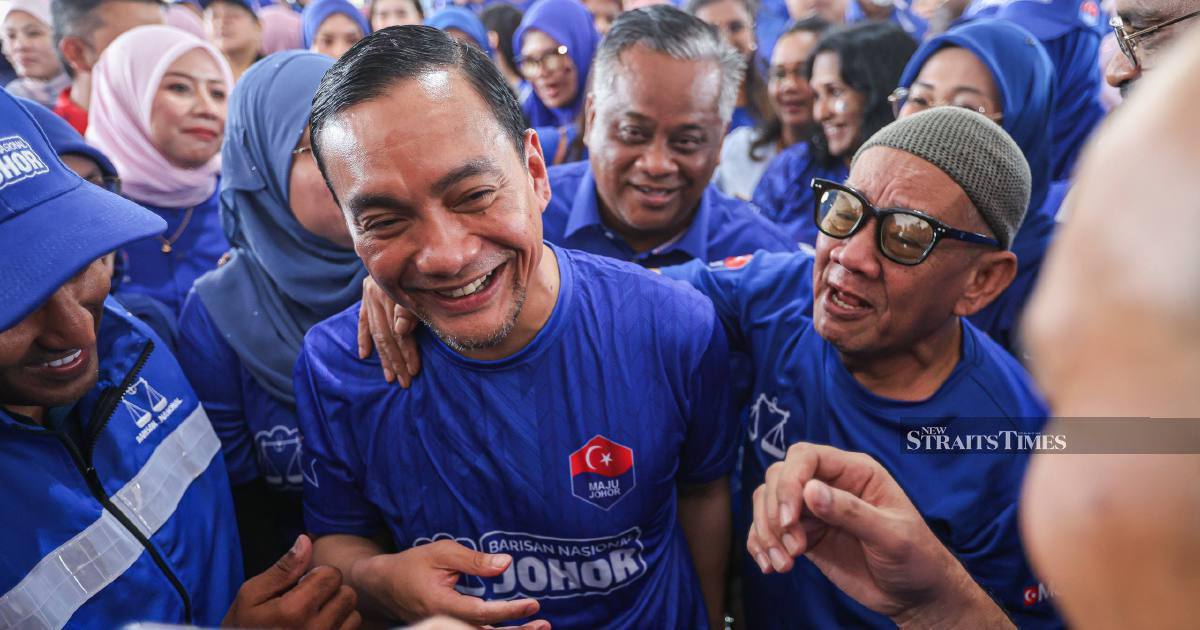
Johor's electoral landscape has been marked by an intriguing phenomenon that observers and political insiders are now reading as a barometer of public sentiment towards the state's current administration. The phrase 'Onn tak Onn'—roughly meaning "Onn, yet not quite Onn"—has circulated throughout the campaign season, and according to Umno secretary-general Datuk Dr Asyraf Wajdi Dusuki, this linguistic quirk actually reveals something more profound than wordplay. Rather than criticism or mockery, he contends the expression reflects genuine acceptance and growing confidence among Johor voters in Datuk Onn Hafiz Ghazi's tenure as Menteri Besar.
The paradoxical nature of the phrase itself warrants examination. In Malaysian political discourse, such seemingly contradictory statements often emerge when voters hold complex or nuanced views about a leader—appreciating certain qualities while maintaining reservations about others, or experiencing surprise at how a politician differs from expectations. In Onn Hafiz's case, the 'Onn tak Onn' phenomenon may indicate that Johor residents have come to accept him as a legitimate administrator, even if his style, background, or approach diverges somewhat from traditional Umno or conventional political molds.
Understanding the context of Onn Hafiz's political journey illuminates why such a phrase would emerge. Since assuming the Menteri Besar position, he has navigated the delicate balance between satisfying his party's establishment while projecting an image distinct from older-generation Umno politics. This careful positioning appears to have resonated with a cross-section of Johor voters who may have initially been skeptical of his credentials or political positioning. The fact that his name has become central to campaign discourse, rather than overshadowed by it, suggests he has achieved a degree of political legitimacy that extends beyond his party's hardcore base.
The electoral campaign period itself serves as a crucial testing ground for any political phenomenon. When voters are actively engaged in choosing representatives, their underlying sentiments become more transparent. The persistence and widespread use of 'Onn tak Onn' throughout Johor suggests it is not merely a fringe critique but rather a phrase that resonates across different communities and demographic groups. This breadth of usage indicates that Onn Hafiz has managed to build acceptance that transcends partisan loyalties, which is a notable achievement for any politician in contemporary Malaysia's polarized electoral environment.
Umno's interpretation of this phenomenon carries institutional weight, given the party's dominant position in Johor politics. For party leadership to frame the 'Onn tak Onn' concept positively represents a strategic acknowledgement that voters are warming to the Menteri Besar's brand of leadership. This framing also serves to legitimize Onn Hafiz within Umno circles and pre-empt any potential internal criticism that he may have strayed too far from party orthodoxy. By couching voter acceptance in these terms, Dr Asyraf Wajdi has effectively neutralized any narrative that Onn Hafiz's unconventional approach represents a departure from Umno values.
The implications for Johor's governance trajectory are significant. When voters display growing acceptance of a leader during an active campaign, it typically signals that election outcomes will favor that leader's party and consolidate his position. This would provide Onn Hafiz with a stronger mandate to pursue his policy agenda and implement initiatives that may have faced resistance during his initial term. The phenomenon also suggests that whatever distinguishes him from previous Menteri Besars—whether personality, policy priorities, or communication style—has been absorbed and accepted by the electorate rather than rejected.
For other states and political actors across Malaysia, Johor's experience offers lessons about the evolution of voter preferences in the post-2018 political landscape. The 'Onn tak Onn' phenomenon reflects an electorate willing to evaluate leaders on governance performance and contemporary relevance rather than strict adherence to political tradition. This shift potentially indicates broader voter maturation, where personality cults and hereditary political legacies matter less than competence and voter-responsive administration. Such a trend, if sustained across Malaysia, could encourage politicians to focus more on substantive delivery and less on maintaining conventional power structures.
The phrase itself has become politically valuable precisely because of its ambiguity. It functions simultaneously as acknowledgement of difference, acceptance of legitimacy, and appreciation for effectiveness—all without requiring voters to explicitly abandon their preconceptions. This linguistic flexibility may explain why it has gained traction so broadly. Voters who might otherwise express reservations can use it as a qualified endorsement, while supporters can read it as full validation. Political operators from various camps can interpret it to support their preferred narratives.
The campaign period has thus served to crystallize what may have been latent public sentiment regarding Onn Hafiz's leadership. As voting nears, the manifestation of 'Onn tak Onn' throughout Johor communities suggests that the Menteri Besar has successfully positioned himself not as a divisive or transitional figure, but as an acceptable and increasingly embraced leader. Whether this phenomenon translates into corresponding electoral support will provide the definitive measure of how thoroughly Johor voters have accepted Onn Hafiz's particular brand of governance and leadership.

