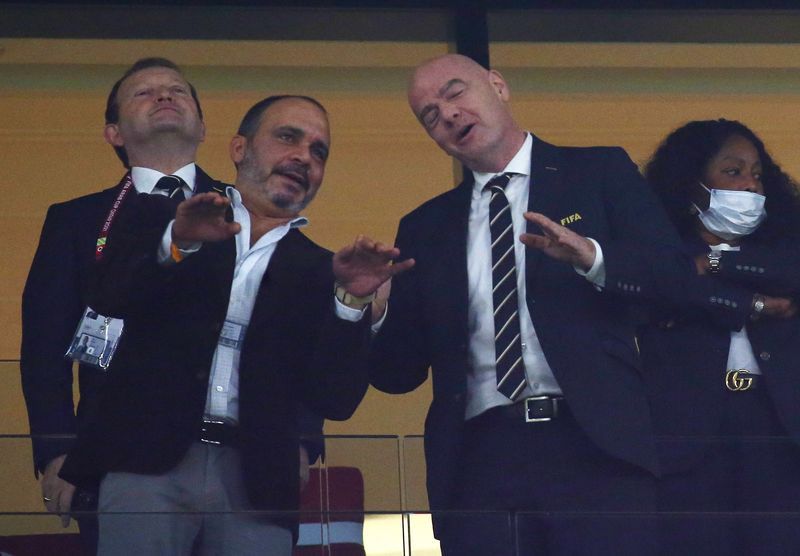
Ali bin Hussein, president of the Jordan Football Association, has escalated tensions within world soccer's governing structure by levelling serious allegations of coercion against FIFA President Gianni Infantino. In a public statement released on Tuesday, bin Hussein accused the FIFA leadership of employing what he characterised as blackmail tactics, specifically claiming that during the World Cup period, FIFA officials suggested verbally that endorsing Infantino's leadership "would go a long way to helping our FA out" after the organisation had previously withheld assistance on multiple matters. The accusation adds considerable weight to mounting pressure facing Infantino as his authority within football's hierarchy continues to erode amid internal dissent.
The Jordan FA chief's rebuke reflects broader frustrations with FIFA's governance and decision-making processes that disproportionately affect smaller football nations. Bin Hussein emphasised his association's commitment to ethical principles, stating clearly that Jordan would not compromise its values through transactional political support. "We pride ourselves in Jordan in upholding ethical values. We did not endorse him before and certainly will not now," he declared on social media, before adding that the situation amounted to blackmail that his organisation categorically refused to accept. His defiant tone signals a willingness to challenge FIFA's leadership despite the power imbalance between a small national association and the sport's global governing body.
Infantino's position has become increasingly precarious following his forced abandonment of a contentious proposal to monetise FIFA's commercial operations through a partial stake sale. The initiative, which Infantino championed as a mechanism to generate billions of dollars for grassroots development globally, faced coordinated rejection from confederations and national associations following a September 19 deadline imposed by the Swiss official. This heavy-handed approach backfired spectacularly, with even senior FIFA executives including Secretary General Mattias Grafstrom and football legend Arsene Wenger publicly distancing themselves from the scheme. The accumulated effect has substantially weakened Infantino's mandate at a critical moment in FIFA's institutional evolution.
For Jordan specifically, the grievances extend far beyond questions of political endorsement. As a relatively modest football nation operating with tight financial constraints, the association has encountered systematic obstacles that bin Hussein argues reflect FIFA's indifference to smaller member states' circumstances. Jordanian supporters have reportedly been compelled to pay inflated ticket prices for World Cup matches while simultaneously facing visa rejections that prevented their attendance at matches in the United States. Such bureaucratic failures strike at the heart of football's supposed commitment to universal accessibility and fan engagement.
The financial dimension of Jordan's complaint reveals deeper structural inequities within FIFA's operational framework. The association confronts a unique tax liability imposed by the United States government through FIFA's administrative channels, a burden that notably does not apply to participating nations based in Canada or Mexico. This discriminatory treatment underscores how geographical accidents of tournament hosting can create unequal financial obligations for participating associations. Bin Hussein calculated that these taxation costs should rightfully flow toward player compensation and staff expenses, rendering the tax treatment fundamentally at odds with football development priorities.
Jordan's maiden World Cup qualification represented a historic achievement for the nation's football programme, yet the experience has been marred by unresolved financial entitlements and administrative frustration. The association reached the final of the 2025 Arab Cup, a FIFA-organised tournament, yet remains unpaid for this accomplishment more than eight months after the competition's conclusion. This extended payment delay is particularly galling given FIFA's public pronouncements regarding its substantial financial reserves, creating an apparent contradiction between the organisation's proclaimed wealth and its sluggish disbursement of earned funds to participating associations.
Bin Hussein's characterisation of FIFA's conduct as blackmail reflects a calculation that smaller nations possess minimal leverage within world football's power structures. When the global governing body conditions administrative assistance or financial support upon political alignment with its president, the dynamic inevitably favours wealthy confederations and larger national associations capable of weathering such pressures. Smaller nations operating with constrained resources face genuine dilemmas when confronted with implicit threats regarding withholded institutional support, potentially forcing them toward compromising their governance principles to secure necessary assistance.
The timing of bin Hussein's public intervention coincides with accelerating institutional vulnerability for Infantino, suggesting that resistance from smaller associations may embolden broader reform movements within FIFA. As confederations evaluate their positions within world football's governance architecture, the credibility of FIFA's leadership increasingly depends upon demonstrating equitable treatment across all member organisations regardless of market size or commercial value. Infantino's apparent willingness to weaponise FIFA's institutional advantages against those unwilling to provide political endorsement undermines his capacity to manage football's complex international ecosystem effectively.
For Southeast Asian football stakeholders observing these developments, the Jordan situation illuminates broader vulnerabilities facing smaller confederations operating within FIFA's asymmetrical power structures. Malaysia, Vietnam, and Thailand, among other regional nations, maintain comparable positions to Jordan regarding financial constraints and administrative dependencies upon FIFA support. Should FIFA officials employ similar conditional assistance tactics with other associations, precedent established through Infantino's approach to Jordan could establish dangerous templates for institutional coercion that undermine the integrity of football governance across the region and globally.
The fundamental issue extends beyond individual personalities or temporary controversies to encompass structural questions about FIFA's accountability mechanisms and its responsibilities toward member associations of varying scales. The organisation's ability to withhold assistance, impose discriminatory tax treatment, and delay earned payments while conditioning future cooperation upon political support creates systemic vulnerabilities that corrode football's claimed commitment to universal principles. Until FIFA establishes transparent governance frameworks and equitable treatment protocols that apply uniformly across all member associations regardless of their political alignment with incumbent leadership, allegations of institutional blackmail are likely to persist and compound existing credibility deficits.

