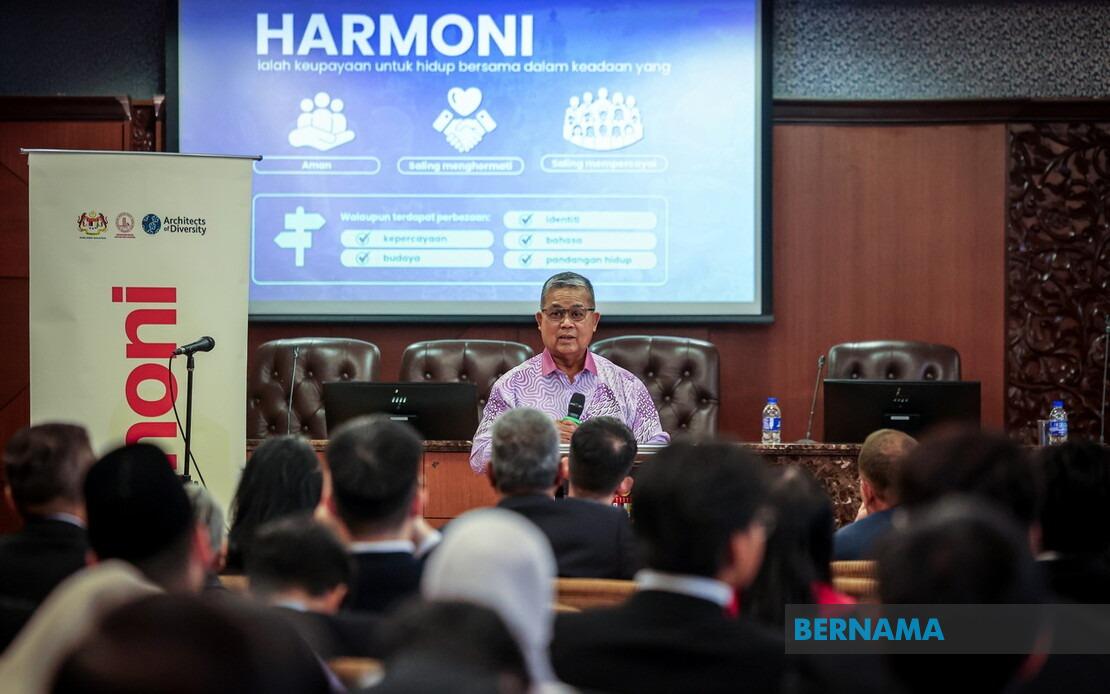
Malaysia's Department of National Unity and National Integration (JPNIN) is embarking on an ambitious research initiative to develop a Community Tension Index, a systematic mechanism designed to quantify the state of social cohesion across the country and provide early warning signals about emerging flashpoints related to race, religion and royalty sensitivities. Minister of National Unity Datuk Aaron Ago Dagang unveiled the initiative at the 2026 Harmony Symposium, held at Parliament Building, framing it as a critical strategic tool for government decision-makers navigating Malaysia's complex multicultural landscape.
The index represents a significant shift toward data-driven policymaking in the unity and integration space. Rather than responding reactively to communal tensions after they have already escalated, the government seeks to establish baseline measurements that can track shifts in social attitudes and identify emerging polarisation trends before they spiral into conflict. This proactive approach acknowledges that Malaysia's diversity, while a source of national strength, requires continuous monitoring and deliberate stewardship to prevent fractures that could undermine social harmony.
According to Aaron, the research findings will serve as a foundational reference point for formulating targeted early intervention strategies. By understanding where and how tensions manifest—whether in specific geographic areas, age groups, or socioeconomic communities—JPNIN can tailor its programmes and messaging to address root causes rather than symptoms. This granular approach to unity work represents an evolution from broad, nationwide campaigns toward precision interventions that acknowledge the heterogeneous nature of Malaysian society.
The timing of this initiative is particularly significant given the mounting challenge posed by digital platforms and online discourse. Between January 2025 and January 2026, Malaysia's Communications and Multimedia Commission (MCMC) identified and removed 1,493 pieces of online content deemed problematic for their treatment of 3R matters. This figure underscores the scale of divisive material circulating in Malaysian cyberspace and the resource-intensive nature of content moderation efforts. The sheer volume highlights that addressing online divisiveness cannot be tackled through enforcement alone.
Aaron articulated a sophisticated analysis of how digital ecosystems actively amplify polarisation. Social media algorithms, designed to maximise engagement, inadvertently create "filter bubbles" and "echo chambers" where users encounter predominantly content aligned with their existing worldviews. This algorithmic reinforcement mechanism narrows the conceptual space for genuine cross-community dialogue and understanding. Rather than encountering perspectives that challenge or expand their thinking, Malaysians increasingly inhabit separate informational universes, each with its own narratives and grievances. The minister's framing suggests that traditional regulatory tools addressing content may be insufficient if the underlying technological architecture itself promotes division.
The proposed National Harmony Commission (SKN) emerges as JPNIN's institutional response to these systemic challenges. According to Aaron, the commission would function as a dedicated conflict prevention and resolution body, operating through mediation and early intervention mechanisms rather than punitive approaches. By positioning itself as constructive and harmonious in its methods, the proposed SKN distinguishes itself from enforcement-focused bodies. The commission would also investigate issues that threaten national harmony, suggesting it would combine both preventive and investigative functions.
The consultative process surrounding SKN's establishment indicates careful deliberation about its design and legitimacy. JPNIN has already commenced engagement sessions with diverse stakeholders—presumably including civil society organisations, religious bodies, community leaders, and political representatives across the spectrum—to gather preliminary feedback on the proposal. This participatory approach to institutional design carries its own symbolic weight, signalling that harmony-building mechanisms should themselves embody inclusive and consultative principles rather than being imposed from above.
For Malaysian readers and policymakers, the Community Tension Index addresses a genuine gap in the nation's capacity for evidence-based unity work. While Malaysia has invested considerable resources in promoting harmony through education, interfaith dialogue, and cultural events, these efforts have often proceeded without rigorous baseline data about the actual state of social cohesion. Introducing systematic measurement enables evaluation of whether existing programmes are moving the needle and where new initiatives might be most impactful.
The initiative also reflects international trends in conflict prevention research, where quantitative indices have become increasingly important for early warning systems. Countries confronting communal tensions now routinely employ social cohesion metrics, demographic monitors, and sentiment analysis tools to detect brewing crises. Malaysia's adoption of similar methodologies positions it within a global best-practice framework while acknowledging that the specific content, triggers, and manifestations of polarisation are distinctly Malaysian.
However, the index's effectiveness will depend critically on how rigorously it captures the lived experiences of ordinary Malaysians across different communities. A poorly designed index risks reinforcing existing biases or missing crucial dimensions of tension that academic or bureaucratic frameworks overlook. The research team must ensure representation from all major ethnic and religious communities and should incorporate qualitative research alongside quantitative metrics to grasp the emotional and relational dimensions of communal harmony.
The emphasis on addressing online divisiveness likewise requires acknowledging the limits of institutional solutions. While MCMC's removal of 1,493 pieces of problematic content demonstrates enforcement capacity, it simultaneously reveals that divisive content continues to proliferate faster than moderation systems can manage. Supplementary strategies addressing digital literacy, promoting responsible online citizenship, and engaging platform companies themselves in managing algorithmic amplification of divisive content will likely prove necessary complements to institutional monitoring and commission-based mediation.
Looking forward, the success of JPNIN's initiatives will ultimately rest on whether they transition from administrative machinery into genuine community engagement. A Community Tension Index that informs policy but never reaches public awareness, or a National Harmony Commission that operates in isolation from grassroots civil society, risks becoming another bureaucratic structure rather than a catalytic force for change. The department's articulated commitment to stakeholder engagement suggests openness to this challenge, though translating that commitment into sustained practice presents its own complexities.
The convergence of these initiatives—the index, the proposed commission, and ongoing content enforcement—indicates that Malaysian leadership increasingly recognises that national unity requires multifaceted approaches operating simultaneously across policy, institutional, technological, and cultural registers. Rather than privileging any single solution, JPNIN's strategy attempts to address polarisation comprehensively, from measurement and mediation through to digital governance. Whether this integrated approach succeeds in reversing polarisation trends or merely manages symptoms at greater expense remains a question only time and rigorous evaluation can answer.

