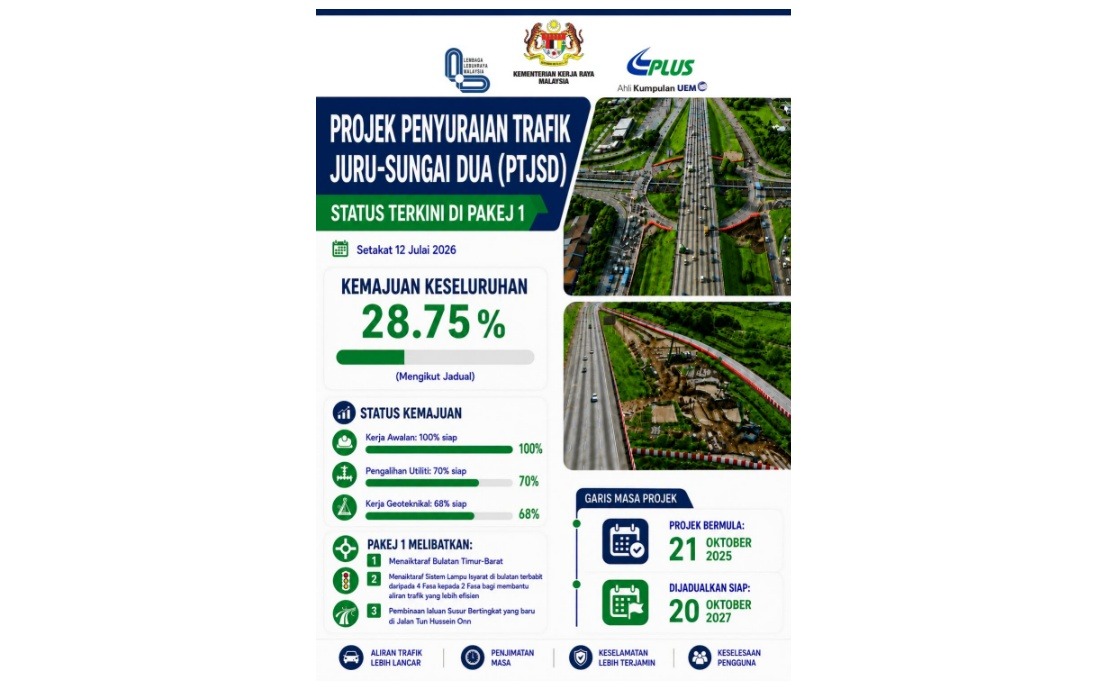
The ambitious Juru-Sungai Dua Traffic Dispersal Project (PTJSD) in Penang is maintaining its development momentum, with Package 1 recording 28.75 per cent overall progress as of mid-July and tracking toward its targeted completion in October 2027. PLUS Malaysia Berhad, the highway operator managing the infrastructure initiative, has confirmed the project remains within its scheduled timeline despite the scale and complexity involved in transforming one of northern Peninsular Malaysia's most congested transport corridors.
According to PLUS, the project has already accomplished several critical foundational stages. All preliminary works have been fully completed, establishing the groundwork for subsequent phases. The utility relocation effort—a major undertaking involving the rerouting of water, electrical, telecommunications and other essential services—has advanced to 70 per cent completion. Similarly, geotechnical investigations and preparatory activities have progressed to 68 per cent, indicating that the project is moving beyond its planning phases into active construction territory.
Package 1 encompasses three interconnected infrastructure improvements designed to fundamentally reshape traffic patterns in the area. The project includes a comprehensive upgrade of the East-West Roundabout, a critical junction that currently experiences severe congestion during peak periods. It also encompasses substantial enhancements to the traffic light management system at the roundabout itself, intended to optimise vehicle flow by improving signal timing and coordination. Additionally, the package involves construction of a new elevated slip road at Jalan Tun Hussein Onn, a strategic intervention meant to separate certain traffic streams and reduce conflicts at ground level.
The broader PTJSD initiative represents a significant regional infrastructure commitment, with an estimated total cost of RM3 billion and a footprint spanning 17.3 kilometres across three major administrative divisions of Seberang Perai: the South, Central and North districts. The project is being implemented collaboratively between PLUS Malaysia, the Ministry of Works and the Malaysian Highways Authority, reflecting the scale of coordination required to address a traffic problem that affects the entire region's connectivity and economic efficiency.
The Juru-Sungai Dua corridor serves as the primary arterial route connecting Penang with other northern peninsula states, making it economically vital for both local residents and through-traffic. Currently, the route experiences severe daily congestion, with journey times extending to one hour during peak periods despite relatively modest distances. This bottleneck constrains regional commerce, increases logistics costs and degrades quality of life for the estimated 200,000 daily users who depend on the corridor.
When the PTJSD reaches completion, traffic forecasting models anticipate substantial capacity improvements. The new direct Juru-Sungai Dua route is projected to absorb approximately 30 per cent of current traffic volume, effectively redistributing vehicle loads across the network. More significantly, travel time on the corridor is expected to compress from the current one-hour average during peak periods to just 20 minutes, representing a 67 per cent reduction in journey duration. Such improvements would yield substantial benefits not only for commuters and freight operators but also for air quality and public health outcomes.
Beyond the raw transportation metrics, PLUS has emphasised that the project addresses multiple dimensions of infrastructure quality. The improvements are designed to enhance traffic flow efficiency, reduce overall network congestion, strengthen safety performance through better traffic management and separated movements, and deliver a more comfortable travel experience for both highway users and local residents whose quality of life is affected by current congestion levels.
For Malaysian policymakers and regional observers, the PTJSD exemplifies the infrastructure adaptation challenges facing fast-growing northern regions. As Penang and surrounding states continue economic diversification and population growth, transport corridors that were designed for earlier traffic volumes require systematic expansion and modernisation. The project's scale and complexity—requiring coordination across multiple agencies and careful management of utility services—underscore the organisational and financial demands of contemporary infrastructure development in Malaysia.
The project's phased approach and detailed progress tracking suggest a maturing approach to large-scale transport infrastructure delivery in Malaysia. By maintaining transparent milestone reporting and adhering to scheduled timelines, PLUS and its partner agencies are building public confidence in the project's viability. With preliminary and geotechnical phases substantially advanced, the transition to active construction—where physical progress becomes more visible to the public—should proceed in coming months, further validating the project's trajectory toward the October 2027 completion target.

