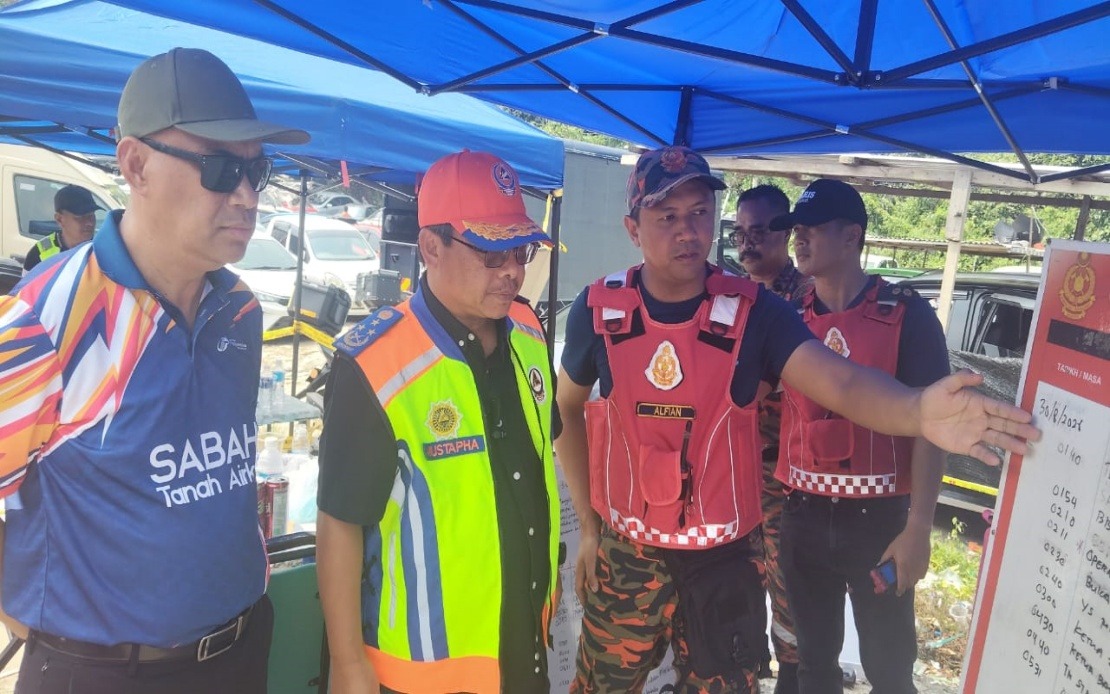
A devastating fire swept through Kampung Lok Buta in the early hours of Friday morning, destroying more than 200 residential structures and claiming the lives of three children in what has become one of Kota Kinabalu's most serious fire incidents in recent memory. In response to the scale of the disaster, authorities have swiftly mobilised resources to support the affected community, establishing two temporary relief centres to provide immediate shelter and coordinate assistance for more than 200 displaced victims.
Dewan Kampung Likas and Dewan Damai have been designated as temporary shelters, serving as central hubs for victim registration, coordination efforts, and the distribution of both government aid and public donations. The decision to open multiple relief sites reflects official recognition that the traditional single-centre approach would prove inadequate given the scope of displacement and the urgent humanitarian needs arising from the incident. These facilities will remain operational for as long as required to ensure orderly processing of assistance and to maintain transparent records of aid distribution.
Minister in the Prime Minister's Department for Sabah and Sarawak Datuk Mustapha Sakmud announced the establishment of the centres during a visit to the affected area, emphasising that their primary function extends beyond shelter provision. The registration process will enable authorities to compile comprehensive data on victims, including their employment status, housing circumstances, and other relevant factors that will inform the scope and nature of assistance packages. This systematic approach reflects lessons learned from previous disaster responses across the region and aims to ensure that support reaches those most in need of intervention.
Following the incident, Kota Kinabalu City Hall formally declared Kampung Lok Buta a disaster zone, a designation that unlocks various statutory powers and expedited administrative procedures for emergency response. This official declaration carries significant implications for resource allocation, waiving of certain bureaucratic requirements, and enables rapid coordination between multiple government agencies and departments. The zone designation also facilitates faster processing of compensation claims and reconstruction permits that residents will require in the coming weeks and months.
Three young victims perished in the conflagration that erupted at 1.40 am: Nana Abdullah aged four, her brother Mohd Asrul Abdullah aged six, and their cousin Nurfarahdilah Mohd Tajihah aged eight. The loss of children has sparked particular concern among state authorities, who recognise both the psychological impact on the community and the administrative complexities that arise when families lose multiple members simultaneously. The tragic nature of these deaths, particularly the sibling pair, has galvanised political commitment to ensuring comprehensive support for surviving relatives.
Acknowledging that disaster recovery extends beyond immediate physical needs, Mustapha highlighted the necessity of identifying students affected by the fire to minimise disruption to their education. The impact on schooling represents a secondary but serious consequence of such disasters, particularly in a community where economic constraints may have already limited educational opportunities. By engaging with the Ministry of Education early in the response phase, authorities aim to arrange alternative placements, provide transport assistance, and ensure that displaced students do not fall behind academically during the reconstruction period.
The minister indicated his intention to coordinate with the Ministry of Education regarding affected pupils at primary, secondary, and technical institutions, ensuring that appropriate support mechanisms are activated promptly. TVET students present a particular consideration, as displacement during vocational training programmes could derail career pathways and apprenticeships that often operate on strict timelines. Educational continuity becomes especially crucial in disaster contexts, where the disruption compounds existing socioeconomic pressures facing affected families.
Joining Mustapha during his inspection of the devastated area was DBKK mayor and District Disaster Management Committee chairman Datuk Seri Dr Sabin Samitah, whose local authority will play a central coordinating role in the recovery effort. The involvement of both state and municipal leadership signals the political priority assigned to this incident, ensuring that resources flow through established channels and that accountability mechanisms remain clear. The District Disaster Management Committee structure provides an institutional framework for sustained engagement beyond the immediate emergency phase.
Mustapha emphasised the urgency of convening meetings between DBKK and relevant agencies to formulate a comprehensive assistance strategy. These discussions will address housing reconstruction, livelihood restoration for those whose businesses or informal economic activities were destroyed, and longer-term planning to reduce vulnerability to future fire incidents. The multi-agency approach reflects recognition that disaster recovery requires inputs from housing authorities, social welfare departments, fire safety inspectorates, and urban planning bodies working in coordinated fashion.
In a significant development, Mustapha revealed plans to escalate the incident for discussion at the Malaysia Agreement 1963 Implementation Action Council, a high-level body that includes Prime Minister Datuk Seri Anwar Ibrahim and Sabah Chief Minister Datuk Seri Hajiji Noor. This move suggests that state leadership views the Kampung Lok Buta fire as having implications beyond immediate disaster response, potentially touching on broader questions of federal-state cooperation in emergency management and resource allocation for Sabah. The involvement of the PM and CM would ensure executive-level attention to recovery planning and potentially unlock additional development resources.
Mustapha indicated that the DBKK mayor would brief both leaders on the situation and present recommendations regarding reconstruction and future fire prevention measures in urban settlements. Such high-level engagement could facilitate faster approval of emergency funding, expedited zoning and permit procedures, and potentially commitments for upgrading infrastructure resilience in vulnerable communities. The Malaysia Agreement 1963 Implementation Action Council framework provides a mechanism for addressing fire prevention at a policy level, potentially leading to revised building codes or enhanced fire safety enforcement across Sabah.
Immediate material assistance was announced for families of the three deceased victims, though specific quantum and modalities remain to be formalised through established government assistance channels. Beyond emergency cash payments, surviving relatives will require longer-term support including counselling services, priority access to housing assistance programmes, and consideration of education sponsorships for any remaining children. The deaths of multiple members within single families create particular hardship scenarios requiring individualised assessment rather than standardised assistance packages.
The fire in Kampung Lok Buta underscores persistent vulnerabilities in dense urban settlements in Malaysian cities, where older wooden structures, inadequate fire separation distances, and limited emergency access create conditions where small incidents can escalate rapidly into major disasters. Recovery efforts will necessarily include evaluation of fire prevention measures, emergency response protocols, and urban planning practices that might reduce risk in comparable communities across Sabah and the broader region. The involvement of multiple layers of government provides opportunity for systematic learning that could prevent similar tragedies in the future.

