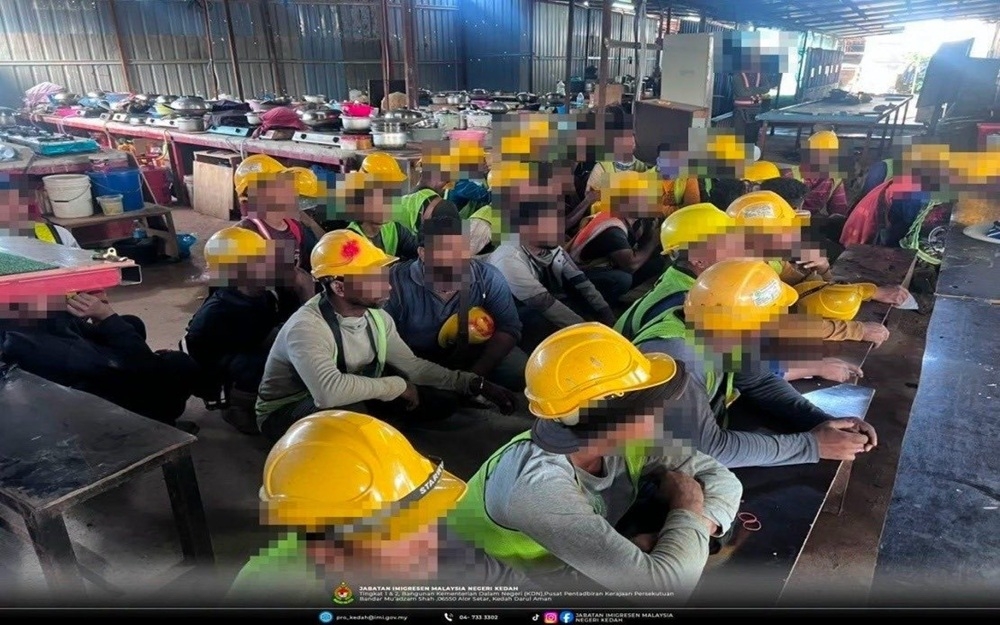
The Kedah Immigration Department has completed a significant enforcement sweep that resulted in the detention of 81 undocumented migrants at a construction site in Alor Setar. The operation, conducted as part of the broader Ops Sapu initiative aimed at combating irregular migration and document fraud, underscores the persistent difficulty Malaysian authorities face in monitoring and regulating migrant worker populations across the country's diverse sectors.
Ops Sapu represents a coordinated enforcement strategy deployed by immigration agencies to conduct unannounced inspections at high-risk locations where undocumented workers are believed to concentrate. Construction sites across Malaysia have historically proven to be significant focal points for such operations, given the sector's reliance on both documented and undocumented labour, competitive cost pressures that incentivize hiring without proper documentation, and the transient nature of employment on building projects. The Kedah site serves as a concrete example of how irregular migration continues to permeate Malaysia's critical infrastructure development activities.
The detention of 81 individuals in a single operation reflects the scale at which undocumented migration occurs within specific workplaces. While the exact circumstances surrounding their discovery remain to be detailed, such concentrations suggest that workplaces may operate with minimal scrutiny or that enforcement capacity in certain regions struggles to maintain consistent oversight. The numbers also indicate that despite successive waves of enforcement campaigns, the pull factors driving undocumented migration—including wage differentials between Malaysia and neighbouring countries, established migration networks, and labour shortages in certain industries—remain sufficiently powerful to sustain irregular movements.
From a regional perspective, Kedah's vulnerability to undocumented migration reflects its geographical positioning. As a northern state bordering Thailand, Kedah sits along established migration corridors that facilitate movement from Thailand, Myanmar, Bangladesh, and other origin countries. Proximity to international borders, combined with the state's significant construction activity and other labour-intensive industries, creates conditions where undocumented workers find employment opportunities. The state's economy relies substantially on manufacturing, agriculture, and infrastructure development, sectors characterised by high labour demand and, frequently, weak enforcement of documentation requirements.
The construction industry specifically presents recurring challenges for immigration authorities. Projects operate on tight timelines with pressure to complete phases on schedule, creating incentives for contractors to minimise hiring bureaucracy. Subcontracting arrangements further complicate oversight, as responsibility for verifying worker documentation becomes diffuse across multiple layers of employment. Workers themselves may hold fraudulent documents, making detection difficult without comprehensive verification systems. Additionally, the physical nature of construction sites—with multiple entry and exit points and constant workforce rotation—complicates monitoring efforts for authorities with limited resources.
Ops Sapu operations carry implications beyond immediate detentions. Successfully apprehended undocumented migrants enter processing pipelines where they face verification of identity, determination of nationality, and ultimately deportation or regularisation procedures. These processes consume substantial government resources, including accommodation, medical screening, administrative processing, and eventual repatriation. The detained individuals must be transported to immigration facilities, processed through databases to establish identity and migration history, and eventually returned to origin countries—a sequence requiring coordination between Malaysian agencies and diplomatic representations of worker source nations.
The broader context involves Malaysia's struggle to balance multiple policy objectives. The country requires migrant labour to sustain economic growth in sectors unable to attract sufficient domestic workers, yet must simultaneously enforce immigration laws, protect national security, prevent labour exploitation, and maintain public order. Undocumented status creates particular vulnerabilities, as workers without legal standing lack institutional protections, making them susceptible to exploitation, unsafe working conditions, wage theft, and trafficking. Authorities confront the dual challenge of enforcement and protection—apprehending irregular migrants while recognising their vulnerability to abuse.
Industrial relations implications also merit consideration. When undocumented workers compete for positions alongside documented migrants and Malaysian citizens, they suppress wage standards and working conditions across the sector. Employers hiring undocumented labour gain unfair cost advantages, disadvantaging competing firms that maintain compliant workforces. This creates perverse incentives encouraging further irregular hiring. Construction firms operating legitimately face pressure to reduce labour costs or lose contracts, potentially pushing them toward informal hiring practices. Strengthening enforcement therefore protects not merely immigration objectives but also labour market integrity and fair competition among employers.
The operation highlights practical challenges facing enforcement agencies. Immigration departments conduct targeted operations based on intelligence or complaint-driven leads, but comprehensive systematic monitoring proves resource-intensive. Building inspections into project approval processes, requiring employers to demonstrate compliant workforces, and imposing stronger penalties on firms hiring undocumented workers might create stronger deterrents. Some analysts suggest regularisation programmes offering temporary documentation to undocumented workers already employed could improve visibility while generating revenue, though such approaches involve complex policy tradeoffs and require careful administration to avoid creating incentives for further irregular migration.
Looking forward, the Kedah operation exemplifies how enforcement will likely remain cyclical—alternating periods of intensive operations, some detentions, diplomatic returns, and resumed hiring of undocumented workers. Sustainable solutions require simultaneously addressing pull factors through employer regulation, strengthening verification systems, improving labour standards to reduce exploitation of undocumented workers, and cooperating with origin countries to manage migration flows more systematically. The construction site raid in Alor Setar thus represents not merely an isolated enforcement success but rather a recurring phenomenon illustrating the complexity of managing migration in a region characterised by substantial economic disparities and persistent labour demand.
For Malaysian policymakers and regional observers, the operation underscores that temporary enforcement surges, while necessary, prove insufficient without complementary structural reforms. Effective migration management requires sustained institutional investment, employer accountability mechanisms, worker protection frameworks, and regional cooperation—elements that demand consistent political commitment and resource allocation extending beyond individual Ops Sapu exercises.

