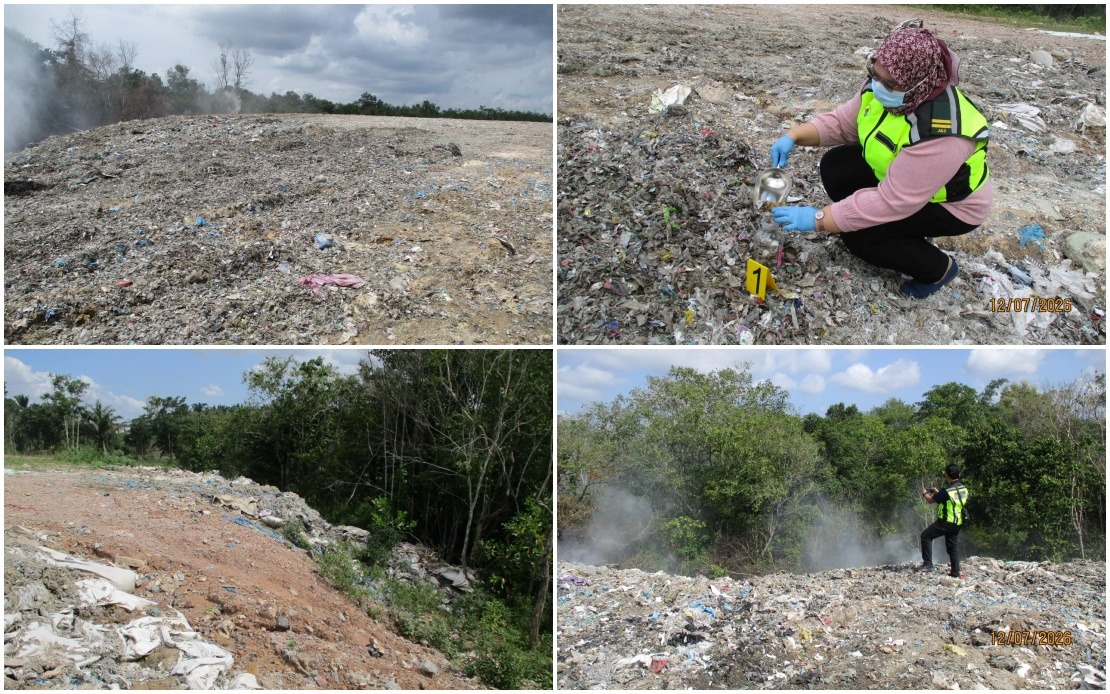
The Kedah Department of Environment has uncovered an illegal solid waste disposal facility operating in Bukit Banyan near Sungai Petani, complete with unauthorised open burning practices that sparked complaints from nearby residents. According to Sharifah Zakiah Syed Sahab, the state DOE director, inspectors descended on the location after receiving public reports of acrid smoke drifting through the neighbourhood. What they discovered was a concerning breach of environmental protocols that underscores persistent challenges in waste management enforcement across Malaysia's northern states.
Upon site inspection, environmental officers confirmed that roughly 250 square metres of cleared land had been converted into an informal dump for domestic refuse. The presence of smoke and smouldering waste indicated that individuals at the location had been deliberately igniting the accumulated rubbish, a practice commonly employed by unscrupulous waste handlers attempting to recover valuable metals embedded within discarded electronics and other industrial refuse. This method of metal extraction is particularly hazardous, releasing toxic fumes and heavy metals into surrounding air and soil while generating minimal recovery value compared to organised recycling processes.
Investigations revealed that the dumping operation lacked any formal authorisation from the director-general of the Environment Ministry, a fundamental requirement for any waste disposal enterprise. The pattern of activity suggests that a contractor engaged in collecting domestic waste from industrial zones throughout the district had established this unauthorised site as a convenient but illegal processing point. Rather than transporting collected materials to licensed facilities, the contractor appears to have opted for this clandestine arrangement, saving costs whilst disregarding environmental and public health implications.
The discovery highlights a recurrent problem in Malaysia's waste management sector: the disconnect between regulatory frameworks and actual enforcement capacity. While comprehensive legislation exists to govern solid waste handling, the reality on the ground often involves small operators exploiting gaps in monitoring and inspection regimes. In this instance, the illegal operation managed to persist long enough to generate public complaints—suggesting it may have been functioning for some time before detection. The voluntary complaint mechanism, whilst valuable, should ideally complement rather than substitute for proactive enforcement.
Environmental authorities have moved swiftly to pursue legal action, invoking two separate provisions of the Environmental Quality Act 1974. Section 29A(1) addresses the open burning violation specifically, whilst Section 34A(6) targets the operation of an unlicensed waste disposal facility. These charges carry meaningful penalties under Malaysian law, though observers note that actual sentencing and enforcement varies considerably depending on prosecutorial resources and judicial interpretation. The involvement of multiple regulatory frameworks—state DOE, Department of Chemistry, and the Solid Waste and Public Cleansing Management Corporation—indicates the complexity of environmental prosecution in Malaysia's federal system.
Additional investigative steps include collection of solid waste samples destined for laboratory analysis by the Department of Chemistry. This scientific component strengthens the prosecution case by documenting the composition and contamination levels present at the site, potentially revealing hazardous materials beyond simple domestic refuse. Such analysis also creates an evidentiary trail that makes legal challenges more difficult to sustain, whilst establishing baseline environmental damage that could inform remediation orders.
The case will eventually transfer to SWCorp, the statutory authority responsible for solid waste oversight and enforcement nationwide. SWCorp's involvement signals a transition from investigation to long-term compliance monitoring, should the operator attempt to legalise operations or relocate activities elsewhere. This handover also ensures that specialised waste management expertise informs the enforcement approach rather than relying solely on environmental department capacity.
For Malaysian readers, this incident reflects broader waste management tensions currently affecting the region. As industrialisation accelerates and consumption patterns shift, illegal dumping has become increasingly common in areas where formal disposal infrastructure lags behind waste generation rates. Kedah, like many states, struggles to balance development pressures with environmental protection. The proliferation of unorganised contractors in the waste sector creates ongoing vulnerabilities, particularly for hazardous or contaminated materials.
The case also underscores public vigilance as a crucial enforcement tool. Without resident complaints, the Bukit Banyan operation might have continued indefinitely. However, reliance on reactive complaints rather than systematic monitoring represents a significant enforcement gap. Authorities across Malaysia could benefit from enhanced predictive targeting of high-risk zones, potentially using satellite imagery, industrial activity mapping, and contractor licensing data to identify vulnerable locations before illegal operations become established.
Moving forward, this enforcement action may deter similar operations in the immediate vicinity, at least temporarily. However, addressing the root cause requires addressing the economic incentives driving informal waste handling. Licensed operators face higher compliance costs than unlicensed competitors, creating pressure to undercut through substandard practices. State governments working with industry bodies to develop more accessible formalisation pathways—including tiered licensing for smaller operators and support for upgrading facilities—may prove more effective than enforcement alone in shifting market dynamics toward environmental compliance.

