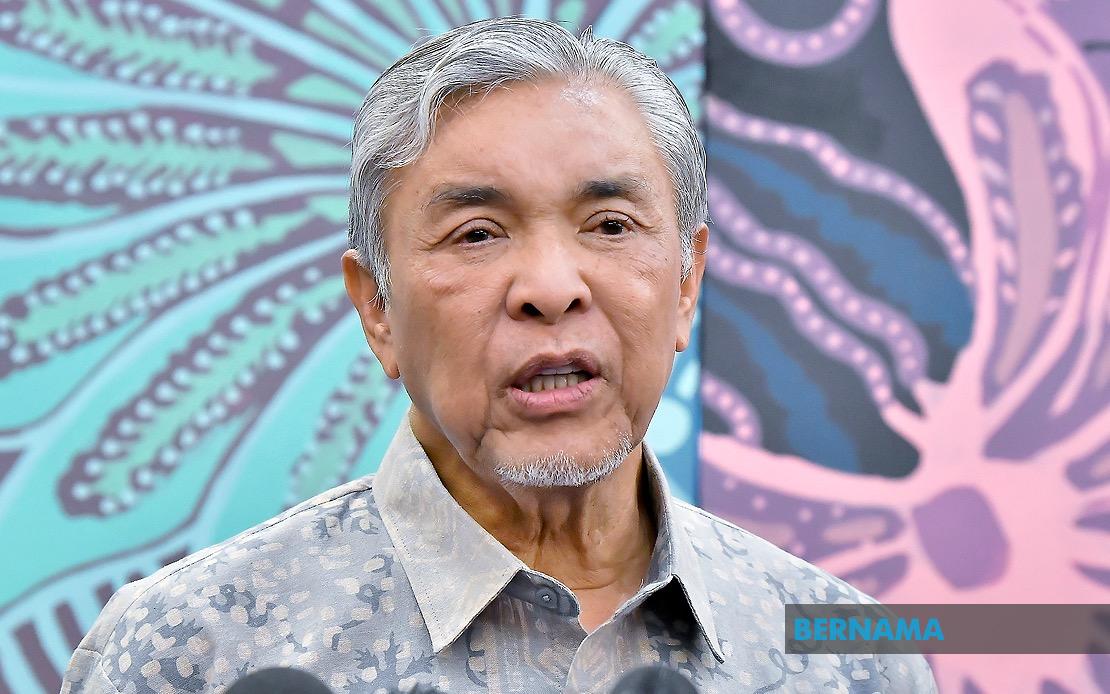
Deputy Prime Minister Datuk Seri Dr Ahmad Zahid Hamidi has sought to correct widespread public misunderstanding about the South East Johor Development Authority's planned territorial expansion, emphasizing that the agency's objective is to orchestrate coordinated development rather than accumulate land ownership across the affected districts. Speaking at an official ceremony in Kota Tinggi, Ahmad Zahid, who simultaneously holds the portfolio of Rural and Regional Development Minister, underscored the critical distinction between KEJORA's expansionist ambitions and the often-contentious practice of large-scale land acquisition that sometimes accompanies governmental consolidation initiatives.
The clarification reflects sensitivity to concerns that have periodically surfaced in Malaysian discourse about state agencies leveraging development mandates to accumulate property assets. Ahmad Zahid's intervention suggests awareness that public perception of land-grabbing can undermine support for otherwise beneficial regional initiatives. By framing the expansion as fundamentally about synchronizing disparate development activities rather than property consolidation, the deputy premier appears to have calculated that transparency regarding KEJORA's true intentions will strengthen rather than weaken backing for the proposal among rural and regional stakeholders who depend on coordinated infrastructure investment.
At the heart of KEJORA's case for territorial expansion lies an impressive operational record that provides empirical grounding for the authority's confidence. The agency has achieved a 98.3 per cent success rate across its implemented projects, a metric that substantially exceeds typical benchmarks for Malaysian development authorities. This track record, Ahmad Zahid argued, constitutes the principal rationale driving the expansion proposal and validates the agency's request for expanded operational scope. The demonstrated ability to deliver results consistently creates institutional credibility that extends beyond bureaucratic circles into public consciousness, particularly in the south-eastern Johor communities where residents have experienced tangible benefits from KEJORA-coordinated initiatives.
Pengerang, the rapidly developing peninsula district emerging as a focal point for regional economic transformation, exemplifies how KEJORA's coordination model translates into concrete prosperity. The district is experiencing accelerated growth driven by substantial mega-projects and tourism sector expansion, developments that require sophisticated coordination mechanisms to prevent inefficiency and ensure complementary rather than conflicting investments. Ahmad Zahid specifically referenced Pengerang's trajectory as evidence that KEJORA's expanded mandate would support the Johor government's broader ambitions to distribute development advantages across the entire south-eastern region rather than concentrate them in established urban centres.
Public consultation conducted by KEJORA itself reveals substantial grassroots receptivity to the expansion initiative, with 96 per cent of survey respondents expressing support. While opinion research sponsored by agencies promoting their own expansion should always be interpreted with appropriate caution regarding potential bias, such overwhelming endorsement does suggest that regional communities perceive genuine benefits from KEJORA's operations. This high level of acceptance indicates that residents view the authority less as a threatening external imposer of development visions and more as an effective instrument for realizing their own aspirations for infrastructure improvement and economic opportunity.
The expansion proposal nonetheless remains contingent upon constitutional and institutional requirements that reflect Malaysia's federal structure and hereditary monarchy. Ahmad Zahid emphasized that formal approval requires explicit consent from His Majesty Sultan Ibrahim and the Regent of Johor, Tunku Mahkota Ismail. This constitutional gatekeeping ensures that state and royal authorities retain ultimate authority over territorial reorganization decisions, preventing the federal ministry from unilaterally reconfiguring regional boundaries or developmental jurisdictions. The invocation of these formal requirements demonstrates respect for federal-state protocols and the constitutional position of the Johor monarchy, constituencies that must ultimately endorse any significant expansion of KEJORA's operational domain.
Financial commitment to regional development through KEJORA remains substantial, with the Rural and Regional Development Ministry allocating approximately RM138 million for projects across the designated area. This capital allocation has already enabled implementation of 107 distinct programmes, with approximately 350 additional smaller-scale projects queued for commencement once funding disbursement proceeds. The scale of this financial injection underscores the centrality of KEJORA-coordinated development to federal strategy for reducing regional inequality and promoting growth in geographically peripheral but strategically important areas of Peninsular Malaysia.
Minister in the Prime Minister's Department (Law and Institutional Reform) Datuk Seri Azalina Othman Said, who represents Pengerang in Parliament, amplified the case for regional administrative reorganization by proposing elevation of Pengerang to full district status. Azalina's proposal complements the KEJORA expansion initiative by addressing governance structures appropriate to Pengerang's accelerating development trajectory. She further advocated construction of a new hospital facility to serve the district's expanding population, a proposal that acknowledges the public health infrastructure deficiencies that typically accompany rapid economic growth when investment patterns emphasize commercial and industrial development over essential services. Ahmad Zahid's expressed support for Azalina's dual proposal—district elevation and hospital construction—signals alignment between federal development strategy and parliamentary representation from growth districts, suggesting coordinated advancement of complementary initiatives.
The expansion proposal represents a distinctive model of regional development governance that merits careful scrutiny from Malaysian policy observers. Rather than concentrating development authority within expanded state apparatus, KEJORA operates as a coordinating mechanism that can synchronize investment activities conducted by multiple agencies and private sector participants. This coordination approach theoretically maximizes development impact by preventing duplicative infrastructure investment and ensuring complementary sequencing of projects across connected sectors. For south-eastern Johor specifically, and potentially as a model for other Malaysian regions experiencing similar growth dynamics, KEJORA's expansion may offer a sophisticated alternative to both purely market-driven fragmentation and centralized state control over development decisions.
The deputy premier's public reassurance regarding land acquisition reflects deeper questions about developmental legitimacy in Malaysian federalism. Many rural and peripheral communities harbor historical anxieties about governmental expropriation or displacement, sensitivities rooted in previous experiences with infrastructure projects and commercial land acquisition. By explicitly disavowing land acquisition ambitions, Ahmad Zahid attempts to reposition KEJORA expansion as an initiative that enhances regional agency rather than threatens communal asset security. Whether this assurance fully addresses resident concerns will likely depend on transparent demonstration that KEJORA's expanded coordination mandate genuinely serves community interests rather than subordinating local development priorities to centralized planning preferences.

