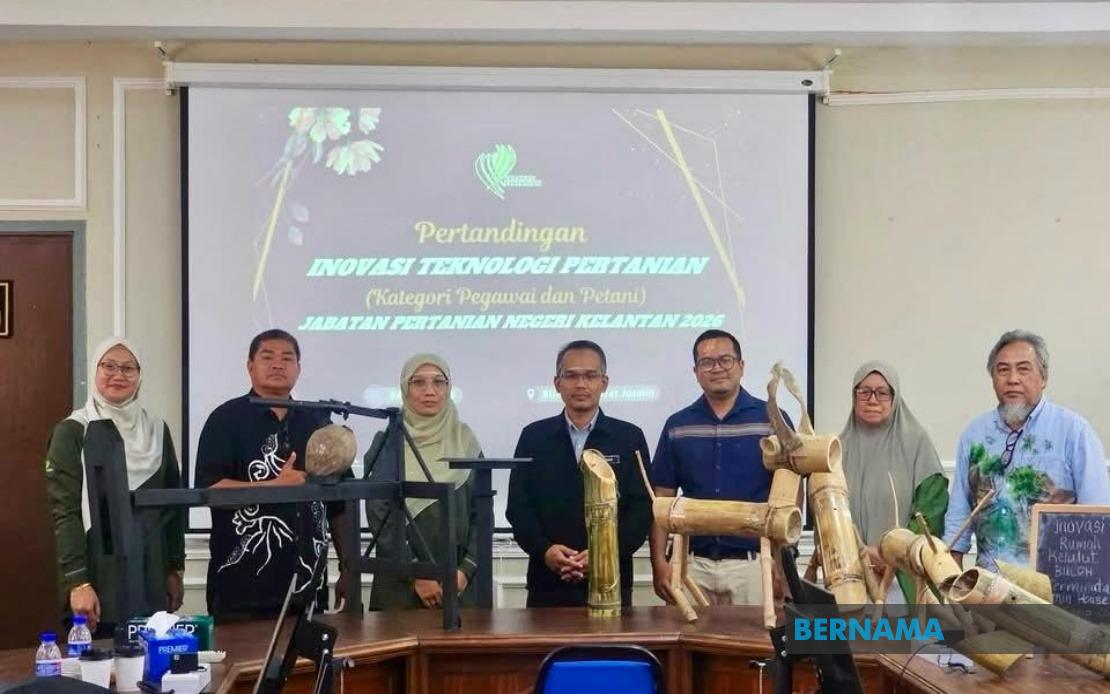
An agricultural innovation that could transform how Southeast Asian farmers process tropical fruits has emerged from a small farm in Kelantan. Che Adnan Che Kadir, a 56-year-old plantation entrepreneur, has developed a coconut dehusking device that judges at the Kelantan Department of Agriculture's 2026 Agricultural Technology Innovation Competition awarded a four-star rating, with recommendations that it be adapted for processing durians—a crop far more valuable and labour-intensive than coconuts across the region.
Che Adnan's invention addresses a genuine pain point in coconut farming. Traditional hand dehusking methods require two to three minutes per fruit and carry significant injury risk for workers. His portable 3.5-kilogram device cuts processing time to approximately one minute per coconut, with experienced operators reducing this to 40 to 45 seconds. For a farmer managing a six-hectare plot in Kampung Chetok, Pasir Mas, such efficiency gains translate directly to reduced labour costs and faster harvest cycles—advantages that matter acutely in an industry operating on thin margins.
The innovation holds particular significance for Malaysian and broader Southeast Asian agriculture given the region's dominance in durian production. While coconut processing represents an established market, durian handling presents unique challenges that currently favour manual labour. Opening durians safely requires considerable skill and experience; improper technique risks fruit damage and worker injury. The competition's judging panel, comprising representatives from the Kelantan Department of Agriculture, the Malaysian Agricultural Research and Development Institute (MARDI), and local polytechnics, specifically identified durian processing as the primary adaptation target after recognising the device's technical potential.
Che Adnan's journey reflects how farm-level innovation often emerges from practical necessity rather than corporate research departments. He initially developed the device in 2024 to solve specific challenges on his own holding, seeking to reduce workplace injuries while maintaining productivity. The recognition at the state-level competition validates an approach increasingly central to agricultural modernisation in Malaysia—where smallholder farmers innovate incrementally to solve local problems, then scale solutions across regions.
The competition framework itself demonstrates institutional support for grassroots innovation. That the Department of Agriculture facilitated Che Adnan's participation at the state level, with assessment conducted by government researchers and polytechnic experts, suggests a structured pathway for farmer-inventors. His success has positioned him for potential representation at the national level during National Innovation Week in Putrajaya at the end of September, providing visibility and potentially access to broader commercialisation networks.
Financial support remains critical to transforming the prototype into a market-ready product. Che Adnan has identified the need for an innovation grant to refine the design and optimise production capacity according to commercial requirements. The national competition offers a RM10,000 prize, which while modest in absolute terms, provides crucial funding for prototype iteration and testing. Such grant mechanisms acknowledge that moving from functional prototype to commercially viable product requires capital beyond the reach of most individual farmers.
The durian adaptation represents a compelling business opportunity. Malaysia, Thailand, and Indonesia collectively dominate global durian production and export, with demand growing across Asia and increasingly in international markets. However, durian processing remains labour-intensive and seasonal, creating bottlenecks that limit production capacity. A mechanised solution that maintains fruit quality while reducing processing time could unlock significant productivity gains across the supply chain, from farm gates to processing facilities preparing export-quality products.
Safety considerations strengthen the commercial case. Durian processing injuries are commonplace in plantation regions; a device reducing hand and blade injuries while maintaining consistency would appeal to larger producers seeking to improve workplace safety standards. This aligns with evolving regulations across Southeast Asia that increasingly mandate occupational safety compliance, creating regulatory incentives alongside economic ones.
The broader context involves Malaysia's agricultural technology agenda. The nation has invested substantially in agricultural innovation infrastructure, recognising that productivity improvements rather than land expansion offer the primary path to sectoral growth. Innovations like Che Adnan's device, even if modest in technological complexity, contribute to a cumulative shift toward mechanisation and efficiency across the farming sector. Scaling such innovations regionally could meaningfully affect Malaysia's agricultural competitiveness as labour costs rise and younger populations move away from farming.
Che Adnan's willingness to adapt his device for different crops—from coconuts to areca nuts to durians—highlights an important principle in agricultural technology transfer: solutions developed for one commodity often address fundamental processing challenges applicable across multiple crops. This modularity increases the commercial potential and justifies investment in product development and manufacturing infrastructure.
International dimensions warrant consideration. MARDI's involvement in assessment suggests potential pathways for technology documentation and sharing with regional agricultural research networks. Solutions to problems faced by Malaysian farmers often apply equally to counterparts in Thailand, Indonesia, and other coconut and durian-producing nations, creating export markets for agricultural machinery and licensing opportunities.
The timeline remains fluid. Before advancing to national competition and commercialisation, Che Adnan must refine the design based on judges' recommendations and secure appropriate funding. The competitive field will include other innovations from across Malaysia's agricultural sector, all competing for the same pool of resources and market attention. Nevertheless, his device's four-star rating and specific identification of a major commercial application position him favourably within that competitive landscape.
Ultimately, Che Adnan's innovation exemplifies how incremental, farmer-driven improvements can address genuine inefficiencies in tropical agriculture. Whether the durian adaptation succeeds commercially depends on factors beyond the device's technical merit—manufacturing expertise, market adoption, regulatory approval, and capital availability. Yet the trajectory from personal farm problem to recognised innovation to potential regional commercialisation illustrates pathways through which Malaysian agricultural modernisation advances.

