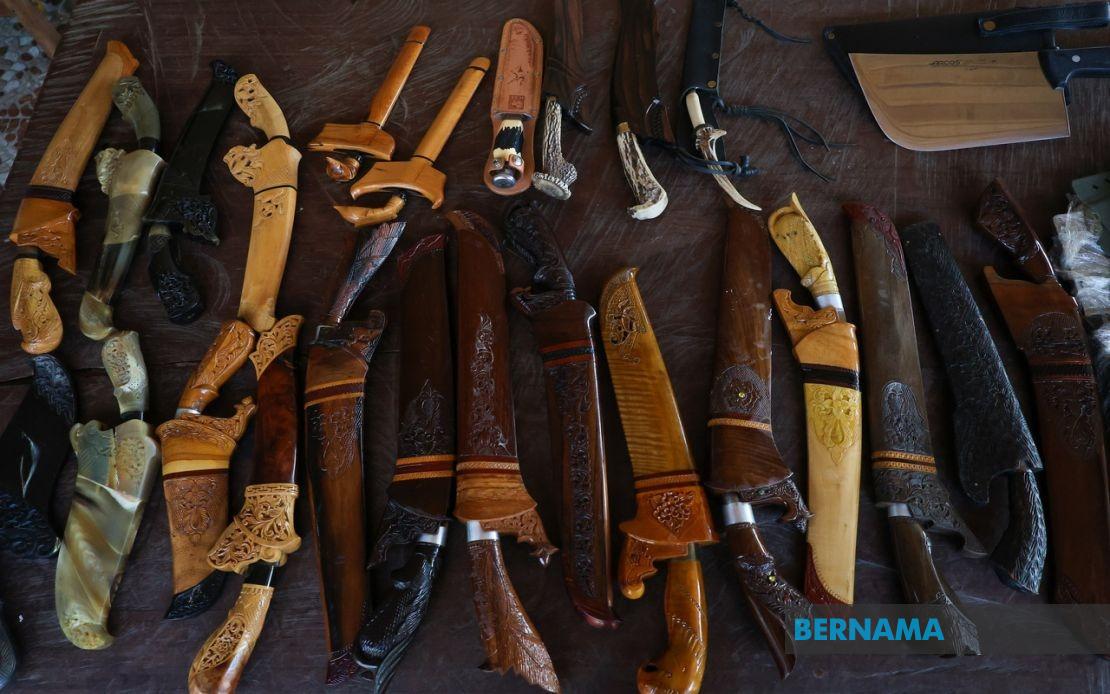
Ahmad, a 71-year-old custodian of Kelantan's metalworking traditions, stands as a living bridge between the state's storied past and an uncertain future. His commitment to preserving the region's blacksmithing legacy has taken concrete form through an extensive private collection of handcrafted blades and traditional weapons, now numbering more than 100 pieces worth approximately RM20,000. In an era when fewer young artisans are learning the intricate skills passed down through generations, Ahmad's meticulous stewardship of these artefacts represents a quiet but determined effort to prevent irreversible cultural loss.
The heart of Ahmad's collection centres on a particular treasure—the bird-headed golok, a machete featuring a distinctive bird-shaped hilt that carries profound historical resonance. This design element reflects more than aesthetic preference; it embodies centuries of Kelantan's artistic vocabulary. The bird motif draws inspiration from the Petalawali figure that graced traditional Kelantan sultanate vessels, connecting contemporary blades to maritime heritage and royal symbolism from a pre-colonial era. Each handcrafted example in Ahmad's possession represents a unique artistic statement, as master blacksmiths traditionally imprinted their work with distinguishing flourishes that made every blade unmistakably their own creation.
What makes Ahmad's preservation work particularly urgent is the demographic reality confronting Kelantan's traditional metalworking community. Multiple master craftsmen have passed away in recent years, taking with them not merely their products but entire repositories of knowledge and technique. The skills required to forge these weapons—understanding metal composition, heat application, finishing touches, and decorative carving—cannot be adequately documented in written form; they demand direct apprenticeship and years of hands-on practice. Ahmad emphasises that whenever a blacksmith dies without having transmitted their expertise to a successor, a fragment of authentic craftsmanship vanishes permanently, unable to be reconstructed by future generations relying solely on finished pieces or incomplete records.
The practical value of the bird-headed hilt extends beyond its symbolic weight. Ahmad explains that the curved, avian-inspired grip provides ergonomic advantages that centuries of refinement have proven effective for handling and wielding the blade. The design accommodates the human hand naturally, distributing weight and stress across the palm in ways that purely utilitarian grips cannot achieve. This fusion of form and function demonstrates how traditional craftspeople integrated artistic expression with practical engineering, creating objects that satisfy both aesthetic and operational requirements simultaneously.
Maintaining such collections demands rigorous discipline and technical knowledge. Ahmad has established careful protocols to prevent deterioration and rust damage that naturally threatens metal artefacts stored across decades. His preservation approach involves housing the weapons in a dedicated cabinet equipped for climate control and dust prevention. Every three months, Ahmad conducts thorough inspections of individual pieces, assessing their condition and applying protective oils to blade surfaces. This preventive maintenance regime reflects his understanding that cultural heritage in material form requires active, ongoing stewardship rather than passive storage.
The origins of Ahmad's involvement with this world trace back approximately two decades, when he began collaborating with a friend working as a blacksmith. What started as helping craft hilts and scabbards evolved into a passionate engagement with traditional weaponry. His collecting interests have since expanded far beyond Kelantan's borders, drawing acquisitions from Germany, Sweden, Denmark, England, the United States, Japan, China, Spain and Portugal. These international pieces—including a knife bearing a Sarawak deer-antler hilt and a keris constructed from black kemuning wood with a golden kemuning wood handle—demonstrate how Ahmad contextualises Kelantan's traditions within broader patterns of global metalworking heritage.
Despite consistent interest from collectors and dealers willing to pay substantial sums, Ahmad has consistently refused to sell individual pieces. His reasoning reflects a curatorial philosophy that transcends commercial valuation. Many blades in his collection were created by now-deceased blacksmiths whose distinctive techniques cannot be replicated, making each example genuinely irreplaceable. To Ahmad, selling such pieces would constitute cultural dispersion—scattering irreplaceable tokens of Kelantan's heritage across private collections where they might become isolated from their broader historical context or even lost to public knowledge entirely.
The broader implications of Ahmad's work extend into questions about how Southeast Asian nations preserve artisanal traditions amid rapid modernisation. Kelantan's blacksmithing heritage represents a category of intangible cultural assets that governments increasingly recognise as endangered. Unlike museums that can display objects behind protected cases, living crafts depend on practising artisans who transmit knowledge through demonstration and repeated practice. The gap between current practitioners and interested younger generations has widened substantially, with vocational training institutions showing declining enrolment in traditional metalworking programmes.
Ahmad's vision for sustaining this heritage balances preservation with pragmatism. He advocates for continuing traditional weapon-making through innovation that respects core artistic and cultural values rather than pursuing purely nostalgic recreation. This approach acknowledges that crafts must evolve to survive; techniques developed for ancient warfare serve little practical purpose in contemporary society, yet the underlying principles of design, proportion, decoration and functional excellence remain relevant to modern applications. By encouraging innovation grounded in traditional understanding, Ahmad suggests that Kelantan's blacksmithing legacy need not exist only in museums or private collections.
The challenge facing Ahmad and others concerned with craft preservation involves creating pathways for knowledge transmission in an economy where fewer families encourage children to pursue demanding artisanal careers. Master blacksmithing requires years of training, physical labour, modest financial returns compared to professional alternatives, and deep commitment to continuous improvement. Without deliberate institutional support—whether through apprenticeship programmes, cultural heritage grants, or demonstration venues that make craft visible to younger generations—the intergenerational transmission line risks severing entirely within a decade or two.

