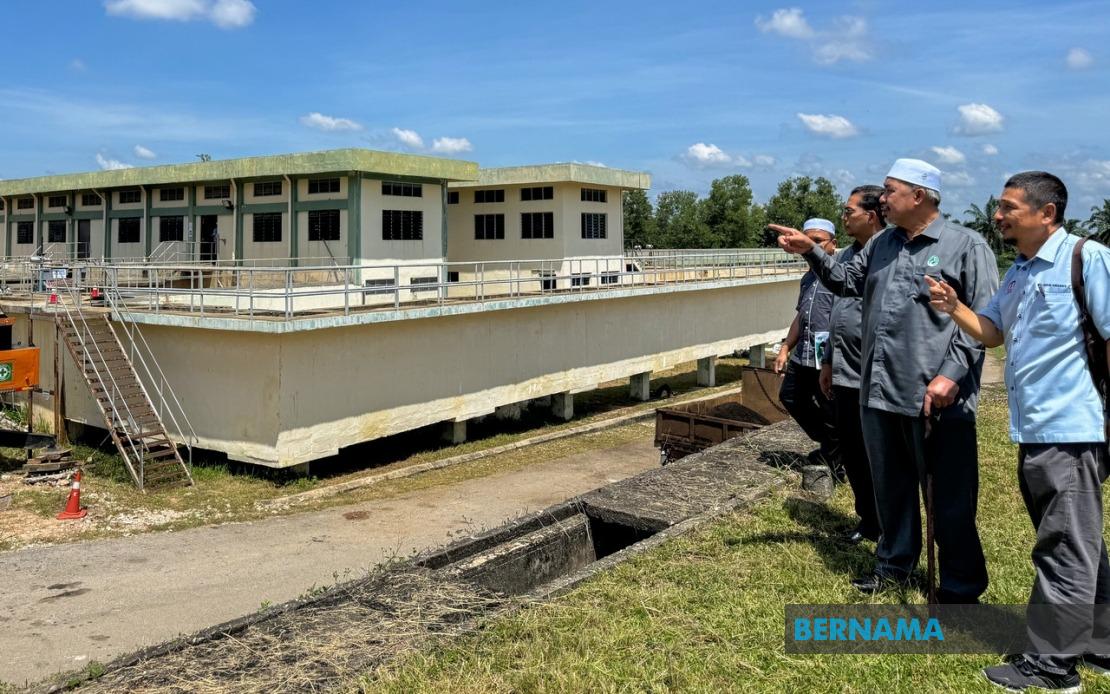
Approximately 34,000 households spread across Machang, Pasir Puteh, and southern Kota Bharu face an imminent end to their persistent water woes. Come September, residents in these Kelantan districts will receive noticeably improved water supply following the completion of a RM11.5 million modernisation project at the Merbau Chondong Water Treatment Plant, which has substantially expanded the facility's treatment capabilities.
The scale of the upgrade is significant for a state long plagued by supply irregularities. The plant's daily production capacity will surge to 80 million litres from its previous ceiling of 45 million litres—a jump exceeding 75 per cent. This expansion addresses a longstanding operational constraint that had limited Air Kelantan Sdn Bhd's ability to boost output without compromising water quality, a balancing act that had defined the company's approach to managing scarcity across the state.
According to Datuk Dr Izani Husin, chairman of Kelantan's Public Works, Infrastructure, Water and Rural Development Committee, the technological transformation underpinning this expansion relies on Xylem's Underdrain Leopold filtration system. This advanced infrastructure enables the plant to process between 70 million and nearly 90 million litres of raw water daily while maintaining stringent quality standards. The investment represents a deliberate shift toward capacity-building rather than rationing, a strategic pivot that recognises the region's growing demand.
Water purity has improved dramatically alongside production gains. The plant has successfully reduced its Nephelometric Turbidity Unit reading from over 10 NTU to 3 NTU, a metric that directly measures clarity and indicates removal of suspended particles and contaminants. For end users, this translates to cleaner water emerging from household taps, addressing quality concerns that have accompanied intermittent supply issues.
The timing of the upgrade's completion carries particular importance for Kelantan's development trajectory. Scheduled for full activation in early September, the enhanced system arrives at a critical juncture when the state confronts dual pressures: immediate relief for water-stressed communities and laying groundwork for future growth. The transition from crisis management to proactive infrastructure improvement marks a notable shift in how Kelantan approaches its water security challenge.
Beyond the immediate relief, state authorities are already charting the next phase of water infrastructure expansion. A partnership between the Kelantan government and Pengurusan Aset Air Berhad envisions a new facility called Machang 1 Water Treatment Plant, a RM120 million investment designed to produce 50 million litres daily. Officials anticipate completion by 2030, which would allow the upgraded Merbau Chondong plant to redistribute its expanded capacity toward other districts facing shortages. This cascading approach to infrastructure suggests recognition that water scarcity extends throughout Kelantan rather than remaining confined to these three districts.
The Machang 1 project remains in preliminary stages, awaiting formalisation of agreements between state authorities and PAAB before contractors can be appointed. While the timeline stretches across six years, the commitment signals confidence in the viability of the upgrade strategy now being implemented at Merbau Chondong. Successful execution of the current project will likely prove instrumental in securing the political and financial backing necessary for the larger, costlier facility.
Nationwide context underscores why this Kelantan initiative warrants attention beyond state boundaries. Water supply disruptions plague multiple Malaysian states, and the engineering solutions employed here—particularly the Xylem filtration advancement—offer blueprints for regions facing similar challenges. As climate variability increases pressure on water resources across Southeast Asia, infrastructure upgrades that simultaneously expand capacity and improve quality demonstrate a model other water utilities might adapt to local conditions.
Progress on the broader water supply issue in Kelantan shows measurable momentum. Air Kelantan has resolved approximately 70 per cent of water supply problems affecting roughly 270,000 user accounts across the state. The utility has committed to achieving at least 90 per cent resolution by 2035, implying that interventions like the Merbau Chondong upgrade represent consecutive incremental steps toward that ambitious target. Each completed project contributes to closing a substantial operational gap that has constrained development in affected areas.
For the 34,000 account holders awaiting September's activation, the upgrade promises tangible improvements to daily life. More predictable water availability enables businesses to operate without accommodation for supply interruptions, allows households to plan consumption without rationing, and reduces the health risks associated with intermittent service that can compromise water quality through infrastructure degradation. The psychological relief of moving from chronic scarcity to stable supply carries economic dimensions often overlooked in infrastructure assessments.
The broader implications extend to investor confidence in Kelantan's infrastructure trajectory. Consistent utilities remain foundational to attracting manufacturing and commerce, particularly in districts like Machang which possess geographic advantages for regional trade. As the state diversifies its economic base beyond traditional sectors, demonstrated commitment to essential services sends important signals to prospective investors evaluating operational feasibility in the region.
Success at Merbau Chondong also establishes institutional capacity for managing larger, more complex projects like Machang 1. The technical expertise, project management discipline, and stakeholder coordination required to execute a RM11.5 million upgrade provide organisational foundations for delivering a RM120 million facility. In this sense, the current project functions simultaneously as immediate relief and as a proving ground for the capabilities Kelantan will need to sustain infrastructure improvements through the coming decade.

