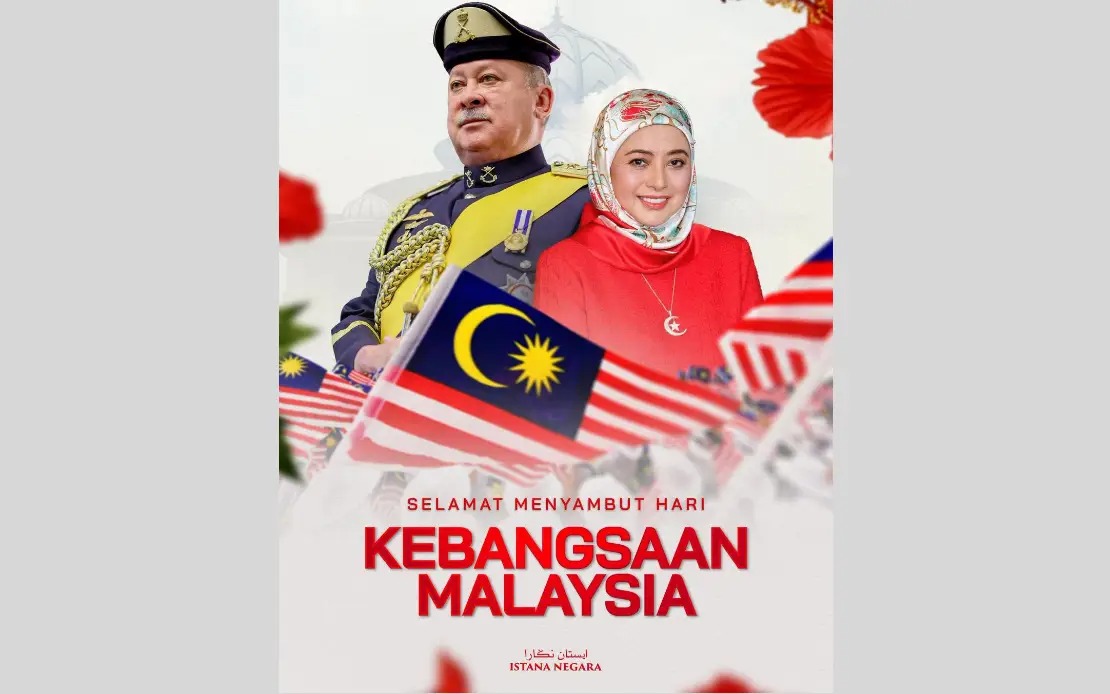
Malaysia's sovereign and consort, Sultan Ibrahim Sultan Iskandar and Raja Zarith Sofiah, jointly presided over the nation's 69th National Day commemoration in Putrajaya on August 31, extending heartfelt greetings to all citizens through an official royal message published on the King's Facebook page. The royal presence underscored the significance of the occasion, which celebrates Malaysia's independence and collective identity as a diverse, multicultural nation committed to shared prosperity.
Their Majesties arrived at the Putrajaya venue early in the morning, where they were ceremoniously greeted by Prime Minister Datuk Seri Anwar Ibrahim and his wife, Datuk Seri Dr. Wan Azizah Wan Ismail. Communications Minister Datuk Seri Fahmi Fadzil, who chairs the National Day and Malaysia Day (HKHM) 2026 Main Committee, also participated in welcoming the royal guests, reflecting the coordinated government effort to deliver a memorable national observance.
This year's celebration carried the thematic banner "Malaysia MADANI: Kesejahteraan Dinikmati," a phrase that translates to "Malaysia MADANI: Wellbeing Enjoyed," encapsulating the government's philosophical framework for development that places citizen welfare and societal cohesion at its core. The theme reflects contemporary policy priorities emphasising inclusivity, prosperity distribution, and the acknowledgment of Malaysia's pluralistic character as a foundational strength rather than a challenge.
The ceremonial proceedings commenced with a formal military display, establishing the solemn tone befitting a national milestone. This was succeeded by a series of stage performances showcasing Malaysia's rich cultural heritage, with artists and performers representing the myriad communities that comprise the nation. The entertainment segments deliberately wove together artistic expressions drawn from Malay, Chinese, Indian, indigenous, and other Malaysian traditions, visually and aurally demonstrating the harmonious coexistence of diverse groups under a shared national banner.
A particularly striking component of the festivities was the grand parade and march-past, which mobilised an impressive assembly of participants spanning multiple sectors of society. The procession involved 10,819 individuals organised across 76 contingents, representing government agencies, civil society organisations, youth groups, and community associations. Accompanying this human tableau were 22 brass bands providing rhythmic accompaniment, 11 specially decorated vehicles carrying thematic displays, and an array of 328 military, naval, and air force assets that demonstrated national defence capabilities.
The parade's composition reflected meticulous planning to ensure comprehensive representation of national institutions and values. Service animals, numbering 112, added an unexpected element of pageantry, whilst 22 electric vehicles highlighted the government's commitment to environmental sustainability and modern technological integration. These elements combined to create a visual narrative of Malaysia as a nation balancing tradition with progressive aspirations.
One of the most visually compelling segments involved a human graphic display orchestrated across multiple terraces. Comprising 26 distinct formations, this element required extensive coordination and rehearsal, with participants arranged to create dynamic patterns and symbols representing Malaysia's multicultural tapestry. Such displays serve as potent reminders that national unity emerges not from uniformity but from the deliberate, organised coming-together of distinct communities in common purpose, a message particularly resonant in contemporary Malaysia where social cohesion remains a priority amid ongoing political and social negotiations.
The scale of this year's observance—with participation numbering in the tens of thousands when counting all performers, security personnel, and support staff—reflects the Malaysian government's investment in the symbolic and morale-boosting dimensions of national celebrations. Beyond the immediate spectacle, such events function as annual reaffirmations of collective identity and are particularly significant in multiethnic societies where explicit demonstrations of unity and shared pride serve important nation-building functions.
For Malaysian citizens and regional observers, the prominence accorded to the Malaysia MADANI theme carries policy implications extending beyond ceremonial rhetoric. The emphasis on wellbeing and inclusivity signals governmental priorities in upcoming legislative and budgetary agendas, suggesting focus areas including equitable economic distribution, accessible public services, and continued efforts at inter-community dialogue and cooperation. The celebration thus operates simultaneously as commemoration, propaganda, and policy preview, embedding future governance commitments within festive national remembrance.
The coordination demonstrated in executing such a large-scale event—involving multiple government ministries, the armed forces, local authorities, and community organisations—also showcases institutional capacity and administrative efficiency. For Southeast Asian nations grappling with governance challenges, Malaysia's ability to mobilise resources for grand public events reflects institutional maturity, though critics might note tensions between expenditure on ceremonial spectacle and resource allocation to substantive social programmes that directly address citizen welfare.

