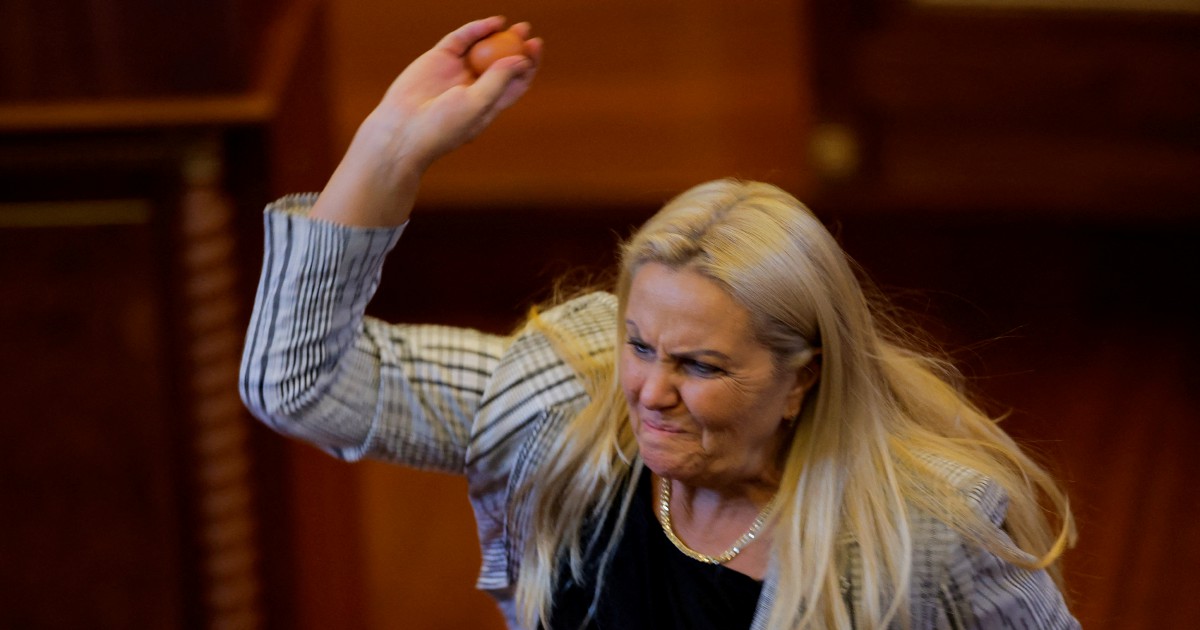
Kosovo's parliament ground to a halt on Saturday following an extraordinary outburst in which an opposition lawmaker flung eggs at caretaker Prime Minister Albin Kurti, exposing the volatile state of politics in the Balkan nation. The incident forced procedural suspension of parliamentary business and underscored the severity of an ongoing governance impasse that now risks pushing the country toward another snap election.
The egg-throwing incident represents far more than parliamentary theatre. It is symptomatic of the deteriorating relationship between Kosovo's governing coalition and its parliamentary opposition, a fracture that threatens institutional stability at a sensitive moment when the country faces pressing challenges including European Union integration efforts, normalisation of relations with Serbia, and economic reform. The physical confrontation during parliamentary proceedings—rare in contemporary European legislative settings—indicates how thoroughly conventional political discourse has fractured.
Albin Kurti's position as caretaker premier places him in an exceptionally precarious political position. In Kosovo's complex political architecture, caretaker administrations typically operate with limited authority and are expected to manage day-to-day governance while avoiding major policy decisions pending formal government formation. However, Kurti has proven unwilling to observe these conventional boundaries, a stance that has inflamed opposition complaints that he is wielding executive power beyond his formal mandate.
The broader political crisis underlying Saturday's disruption stems from fundamental disagreements over Kosovo's governance direction and the composition of future coalitions. Kosovo's fractious political landscape, characterised by deeply rooted ethnic, ideological, and personal rivalries, has repeatedly produced deadlock situations where competing groups struggle to assemble functional legislative majorities. These structural problems are compounded by the country's relatively young democratic institutions, which lack deep roots and face persistent questions about legitimacy and representation.
The prospect of another snap election carries substantial implications for Kosovo's development trajectory. Electoral cycles drain resources, distract political leaders from substantive policy work, and often produce minimal shifts in underlying power distributions—merely rotating the cast while maintaining structural deadlock. For Kosovo, already challenged by lagging economic development, weak institutional capacity, and regional security concerns, repeated elections represent a luxury the nation can scarcely afford.
Regional stability considerations add another dimension to Kosovo's internal political turbulence. The Balkans remain a strategically sensitive zone where internal instability can invite external interference from neighbouring states, particularly Serbia and Russia, which have competing interests in Kosovo's political direction. Extended periods of political uncertainty and weak governance create openings for destabilising external actors to exploit internal divisions. The international community, including the European Union and United States, has long maintained close involvement in Kosovo affairs precisely because of these regional ramifications.
Kurti himself has become a polarising figure, embodying competing visions for Kosovo's future. His supporters credit him with taking stronger positions on rule-of-law issues and European integration standards, while critics accuse him of overstepping constitutional boundaries and prioritising ideological positions over pragmatic governance. The intensity of opposition hostility toward him reflects these deeper disagreements about Kosovo's strategic priorities and the acceptable limits of executive authority.
The immediate constitutional and procedural questions arising from parliamentary suspension touch on fundamental issues of legislative privilege and parliamentary conduct. While egg-throwing, though crude and certainly undignified, falls short of physical violence, it nonetheless violates established norms governing parliamentary behaviour. How Kosovo's institutions respond to this breach will signal whether they possess adequate capacity for self-regulation or whether external intervention becomes necessary to restore order.
For Malaysian and Southeast Asian observers, Kosovo's travails offer instructive lessons about the fragility of young democratic systems. Though geographically distant, Kosovo's experience with political polarisation, institutional instability, and the difficulty of constructing functional coalitions resonates with challenges several Southeast Asian nations have confronted. The repeated cycles of institutional crisis in Kosovo suggest that formal democratic structures alone, without underlying consensus about fundamental governance principles, cannot guarantee stable political development.
The possibility of snap elections looms because Kosovo's parliamentary arithmetic remains unresolved. No political faction commands sufficient support to independently form a government, forcing complex coalition negotiations that repeatedly collapse when partners cannot reconcile divergent priorities. These recurrent deadlocks suggest that Kosovo's underlying political cleavages may be too deep for conventional coalition-building to bridge, at least in the short term.
International observers worry that prolonged political uncertainty might encourage actors to pursue extra-institutional strategies for advancing their interests. The egg-throwing incident, while seemingly trivial, signals that parliamentary norms are weakening and that political competition is becoming increasingly personalised and confrontational. History suggests that such erosion of institutional civility often precedes more serious breaches of democratic procedure.
Looking forward, Kosovo faces a critical juncture. The country must either find mechanisms for resolving its fundamental political disagreements through negotiation and compromise, or accept recurring cycles of deadlock and electoral disruption. The international community's patience with Kosovo's internal crises, though substantial, is not infinite. Extended periods of institutional dysfunction could gradually reduce international support for Kosovo's EU integration aspirations and security guarantees.
The Saturday parliamentary incident thus marks not an isolated embarrassment but rather a warning signal about systemic governance failure. Whether Kosovo's political leaders possess the wisdom to step back from the brink and reconstruct functional democratic practice remains unclear. What seems certain is that business as usual—characterised by confrontation, institutional breakdown, and repeated elections—offers no path toward the stability and development Kosovo desperately requires.

