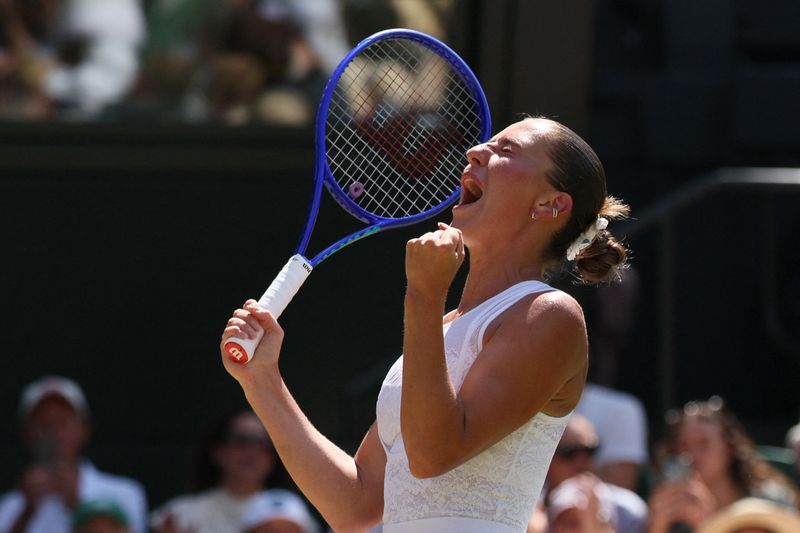
Ukraine's Marta Kostyuk stormed into the Wimbledon semi-finals with a commanding display against Italy's Jasmine Paolini, dispatching the 13th seed 6-3 6-2 on Wednesday in a quarter-final match played under sweltering conditions at Centre Court. The 12th-seeded Ukrainian proved too forceful for her opponent, completing the victory in just 69 minutes with a performance that showcased her aggressive baseline play and superior court positioning.
Kostyuk began with characteristic aggression, racing through the opening set in 36 minutes to put immediate pressure on Paolini's serve. The Ukrainian broke twice during the opening stanza, first establishing a 3-2 advantage and then extending her lead to 5-3 before closing out the set. This rapid-fire opening set the tone for what would become a one-sided affair, with Kostyuk controlling the tempo from the baseline and dictating points with her powerful forehand strike.
The second set followed a similar pattern as Paolini struggled to find any rhythm against her opponent's relentless hitting. Kostyuk secured an early break to lead 3-1 and thereafter managed her service games with ease, never facing a break point throughout the remainder of the match. The Italian competitor, who had reached the final at the French Open and challenged for the title at Wimbledon in previous seasons, found little opportunity to mount a comeback or establish momentum.
This victory assumes particular significance given Kostyuk's recent head-to-head record against Paolini. The 24-year-old had lost her previous two encounters with the Italian, making this reversal especially impressive. The turnaround illustrated how Kostyuk has continued to develop her game and build confidence at the grass-court Grand Slam, where her aggressive serve-and-volley instincts prove particularly effective.
For Kostyuk, reaching the semi-finals represents a career milestone at Wimbledon, marking her first appearance in both the quarter-final and on Centre Court at the prestigious championships. Her journey to this stage demonstrates her emergence as a major force in women's tennis, with her physical prowess and competitive intensity enabling her to compete against the sport's most established players. The performance against Paolini will have sent notice to her semi-final opponent that she possesses the weaponry and temperament to challenge for the title.
The match unfolded before a crowd that included Queen Camilla observing from the Royal Box. Despite the gallery's efforts to encourage the underdog and generate atmosphere, Kostyuk's dominance proved insurmountable. The Ukrainian player's composure and relentless execution made the contest appear almost routine, as she converted her opportunities efficiently and limited her unforced errors.
Kostyuk's powerful forehand emerged as the decisive weapon throughout the encounter, particularly during crucial moments when she needed to break Paolini's service. The Ukrainian's ability to compress the court and finish points at the net demonstrated her versatility beyond baseline exchanges, a quality increasingly necessary for success on grass surfaces where points conclude more rapidly than on clay or hard courts.
The defeat for Paolini, despite her elevated ranking and recent Grand Slam final appearances, underscores the competitiveness of the women's tennis circuit and the difficulty of maintaining peak performance across multiple tournaments. Having reached the final at Roland Garros and challenged at Wimbledon previously, Paolini entered as a title contender, yet the Italian's day proved frustratingly unproductive against an opponent who simply played better tennis.
For Southeast Asian followers of professional tennis, Kostyuk's advancement carries broader significance. The Ukrainian's success at Wimbledon contributes to the increasingly competitive landscape of women's tennis, where players from diverse backgrounds and nations now challenge the traditional powerhouses. Her demonstration of precision and power offers a compelling narrative about contemporary tennis excellence and the global nature of elite sport.
Kostyuk's semi-final appearance also reflects the depth currently visible across the women's draw at Wimbledon, where multiple unseeded or lower-seeded players have exceeded expectations. The tournament's unpredictability—with traditional favorites falling to determined challengers—has made this year's competition particularly engaging for observers throughout Asia and beyond who appreciate competitive sport at the highest levels.

