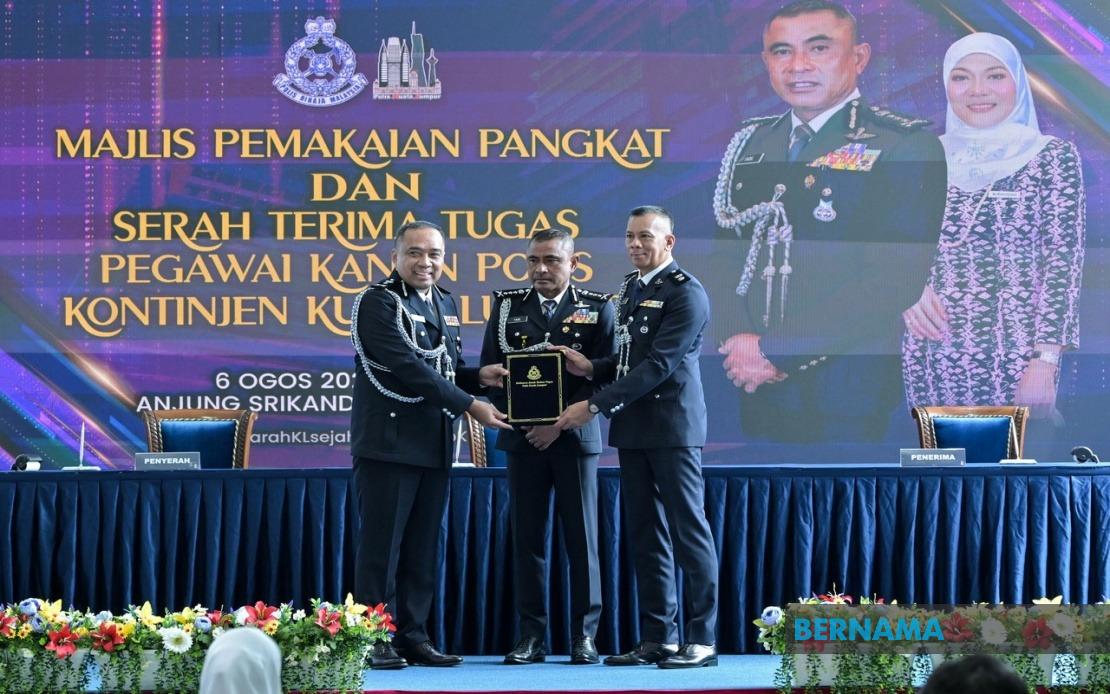
Kuala Lumpur's police force has undergone a significant leadership reshuffle, with the contingent chief Datuk Fadil Marsus presiding over a formal handover ceremony that moved six senior officers into new postings at Kuala Lumpur police contingent headquarters. The transfers, which took effect on August 6, represent a structured personnel rotation designed to inject fresh perspectives into critical law enforcement functions while maintaining operational stability across the city's diverse security landscape.
The most prominent change involves the Criminal Investigation Department, where SAC Zulkarnain Samsudin stepped aside for SAC Sazlee Adam. This transition signals a deliberate shift in how the city's major crime investigations will be directed, with the departing chief now repositioning to oversee intelligence and operations at the deputy chief level. Concurrently, the Narcotics Crime Investigation Department welcomed new leadership under ACP Kee Hang Kee, who assumed the role from SAC Haslah Bachok. These appointments carry particular significance given the ongoing national battle against drug trafficking and consumption, which remains a policy priority across Malaysia.
District-level changes underscore the police leadership's commitment to ensuring consistent policing standards across Kuala Lumpur's administrative divisions. Supt Nuzulan Mohd Din took command of the Dang Wangi district from SAC Sazlee Adam, while Supt Jasni Zolpa assumed leadership of Sentul district from SAC Basri Sagoni. These reassignments reflect the typical career progression patterns within the Royal Malaysia Police, where officers rotate between headquarters roles and ground-level district responsibilities to accumulate diverse experience before advancing further up the ranks.
The Special Branch intelligence function underwent realignment with ACP Saefuddin @ Mohd Fitri Abdul Rahman assuming the deputy chief position for intelligence and operations, succeeding SAC Kamaruzaman Md Alib. Equally important, the Criminal Investigation Department's intelligence and operations division acquired new direction under Supt Ong Seng Keong, taking over from SAC Zulkarnain Samsudin. These structural adjustments within investigative and intelligence portfolios reflect ongoing efforts to modernize how Kuala Lumpur police gather, process, and act upon operational intelligence in an increasingly complex security environment.
Kuala Lumpur deputy police chief Datuk Mohd Azani Omar attended the ceremony, lending official weight to the proceedings and symbolizing hierarchical endorsement of the transfers. The formal nature of such handover ceremonies carries practical importance within police culture, as they provide documented transition points where institutional knowledge is formally transmitted and accountability chains are clearly reestablished. This ceremonial aspect strengthens organizational cohesion during periods of personnel transition.
Addressing the assembled officers and staff, Fadil emphasized that promotions and postings constitute recognition of professional competence rather than mere administrative shuffling. He framed the transfers as validation of demonstrated performance and increasing dedication to police work, highlighting that advancement carries elevated expectations for integrity, professionalism, and personal conduct. This messaging acknowledges that career progression within law enforcement carries not only greater authority but also heightened scrutiny and accountability standards.
The police chief stressed that systematic leadership rotation represents a foundational principle underpinning the Royal Malaysia Police's institutional strength. Rather than viewing personnel changes as disruptive, Fadil articulated a vision where such transitions facilitate the introduction of novel ideas, accumulated experiences from different postings, and refreshed operational approaches. This perspective positions the reshuffle as a mechanism for preventing organizational stagnation and ensuring that institutional practices evolve in response to changing security circumstances.
Fadil's remarks explicitly connected leadership continuity to service quality, suggesting that the force remains committed to maintaining public-facing policing standards despite internal restructuring. He warned that operational changes could theoretically disrupt service delivery, but he assured the community that the police force had implemented this handover strategically to prevent such disruptions. This assurance carries particular relevance for Kuala Lumpur residents and businesses who depend on consistent police responsiveness across criminal investigation, narcotics enforcement, and district-level crime prevention.
Addressing the contemporary security landscape, Fadil identified escalating complexity as a defining characteristic of modern law enforcement challenges. His reference to increasingly sophisticated threats suggests that Kuala Lumpur police must remain vigilant against evolving criminal methodologies, potentially including organized crime networks, cybercrime dimensions, and transnational security concerns affecting the capital city. The leadership transition, framed against this backdrop, becomes a strategic investment in ensuring the force remains adequately equipped intellectually and operationally.
The police chief issued a direct call to all Kuala Lumpur police personnel to recommit to core organizational objectives: strengthening crime combat efforts, addressing drug abuse comprehensively, enhancing investigative methodologies, maintaining operational preparedness, and building community relationships. This multifaceted mandate reflects contemporary policing philosophy that recognizes law enforcement effectiveness depends on both enforcement capability and public cooperation. The emphasis on community engagement suggests the police leadership views public trust as essential infrastructure supporting all other enforcement functions.
These personnel movements occur within a broader context of Malaysian police reform and professionalization initiatives that have advanced significantly over recent years. The systematic nature of the reshuffle—involving defined positions, clear succession planning, and ceremonial formality—reflects institutional maturation and adherence to structured personnel management practices. For Southeast Asian observers, the transition exemplifies how established police forces in the region manage internal organizational evolution while maintaining operational continuity.
The implications for Kuala Lumpur residents extend beyond internal police administration. Leadership transitions in criminal investigation and narcotics enforcement directly affect how effectively the police detect and prosecute serious crimes, how drug trafficking networks are disrupted, and how investigation quality maintains public confidence in the justice system. Similarly, district-level leadership changes influence community policing approaches and local crime prevention effectiveness, making these postings consequential for residents across Dang Wangi and Sentul areas.

